Pretty little things

4 July 2021

Every now and them, as I stroll the streets, I find a little something I can’t resist photographing. Then it sits in my master file, waiting to turn into a post. Here are three such things, petits fours of the street.

I started this blog on 9 July 2007 with a burst of 24 posts, leading off with a photo of a 1901 sidewalk stamp. (That remains the oldest date I’ve found in Oakland.) Soon enough I settled down to a once-daily rhythm that never let me relax for long, ensuring that I’d keep going out to survey a few more blocks. Eight years later I completed walking every block of every street in Oakland, finishing that initial series on 6 December 2015. It’s been easy going ever since. I’m having a great, low-key time.

This is the 3,000th post in Oakland Underfoot.

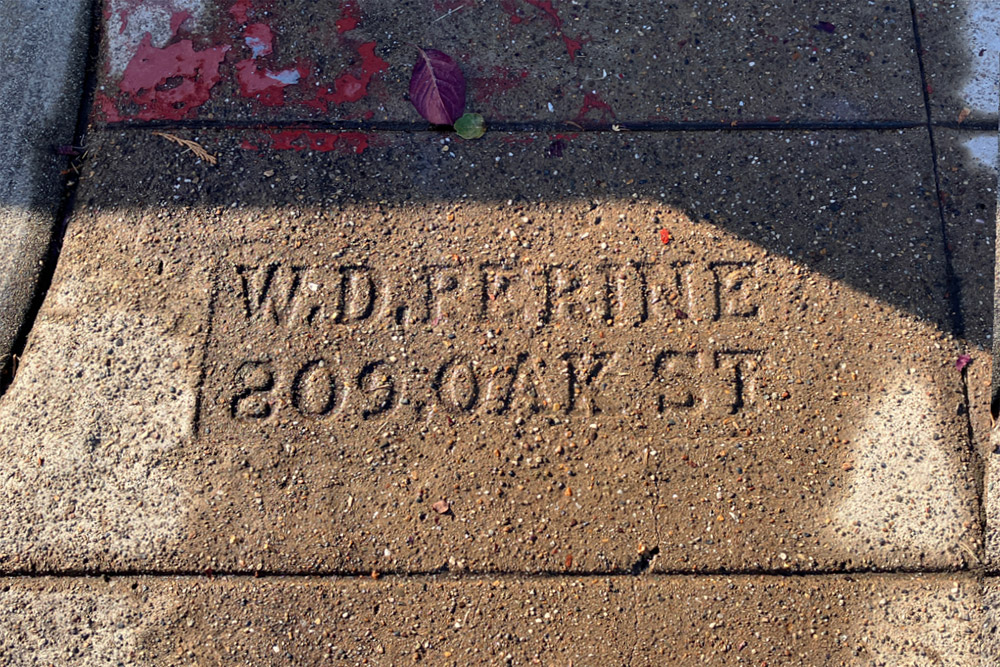
William D. Perine, Oakland’s first sidewalk maker

2 July 2021

William Danforth Perine was born to a farming family in Jackson, New York in 1826 and died in Oakland in 1895. He and his wife Elizabeth had three sons and two daughters; their first two children were born in Canada. He’s buried at Mountain View Cemetery. At Find A Grave an annotator notes, “He was among the first to introduce cement sidewalk laying in Oakland. He was involved in litigation over the patents for years and died a poor man.” The same site reprints a long biographical entry about him published in 1892. (He won in the Supreme Court as reported by the Tribune and the Morning Times.)

Perine first appeared in the 1877 Oakland directory as a “manufacturer of cement walks.” In 1880 his business was listed under “Artificial Stone,” the going name for concrete at the time. Modern portland cement, the binding agent of concrete, had only recently been brought into common use; in the mid-1800s cement was made by roasting naturally occurring rocks of just the right composition, mixing clay and limestone. Concrete became a leading-edge technology in the late 19th century, and San Francisco’s Ernest Ransome (founder of San Leandro’s Ransome Company) gained nationwide fame with his innovations in reinforced concrete.

In 1877 Perine lived on the west side of Myrtle Street near 5th Street. In 1880, Perine’s business was located at 1002 Broadway; he lived at the northwest corner of 4th and Alice Streets. In the directories from 1884 to 1889 he was listed as living at 809 Oak Street. In 1889 and 1892 his business address was 457 Ninth Street. By the 1890s several other artificial stone firms were in business here whose work appears on Oakland sidewalks, including Gray Brothers and George Goodman.

I have found three sidewalk stamps by Perine, none of them dated. All of them bear the 809 Oak Street address, which puts their dates somewhere in the 1880s, unless he never updated his stamp. Two of them look like the mark at the top of this post; this is the third.

In the center of the mark are two digits, presumably from the 1800s. Whatever they are, I feel confident in saying that Perine was Oakland’s first hometown sidewalk maker.

Art Concrete Works

27 June 2021

Art Concrete Works was one of those ancillary businesses that left traces all over Oakland. They made boxes for utilities. The example above is part of this blog’s banner image; it came from a PG&E box on the 4900 block of Broadway:

The firm started out in Oakland in the early 1920s, down by the railroad tracks at 77 Webster Street, on the same block as Heinold’s Saloon. It presented an exhibit at the regional meeting of the American Waterworks Association in October 1922, and that’s the first record I have of its existence.

City directories offer more information. In 1926 the firm moved to a new building at 2400 Adeline Street, just off West Grand, under manager Ralph L. Gates. By 1930 Harold P. Manly had taken over, and the plant was under his steady hand through that whole difficult decade.

As of 1940, Walter B. Allen was manager, but the Internet Archive has no city directories from 1942 to 1966. The Tribune ran help-wanted ads from Art Concrete Works through the 1940s and into 1950, and there the written record ends.

But there are records on the ground that tell me more. East Bay MUD was a steady customer of Art Concrete Works, and for a while the company stamped dates on its meter-box covers!

I discovered this as I was surveying the East Oakland foothills, somewhere west of Fruitvale, and snapped a few pictures before thinking better of that rabbit-hole of documentation — I still had over half the city to cover. All I have at the moment is that image, with a 1951 date, and this one from 1954. That extends the record of Art Concrete Works to a good 32 years, a respectable life span for a company in this business sector.

How many different years are documented on those water-meter covers? Now I have another reason to visit those shady streets again, and readers, maybe you can find some examples around you.

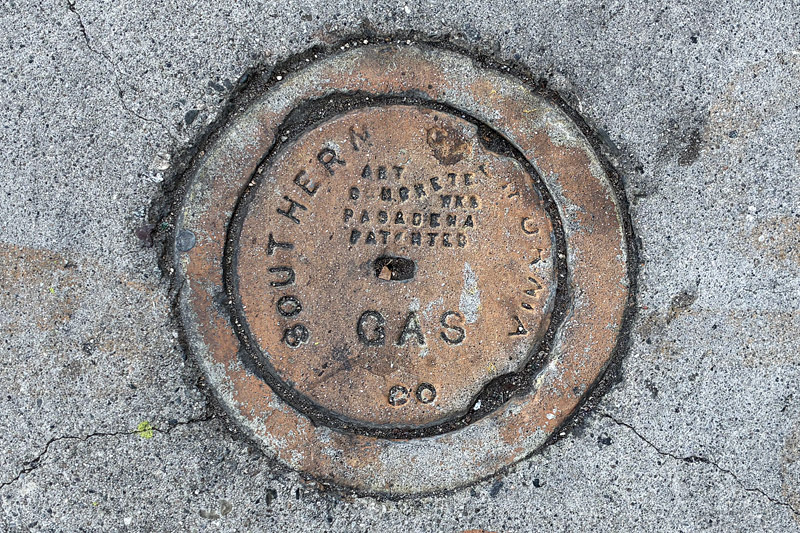
Before moving to Oakland, the firm did business in Pasadena. I’ve confirmed it in the 1913 and 1914 directories so far with the address 373 South Fair Oaks Street. I wouldn’t have known had I not spotted this in downtown Los Angeles.

Oakland Fire Alarm & Police Telegraph

25 April 2021

437 25th Street

14th Street at City Hall

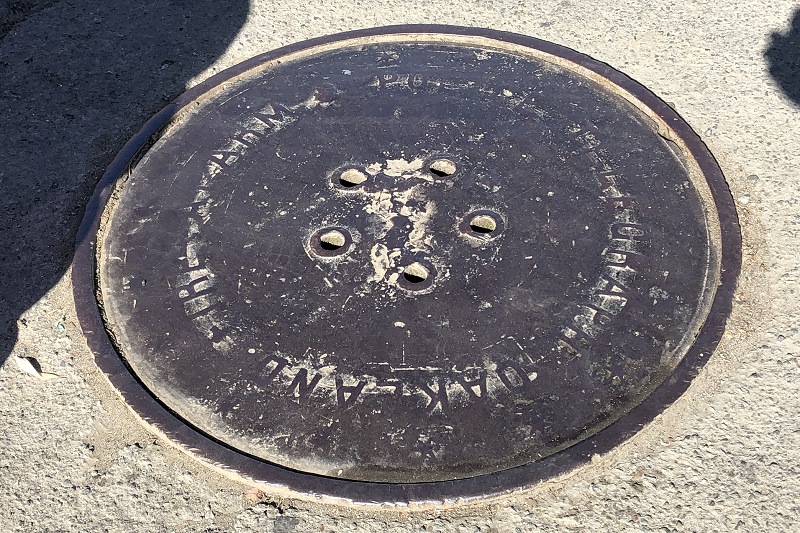
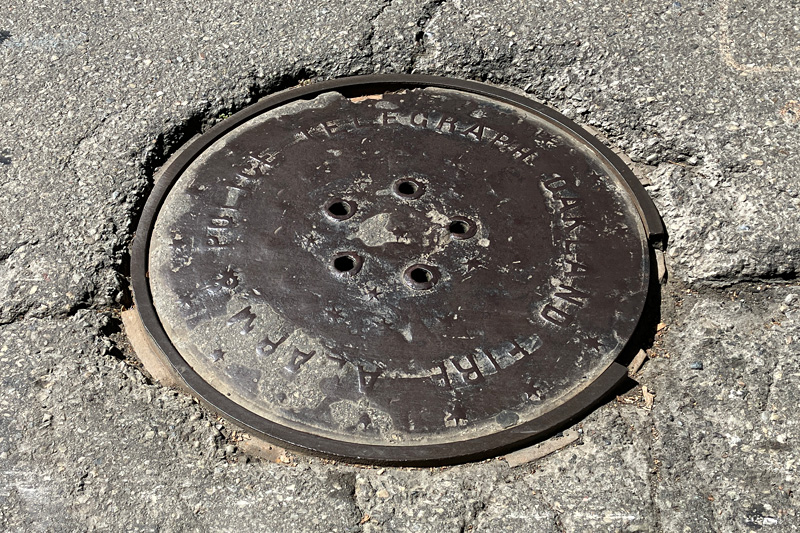
The Fire Alarm Police Telegraph system was the cutting edge of public safety a century and a half ago. It was a wired system that connected battery-powered alarm boxes to transmit alarms instantly across a city. San Francisco had such a system in 1865, described in a history on the S.F. City Museum site. The 1906 earthquake led to complete upgrades in this system. San Francisco dedicated its new Central Fire Alarm Station in 1915, but Oakland was ahead of that city, having finished its fire alarm police telegraph system in 1911. A main building at 13th and Oak Streets was connected by underground cables to police stations and call boxes and fire stations across the city. “With its isolation, fire-proof construction and underground system of cables,” the Tribune reported, “the entire city might burn or be shaken to pieces by earthquake and the operation of the system would not be disturbed in the least.”

These access covers date from that time and belonged to that system.

1943 – J. W. Roberts and E. J. Patrick

6 February 2021

4521 Telegraph Avenue

This mark is on concrete patches, not original paving, on both sides of the Kasper’s building. I have another hand-drawn J. W. Roberts mark from earlier in 1943. No idea who E. J. Patrick was.

Sidewalk maker: J. A. Marshall

2 January 2021

This impression at Lee Avenue at Perkins Street, now gone, was the best example of J. A. Marshall’s stamp in Oakland.

John Albert Marshall (1868-1925), born in Missouri, began his career when concrete craftsmen were still called “artificial stone workers.” That was his title in the 1892 directory for San Francisco, where he lived until 1895 when he relocated to Berkeley. He was known as “J.A.”

J.A. Marshall fulfilled a large paving contract for much of the Adams Point neighborhood during 1897-98, so that would put this and other marks there in the 1800s category.

He sold his sidewalk business in 1901 to Lindgren & Hicks and moved to Portland Oregon, where the city had started a drive to pave all of its sidewalks by 1905. There, with his brother Rudolph Augustus “R.A.” Marshall (1861-1936), a former journalist and supreme court clerk, he launched the Marshall Brothers firm, which laid sidewalks until around 1910. The family made strong connections in Portland during that time, and the Marshall Bros. escutcheon, the same as Oakland’s, can still be found on Portland sidewalks. The firm branched out from sidewalks to more ambitious construction projects.

When the 1906 earthquake triggered a great wave of residential construction in the East Bay, he returned and quickly thrived as a builder of custom homes.

His modus operandi was to build, then sell houses for his growing family, each one more opulent. A practitioner rather than originator of the Berkeley Craftsman style, he left many homes still standing in Berkeley and Oakland neighborhoods.

He became wealthy enough for the family to appear regularly in the society pages both in Portland and Berkeley, especially his wife, the former Emily Virginia Jones (1872-1956), and their three daughters. At the time J.A. died, they were all living in a baronial home at 18 Tanglewood Road. His wife promptly sold the place and moved to a luxury apartment at 22 Domingo Avenue, where the papers followed her doings as “Mrs. John Albert Marshall” long after her husband’s death.

J.A. was the contractor whose young relative, future architect Leola Hall, accompanied him and learned the foundations of her trade. Two of his three sons became contractors, Gardner E. Marshall and J. A. Marshall II. He seems to have had a cantankerous streak, and his sons did little work with him, succeeding or failing on their own. The third son, Eliot, became a car dealer in Concord.

1941 – Dan Doyle Concrete

31 December 2020

2556 Frances Street

This is a much more definitive version than my previous example. Dan Doyle Company stamps with dates are uncommon, and only three years (1940-1942) appear in Oakland.