Sidewalk maker: Lazzero Banchero

29 April 2016

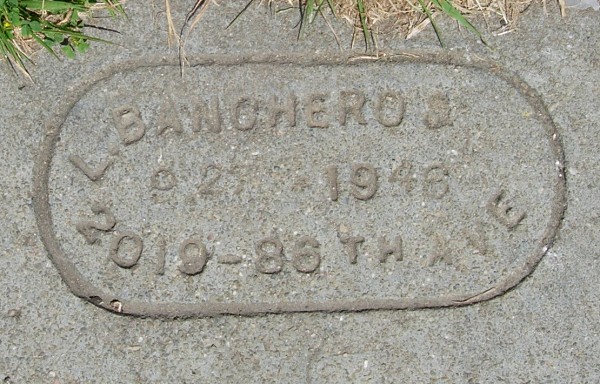
Lazzero and Virginia Banchero lived at 2019 86th Avenue, in East Oakland, for many years while he ran his business. Although the 1925 directory lists him as a “cement worker,” the earliest mark I have from L. Banchero & Co. is a bizarre stamp from 1926 in the area, on Plymouth Street.

The Banchero home is still there, complete with a Banchero & Co. mark from 1928 on the sidewalk.

banchero-house

The earliest example of the standard stamp I have is from 1927. For the first few years of his practice, Banchero’s mark read “L. Banchero & Co.”

banchero-and-co

After 1933, he consistently wiped off the “Co.” (or chiseled it off his stamp). I don’t know why; probably he was just downsizing.

banchero-and

Banchero marks are scattered all over town, but they’re thick on the ground in East Oakland near his home base.

His marks continued until 1948, and possibly 1950. That’s a decent career.

The Bacon Block Building

22 April 2016

The place now occupied by 1111 Broadway was once the site of the Bacon Building, also known as the Bacon Block. It was named for Henry Douglas Bacon (1818-1893), “a pioneer capitalist of this city” who is also remembered at U.C. Berkeley as the benefactor behind the old Bacon Hall library building.

The Bacon Block or Bacon Building was the second structure here. The original Bacon Block, a wooden building that housed Smith’s Market and many other small businesses, burned on December 30, 1902. The newer steel and concrete structure housed many business offices as of 1904.
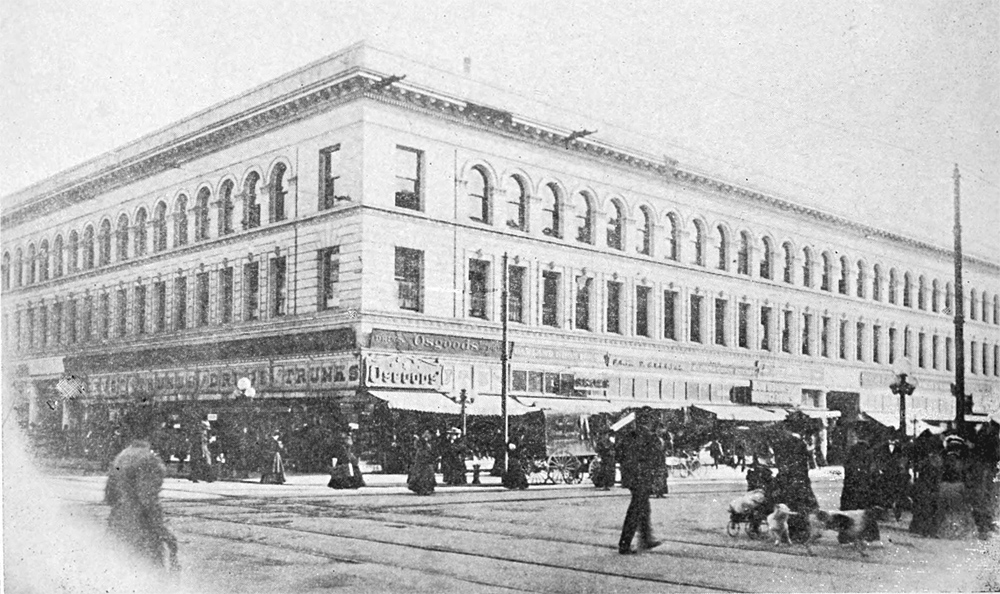

The Bacon Building in 1911.

Between then and 1926, when J.C. Penney took over the entire property, at least four businesses in the Bacon Block/Building left their marks on Oakland’s sidewalks.
baconblock-goldengate

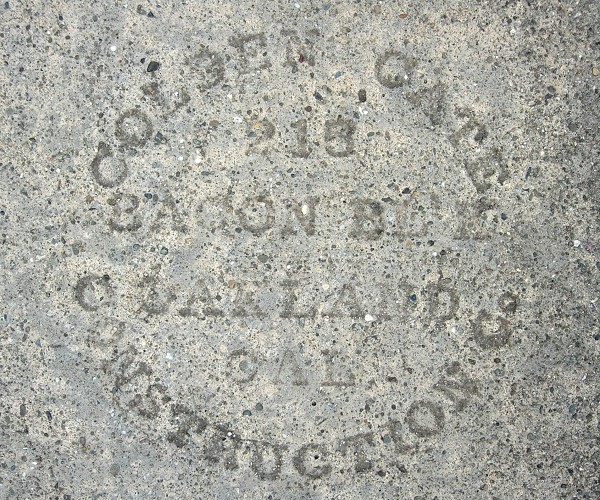
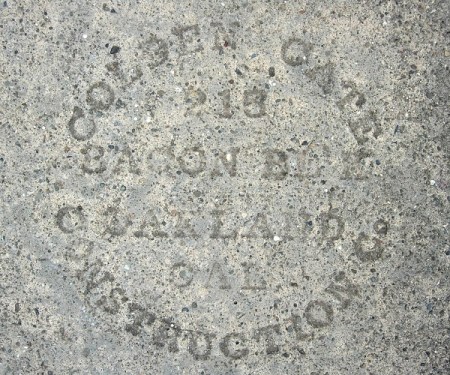
The Golden Gate Construction Company, “215 BACON BL’K”, was listed in the San Francisco directories of 1902 and 1907. It was listed in the 1910 Oakland directory at this address, but not in any other year. It was a partnership between Harry B. Williams and Joe Rosenberg until 1910, when John R. Sorensen of Berkeley replaced Rosenberg. The new partnership apparently lasted only a year. Oakland has a handful of these hard-to-read marks, none of them with a date. This firm also left the G. G. C. Co. mark, of which I’ve seen maybe three examples.
baconblock-williams

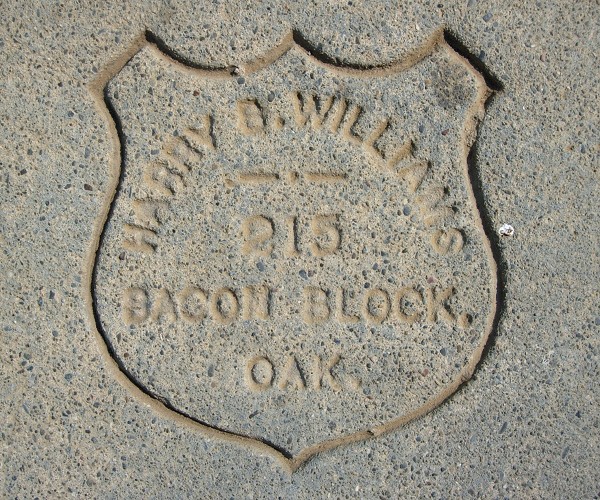
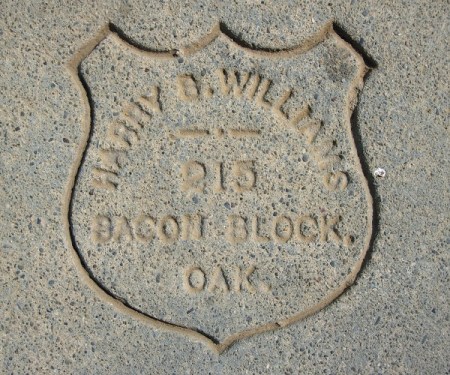
Harry Bennett Williams (1876-1957), not to be confused with the more prominent contractor Harry C. Williams, succeeded Golden Gate in the same office starting in 1911. He lived on the 900 block of 61st Street. From 1915 through 1926 he was president of the Merchants Exchange and in 1918 he headed the Cement Contractors’ Association. As of 1921 the business was at 1106 Broadway, which was across the street in today’s Key System Building, and a garage is also mentioned out at 61st Street. I think he was probably using his second stamp at that time. His marks are thinly scattered in north and central Oakland, none with a date.
baconblock-sundberg

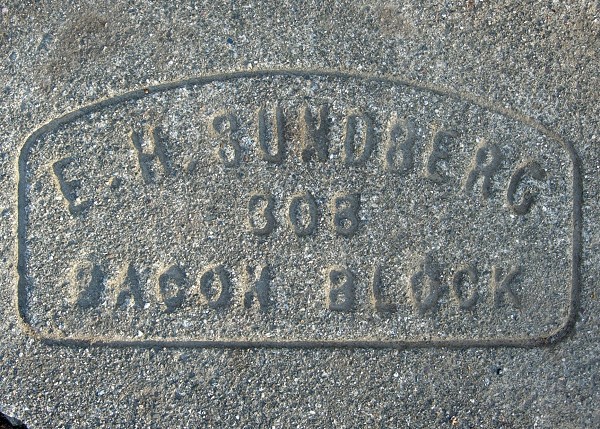
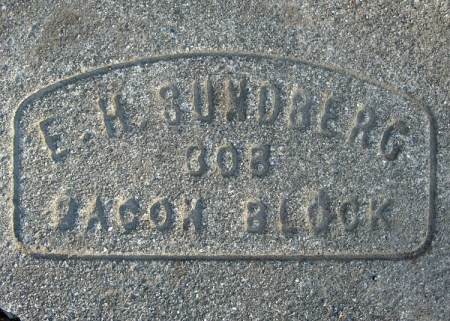
Ernest Hilmer Sundberg (1870-1945), “308 Bacon Block”, was a South African immigrant who lived in San Francisco before moving to East Oakland, on E. 17th Street, then to Pacific Grove. His firm is listed in the Bacon Building in the 1912 and 1913 directories and across the street in the Oakland Savings Bank building in later years. This mark is rare; I have one dated 1912.
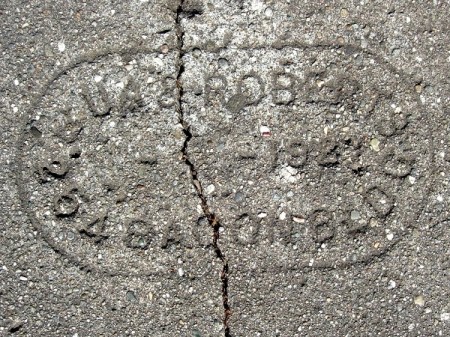
baconblock-bua-n-roberts

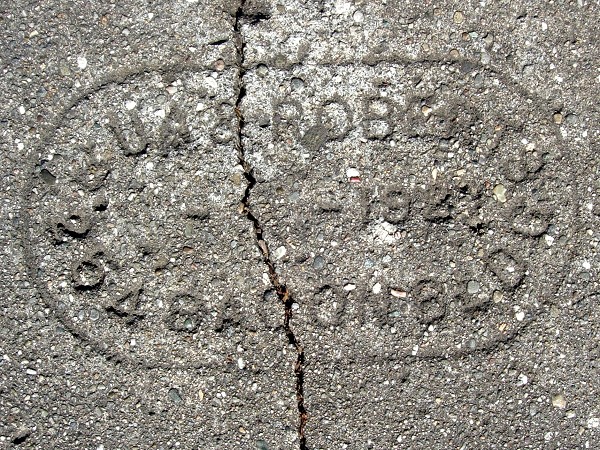
Michele “Michael” Bua had a partnership with Roberts, who may be Frank Roberts (whose F. Roberts stamps date from these years) or someone related to the Roberts Brothers firm (Delore Roberts, president and Arthur Roberts, vice-president), which never had a Bacon Building address. I interpret this date as 1922, and a 1924 date is unequivocal. Vallejo Street has a mess of these marks but they’re scarce elsewhere. The address 254 Bacon Building was used by several different firms in the early 1920s, including contractors and real-estate dealers, so it must have been a large office suite.

Sidewalk maker: Simon Aiassa

15 April 2016

aiassa-maker

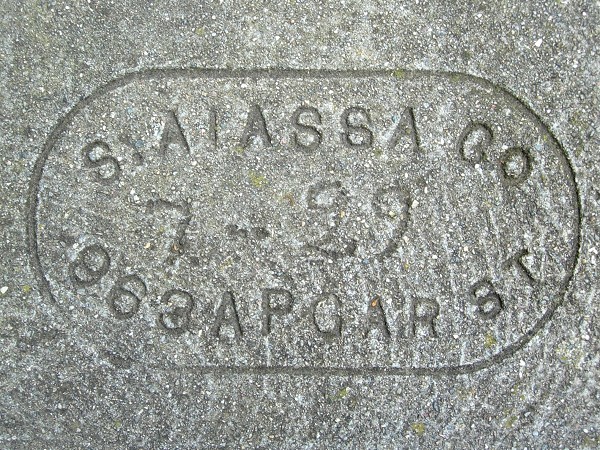
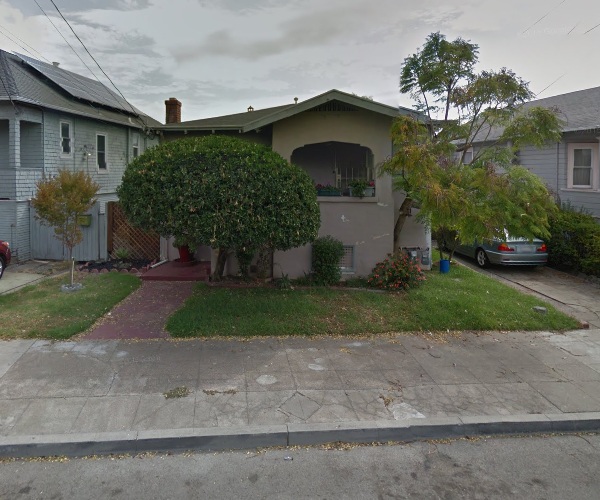
Simon Aiassa worked and lived on Apgar Street, in North Oakland, with his wife Clorinda and their daughter Caroline. I don’t have access to the 1929 directory, but they were listed in the 1930 directory. He was still there in the 1944 directory. This is the house at 963 Apgar Street today, thanks to Google Maps.

aiassa-963-Apgar

Aiassa is a rather rare Italian name, and Simon was the only one in the Oakland phone book. He was born Simone Aiassa in Italy on 13 October 1878, in the Moriondo district of Torino, and Clorinda was born in Italy around 1887. The 1920 and 1930 censuses also list a daughter, Caroline, born about 1915. If there is uncertainty about her birth date, it may be because she was born in Italy, but the whole family used Americanized spelling for their names. Caroline went to Tech High and got a gold pin for high grades in 1932. Another handful of Aiassas came to California about the same time in Santa Clara County.

S. Aiassa marks are scattered throughout North Oakland, with a few more in Allendale. Few of them are dated, and the dates are always drawn by hand. I have marks from 1928-30, 1932, 1937, 1938, 1940 and 1943.

Sidewalk maker: William Andrade

8 April 2016

7th Avenue, Oakland

William B. “Bill” Andrade (1924-2016) left marks on sidewalks all over Oakland. His obituary was in yesterday’s paper and a memorial page is up. He founded the Andrade Concrete Company in San Leandro with his father, August Andrade, shortly after World War II.

In Oakland, I’ve documented Andrade marks dated from 1946 to 1961 (missing 1954, 1957 and 1959). Presumably there are more in San Leandro, Castro Valley and Hayward. The mark above is the earliest I’ve found. Many marks from 1961, the latest year I have, are scattered around Jingletown. His work survives all over Oakland, which speaks to his success and to the quality of his work.

He used a distinctive escutcheon for this company, and also for a short-lived collaboration with Arthur Moniz of Oakland (the two examples I’ve found did not have dates).

23rd Avenue at E. 22nd Street

He is not to be confused with M. Andrade & Son, which was run by Marvin and Mark Andrade of Oakland.

Sidewalk makers of Fruitvale

1 April 2016

I count twelve different firms or practitioners who used “Fruitvale” in their sidewalk stamps. Here they are.

fruitvale-4

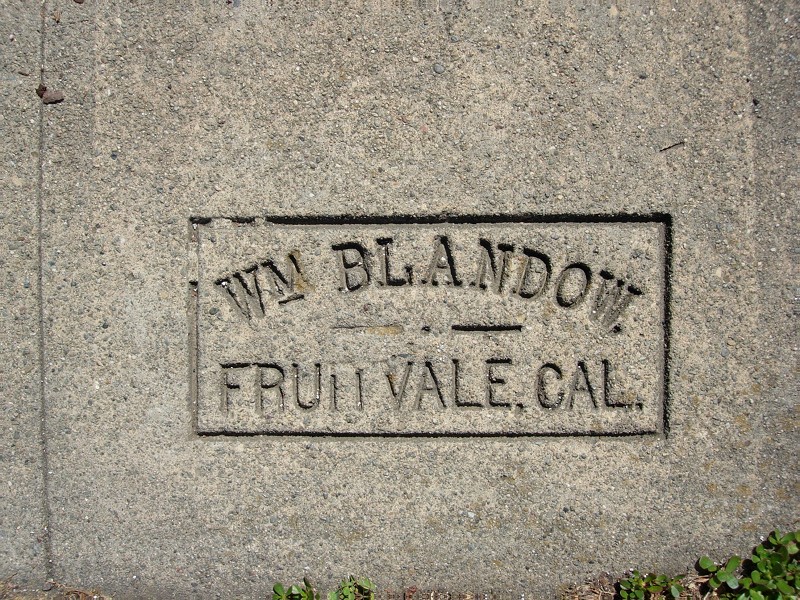
William Blandow. One dated example from 1915.

fruitvale-2

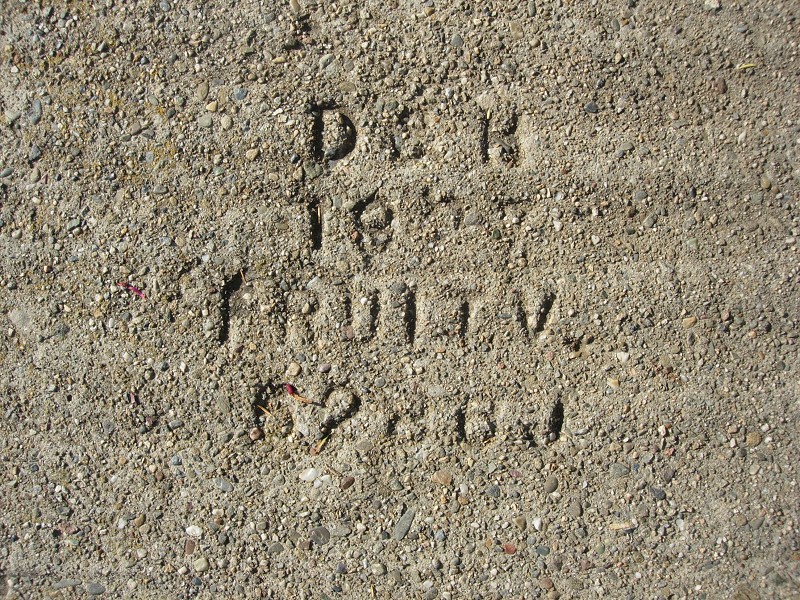
D & H. Davis and Hubmann? One example from 1927.

fruitvale-10

Charles Davis. One example from 1926.

fruitvale-3

R. Fernandez. No dated examples.

fruitvale-7

H. K. C. Co. No dated examples.

fruitvale-8

Christian Hubmann. Examples from 1912 and 1914-1919.

fruitvale-9

Adolph Lazzareschi. Examples from 1913.

fruitvale-1

Roland C. Malone. Examples from 1918, 1920, 1922, 1928, 1929, 1931, 1932 and 1936.

fruitvale-6

Fred W. Metge. Examples from 1911 and 1922-24.

fruitvale-5

Jonathan Ogden. Examples from 1913-18, 1920, 1922, 1924 and 1927.

fruitvale-11

Ogden and C. W. Utterback. One example from 1912.

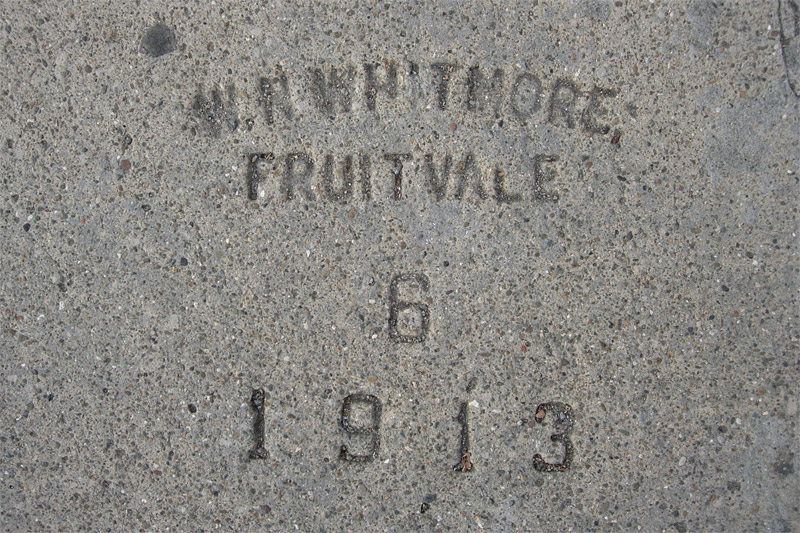
Wallace N. Whitmore. Examples from 1912 to 1915.

Conceivably there are others whose work survives only outside Oakland. I doubt it, though.

Union concrete masters II

25 March 2016

In the last few weeks I’ve spotted five more numbers in the OPCFIA union bug. The last three are interesting to me in a new way.

union-made-nat-lena-235

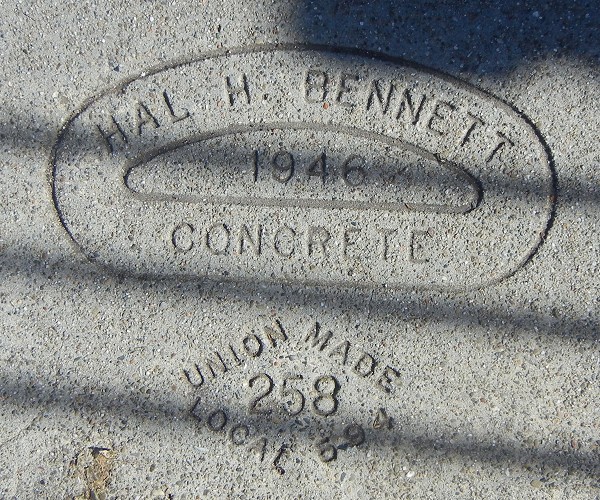
union-made-hal-bennett-258

union-made-fitzmaurice-60

union-made-fitzmaurice-90

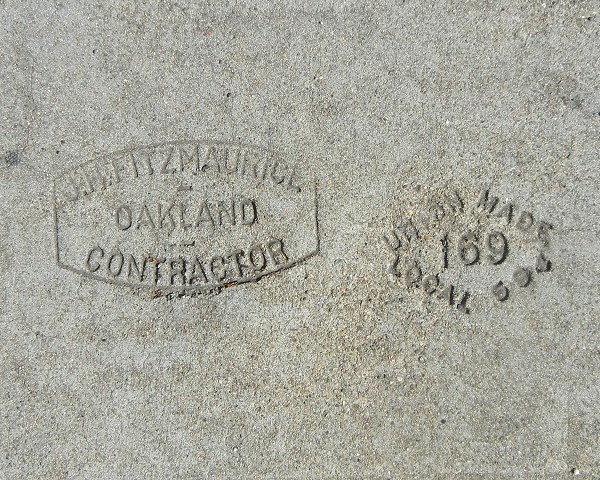
union-made-fitzmaurice-169

What’s interesting about the last three? First, J. H. Fitzmaurice employed several master craftsmen, although that’s not a surprise. It was a big firm, probably accounting for more Oakland pavement than any other. Second, students of Fitzmaurice marks will note that the first is the fourth configuration used by this longtime Oakland company, and the other two are the fifth and last. The older mark was made by an earlier registered master, as indicated by the lower number.

The master number ought to be a secondary clue to the ages of marks, like Fitzmaurice’s, that rarely bear dates. Paleontologists will be familiar with this problem because fossils never bear dates — all we know is their position on the stratigraphic column. That’s an idealized stack of sedimentary rocks built by noting what rocks overlie or underlie other rocks. The stratigraphic position obviously corresponds to some true age, measured in years, but the only way to estimate it, even partially, is to find a secondary clue, like a bed of fresh volcanic ash that yields an absolute date with isotopic (radiometric) methods, like the uranium-lead or potassium-argon or carbon-14 techniques. If we have that, then we can say that a nearby fossil has a comparable age.

In the case of sidewalk stamps, we can safely assume that the numbers of the master concrete workers were assigned in numerical order. But those numbers aren’t dates. We need marks that have both a date and a master number to help establish the timeline of masters. And that won’t tell us much. A single example will only tell us that the master was active that year, not the year he earned his number or the year he retired. With enough data, we can zero in on those years but never know them for sure. I’ll see what comes up as I look around. Because as the saying goes, “What songs the Syrens sang, or what name Achilles assumed when he hid himself among women, although puzzling questions are not beyond all conjecture.”

Vault lights con’d.

18 March 2016

It was exciting to see so much interest in last week’s post about Oakland’s old vault lights. I went back to the Jefferson Court Apartment building at a different time of day, hoping to catch the daylight in the vault lights I showed last week. Success!

Jeffersonlights-lit

We’re facing east on 18th Street. The building’s sunken courtyard is on the right, and the brightly lit concrete floor there is shining up through the prism faces on the bottom of the glass vault lights. I knew you’d get a thrill.

Here’s the combination of ventilator and vault lights that surrounds the Leamington Hotel building. Those are a P. H. Jackson production.

leamingtonlights