Sidewalk maker: Manuel Medis

30 December 2016

Manuel D. Medis was born in Massachusetts to Manuel Medis, a Portuguese immigrant, and his wife Ella, a local of Portuguese descent, on 17 September 1895. He was the oldest of four children when the family moved to Oakland, where they were counted in the 1910 census. He served in the military during the first world war, after which he married an Ohio girl named Sylvia Mae Quickle.

Medis got into the concrete business right away. He was listed in the 1922 directory at 3806 Hopkins, in the Laurel district. As of 1924 he and Sylvia were living at 2427 Scenic Avenue, where they stayed the rest of their lives. The house is a typical working-class dwelling, though it’s been added on to since the 1960s.

2427scenicave-medis

In the 1925 directory he was listed as part of a team, “Medis and Rose,” with an older cement worker named Manuel Rose. No marks from that pair survive, and they may not have used a stamp. Be that as it may, Medis the solo practitioner left his stamp on sidewalks all over Oakland. It never changed.

m-medis29

I’ve documented examples dating from 1927 to 1940.

m-medis40

I don’t know much much longer he practiced, but he was listed in the 1941 directory. He would have been in his mid-forties.

Manuel Medis died in 1954, and Sylvia stayed on at the Scenic Avenue house until her death in 1968. They seem to have been childless, but perhaps his three sisters stayed in town and supplied them with nieces and nephews. He’s buried in Golden Gate National Cemetery next to Sylvia.
Old concrete in the West Bay

23 December 2016

Since this is a cleaning-up period at the end of the year, I’ll feature a couple of photos I’ve had for a long time and get them off my mind.

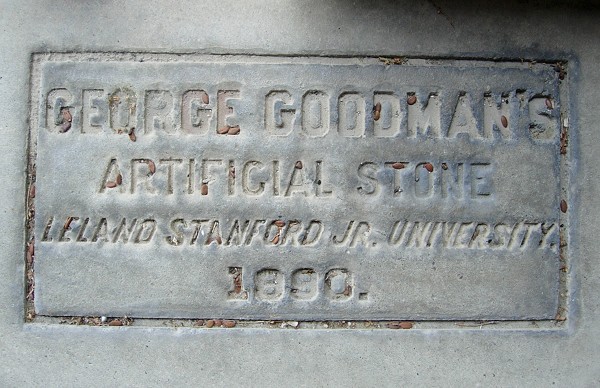
If you’ve been to the Quad at Stanford University, you may have noticed the excellent concrete walkways there. They date from the construction of the buildings in 1890 and were made by the same George Goodman, of San Francisco, whose lovely escutcheon stamp I featured here the other month.

goodmans

Goodman listed himself in the business directory as a specialist in the Schillinger Patent method, which wasn’t really about concrete per se but about making sidewalks in a way that would help keep them from breaking up. The next photo, though, is about concrete itself.

If you’ve been to the Conservatory of Flowers in Golden Gate Park, you must have noticed the vintage pavement there. Its age is uncertain, but probably from before 1900. The Granolithic Paving Company was listed in the 1887 business directory at 422 Montgomery Street, San Francisco.

granolithic

Peter Stuart, a Scot, invented granolithic concrete in the 1830s. It’s an extremely strong material, the Gorilla Glass of concrete, made by an ingenious method that lays down a surface layer, or screed, of concrete densely packed with finely crushed granite or similar rock. At the correct point in curing, an absorbent blanket is placed on the concrete to reduce the water content, raising its strength. (Low water content was one reason ancient Roman concrete was so strong.) Stuart’s granolithic method was patented in this country, as the stamp says, in 1882. The company that bore his name stayed in business until 2012.

While you’re there, walk south to John F. Kennedy Drive and visit the Alvord Lake Bridge, the first reinforced concrete bridge built in America.

Oakland’s lid makers I: Best, Empire, Phoenix

16 December 2016

This week I focused on utility-hole covers again, with an eye on the different foundries that manufactured them.

best-steel

Best Steel Casting Company used to have a huge plant in farthest East Oakland, by the railroad tracks at 105th Avenue. I think this is on Broadway around 29th Street.

empire-and-wutelco

Empire Foundry was founded in 1905, but it seems to be defunct. Its last address was 1950 Embarcadero. It produced a great many lids in a wide range of designs. This example on Harrison Street, made for Western Union, is an unusual one for both companies. Perhaps it’s related to Empire Road, down south of Hegenberger.

phoenix-ironworks

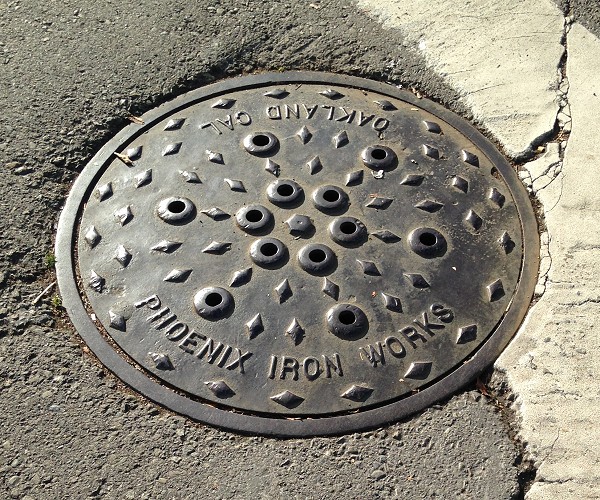
And then there’s Phoenix Iron Works, in Oakland since 1901. Today it’s a shadow of its former self in a funky building in the 5th Avenue Marina, flying the Jolly Roger out front. See more of its work at the Oakland Wiki.

Street blemishes

9 December 2016

brickpaverepair

No mater how carefully you build, someone will come along and make incisions in your work. When streets are re-asphalted, it seems like it happens within weeks. And the only time the repairs are seamless is when the city’s heritage ordinances require a complete restoration.

Until your building is historic, it’s at the mercy of history, and we just accept that degradation as the tax time imposes on existence. In this case, the patch-up crew not only couldn’t replace the original yellow bricks — and they could have if they hadn’t been in such a hurry — they couldn’t even figure out an easy way to match the original pattern. The result is not as bad as tagging, but it’s on the spectrum.

This is at that former bank on Broadway at Grand, the place I think of as the golden building. At least moments like this still happen regularly, if you’re looking.

narabank

Be grateful for good buildings and the conscientious owners who keep them that way.

Sidewalk maker: Gene Tribuzio

2 December 2016

Gaetano “Gene” Tribuzio was born 3 July 1889, in Bari, to Francesco Tribuzio and Isabella Siciliano. The Italian records give his birthplace as Mola di Bari, a seaside village east of the port of Bari, but the family and the U.S. immigration records say he was born in Acquaviva delle Fonti. He emigrated to America with his brother Nicola (see Nick Tribuzio), leaving two brothers behind and entering the U.S. on 6 March 1913.

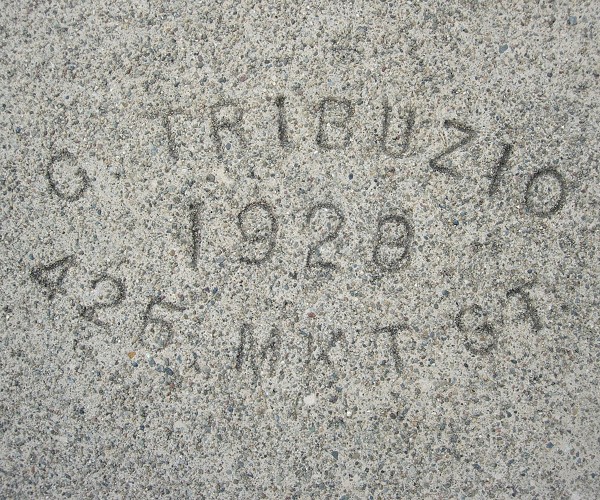
Nick and Gaetano operated briefly as the Tribuzio Brothers, which I mentioned in my post about Nick. The 1926 directory lists him as “Guy,” living with his wife Mary (born Maria Cerimele) at 425 Market Street. Soon Guy, or Gene as he later called himself, was working on his own. His earliest surviving sidewalk stamp in Oakland is from 1928.

gtribuzio-1

In the early years he would often stamp the month underneath the mark.

gtribuzio-2

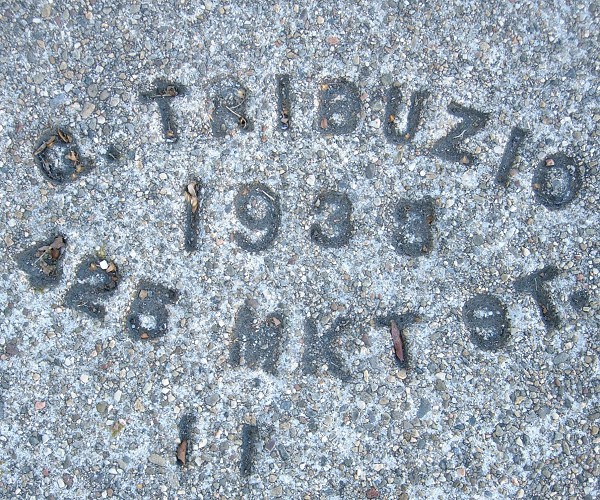
After 1936, he filed the address off his stamp and continued to use it into the 1950s. Presumably that’s when he moved to 3706 Porter Street. (The house is gone, wiped out by I-580.)

gtribuzio-3

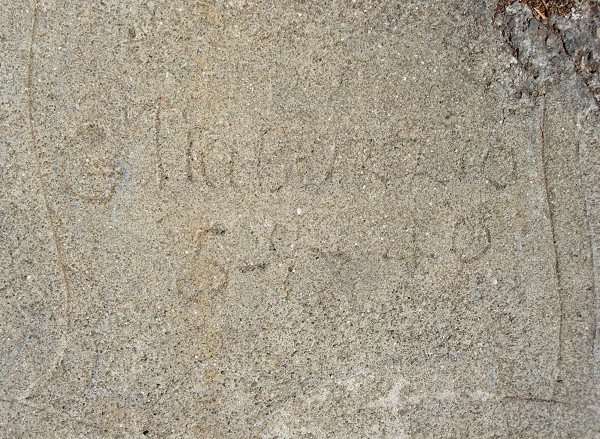
This hand-drawn mark from 1940 shows a hint of his style. Notice that he misspelled his name Tribuzzio.

gtribuzio-4

The Tribuzios had six children, five sons and a daughter. The 1940 census records list the couple as “Gene” and “Mary” along with their children, living at 3706 Porter Street.

Some of the sons joined Gene as “G. Tribuzio & Sons.” I’ve recorded marks with that name, all of them hand-drawn, from 1948 to 1955. Solo “G. Tribuzio” stamped marks survive in Oakland up to 1954.

gtribuzio-5

He was the most prolific Tribuzio, and he left his work all over this city.

Gaetano Tribuzio died 9 October 1974. Various of his descendants have left comments on this site over the years, and I greatly appreciate their personal information.

Sidewalk maker: Nick Tribuzio

18 November 2016

Nicola F. “Nick” Tribuzio was born in the city of Bari, Italy, in 1894 and emigrated to the United States in 1913. He served in World War I as an Army private. While stationed in England, he met and married his first wife Marian, and they had two sons, Francis and Philip.

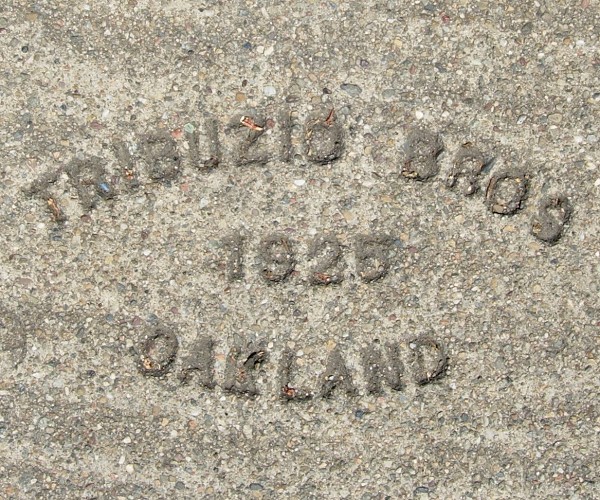
As of 1925, he was listed in the business directory as part of the Tribuzio Brothers.

trib-bros

There were two Tribuzio brothers, Nick and Gene (Gaetano). More about Gene some other time. Tribuzio Brothers marks are very rare in Oakland, and I’ve documented examples only from 1925 and 1926. Nick lived at 355 Adeline.

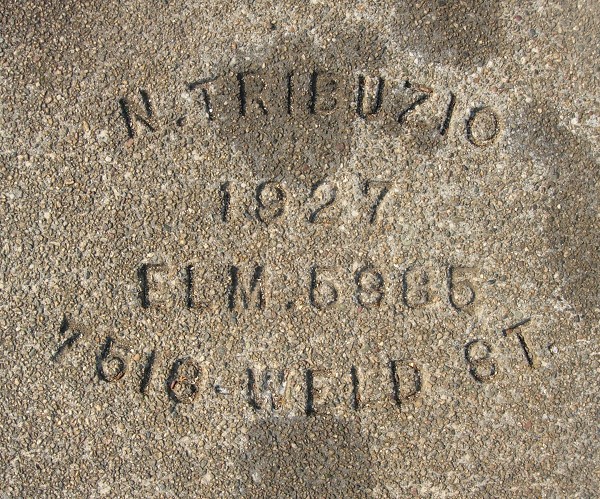
By 1927 Nick was living at 7518 Weld Street and producing sidewalks under his own name.

n-trib27

By 1930 his phone number had changed. It would change again before the decade was out.

n-trib30

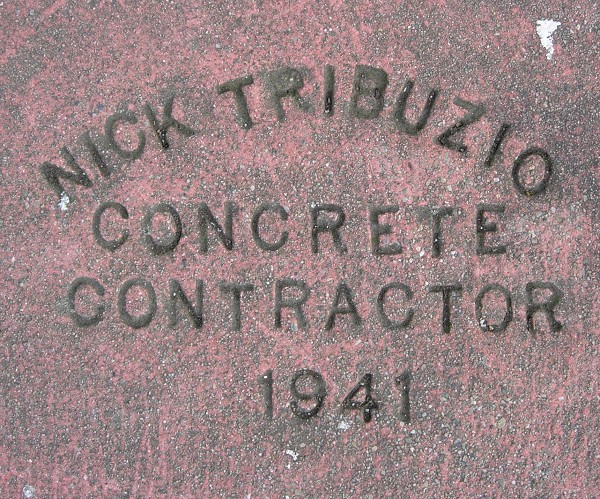
After 1931 there are no examples of this mark left in Oakland, but Nick left several hand-drawn marks in 1937-39. He was a widower by this time, and listed as such in the 1940 census. By 1941 he had acquired a new stamp that bore his full name.

n-trib41

This is the only year I’ve found with this mark in Oakland.

In World War II he enlisted again and served as a Seabee (naval construction). He married Marylyn O’Brien in 1946 and moved to Castro Valley, where he became a beloved character, wearing various costumes in town parades. At this point in time his record in Oakland ends, presumably because there was plenty of work in his new home town. I’d love to see examples of his mark from down there.

Nick Tribuzio died in 1971 and is buried in Lone Tree Cemetery, Hayward.

Sidewalk makers: The DeGuardas

11 November 2016

Three generations of DeGuardas have built sidewalks in Oakland and elsewhere in the Bay Area. It all began with Salvatore P. Guardalibeni (1884-1977), who immigrated from Italy in 1910. The family name is also commonly spelled Guardalabene, Guardalibena, etc. He married Mamie in 1910 and they had their five children (Marino, Leonard, Theresa, Salvatore and Marie) in New Jersey between 1913 and 1922.

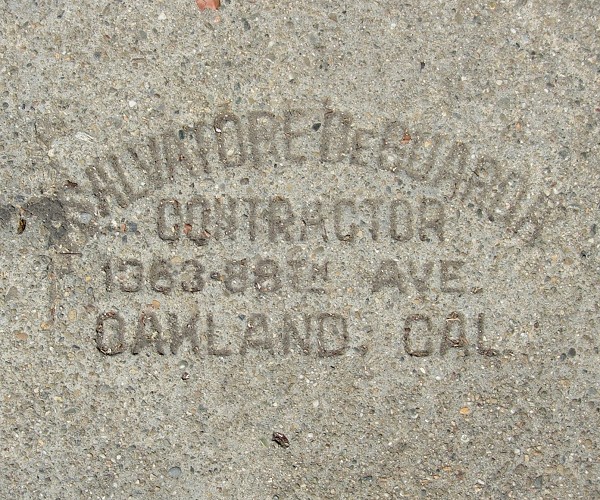
“Salvatore DeGuarda” shows up in directories from 1923 to 1928 living at 1363 88th Avenue. Over the years he was listed as a contractor, a laborer, a builder, and a cement worker. His earliest surviving mark in Oakland is from 1926.

deguarda1

Several undated marks in East Oakland must date from this period. The majority of surviving marks are of this elegant design.

deguarda2

The 1930 and 1933 directories listed Salvatore and Mamie at 1801 34th Avenue. As of 1934 they were living at 2918 E. 16th Street.

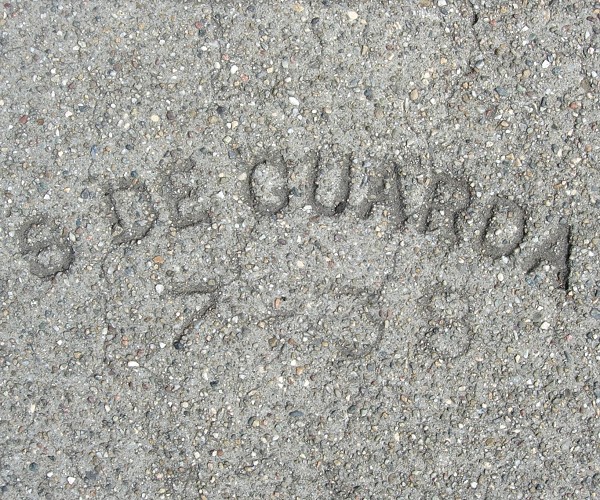
The next date found in Oakland is 1938, on a stamp without the address, just the name “S. De Guarda.” Other undated examples must also date from the 1930s. Salvatore and Mamie were living at 2175 38th Avenue that year along with Leonard, Marino and Theresa, although a newspaper story from that year puts Leonard at 1175 38th Avenue.

deguarda3

As of 1940, Salvatore lived with Mamie at 1636 36th Avenue, while in 1941 Leonard and Elva lived at 1725 E. 21st Street (listed as a salesman for Diamond Dairy).

Salvatore Anthony DeGuarda the son (1920-2012) had a storied life, starting as a swimmer (along with Esther Williams) in Billy Rose‘s Aquacade at the 1939 World’s Fair on Treasure Island. He was also the model for the swimmer in white in Diego Rivera’s Pan American Unity mural, made at the World’s Fair. A stint as a movie stuntman followed. He was for a time an associate of Mae West, appearing in one or more of her films under the name John Dexter.

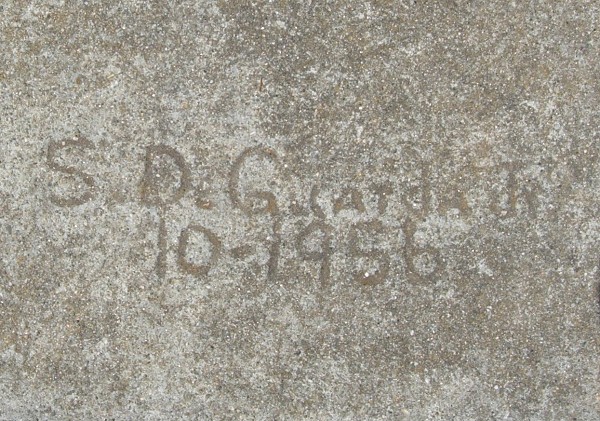
Sal took over the family business in 1955, so it must have been he who drew this mark in 1956. The 1967 directory lists a “Saml De Guarda” at 3321 E. 16th Street.

deguarda5

Sal and his son Rocky carried on the family business together, moving it to San Francisco where it is fondly remembered on Yelp. However, neither of them used a sidewalk stamp, and more’s the pity.

Late in life, Sal Jr. adopted the mission of recreating the iconic Goddess of Pacific Unity statue from the World’s Fair.

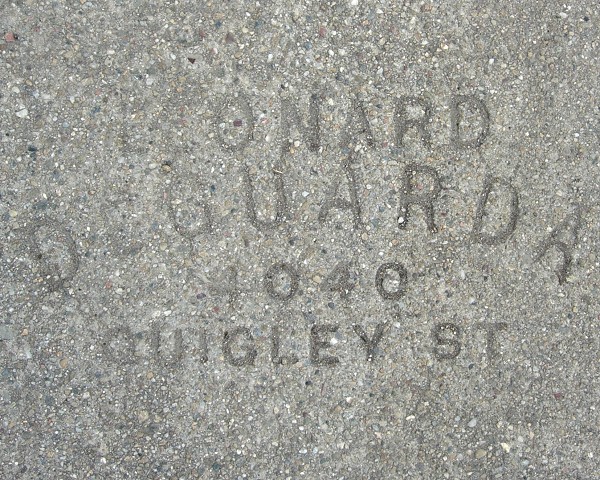
Salvatore’s other son Leonard DeGuarda (1915-1960) had a shorter career, ending in 1938. His business address, at 4040 Quigley Street, appears to have been wiped out by construction of the 580 freeway. A small apartment building sits there today.

deguarda4

I thank members of the DeGuarda family for their help and memories.