Bricks and cobblestones

17 February 2017

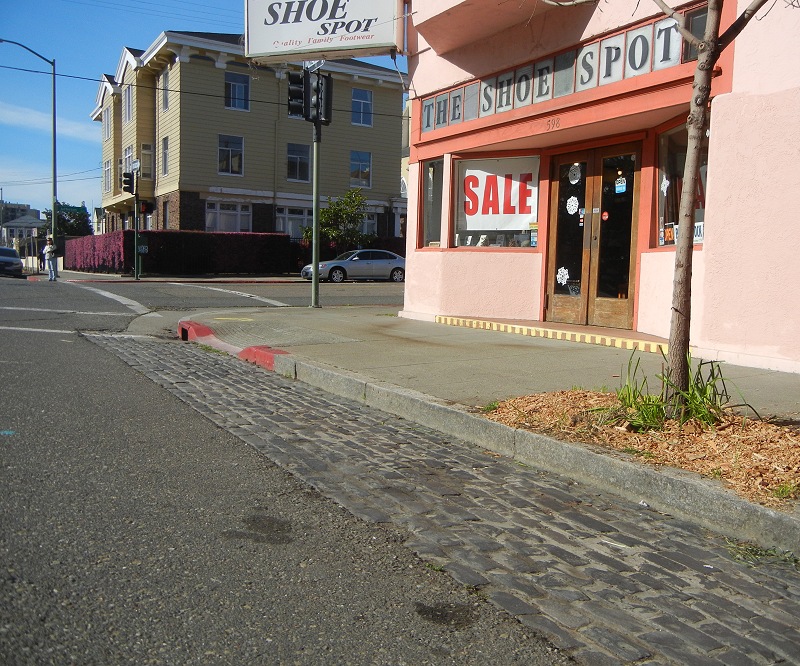
Older parts of Oakland feature gutter strips of brick and cobblestone.

bricks1

Cobblestones are rough blocks of solid stone that essentially never wear out. The most important thing in keeping cobblestone paving sound is the mortar. You don’t want loose cobblestones knocking around in the street.

bricks2

The material itself is tough, nondescript basalt or argillite or gneiss. Some of it could have been quarried locally, but I doubt it.

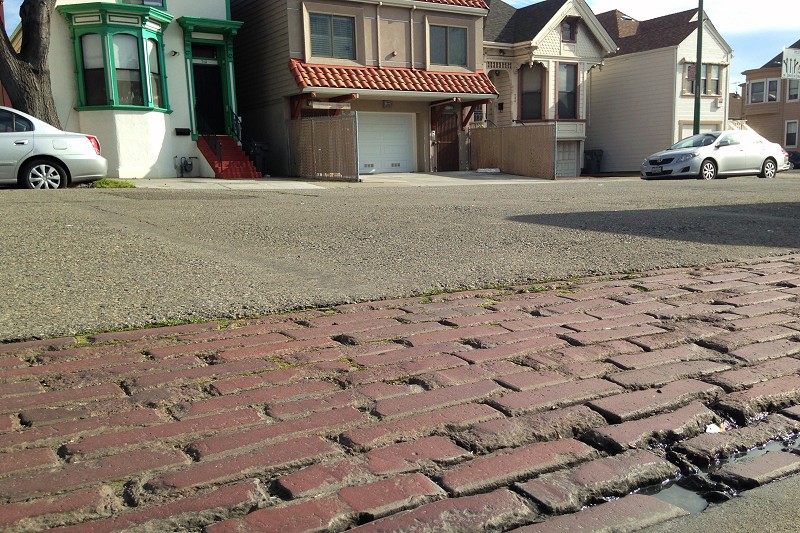
Then there’s good old brick.

bricks3

It’s easier to work with, but it doesn’t wear as well. I think that paving brick is a different grade of material than your wall-building brick.

People out there know a lot more about this stuff than me — people like Dan Mosier, creator of the California Bricks site.

East Bay Water Company

10 February 2017

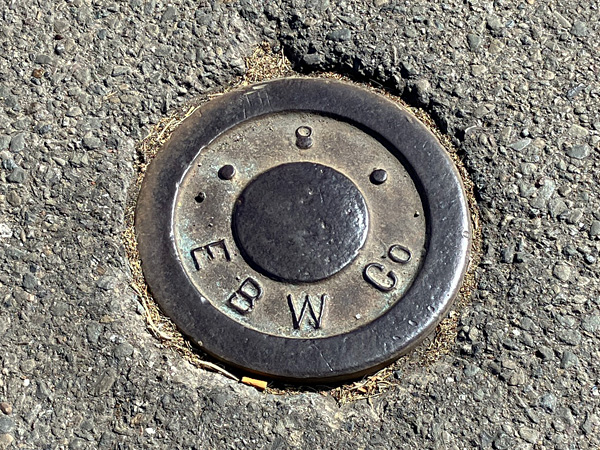
eastbaywaterco

The East Bay Water Company was a private water provider formed in 1916 from the wreckage of the Peoples Water Company, but it struggled under the high costs for materials during World War I and insufficient water for its customers. Oakland and the East Bay were experiencing a boom at the time, and the company couldn’t expand fast enough despite having some 80 square miles of watershed land in Alameda and Contra Costa Counties. It owned Lake Chabot and other reservoirs in Richmond, too. It pumped water from a wellfield in Alvarado. It built the San Pablo Dam in 1919. It ran a long series of informational ads in all the East Bay newspapers in 1920. It took over a competitor, the faltering Union Water Company, in 1921 for $1.1 million. It built the Upper San Leandro Dam in 1926 and the Lafayette Dam in 1928.

Nevertheless, in 1921 fed-up East Bay leaders pushed for the state to enact a law allowing a new type of special government agency — public utilities of regional size. The Municipal Utility District Act having passed, East Bay MUD was established by an overwhelming vote in 1923, and the new utility bought out East Bay Water in 1928 with $26 million in bond money.

That was 12 tumultuous years for this ambitious company. East Bay Water’s excess watershed lands were the core of the East Bay Regional Parks District formed in 1934, also under the state municipal utility district law.

Peoples Water Company

3 February 2017

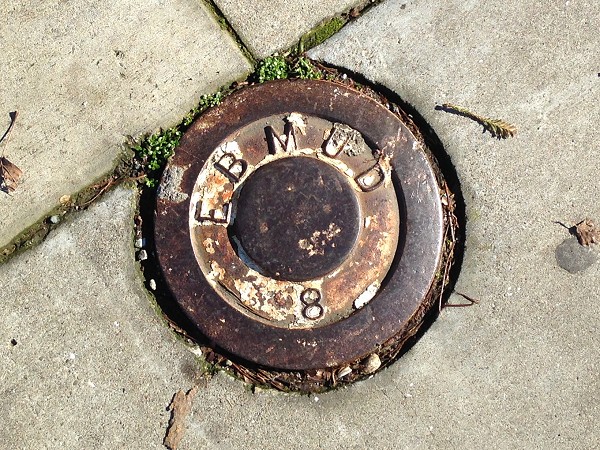
You’ll see plenty of evidence on the street of the East Bay Municipal Utility District. Their 8-inch mains are marked with these ubiquitous caps.

ebmudlid

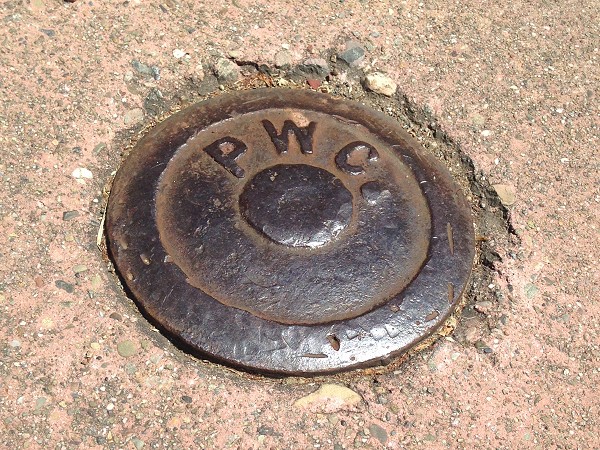
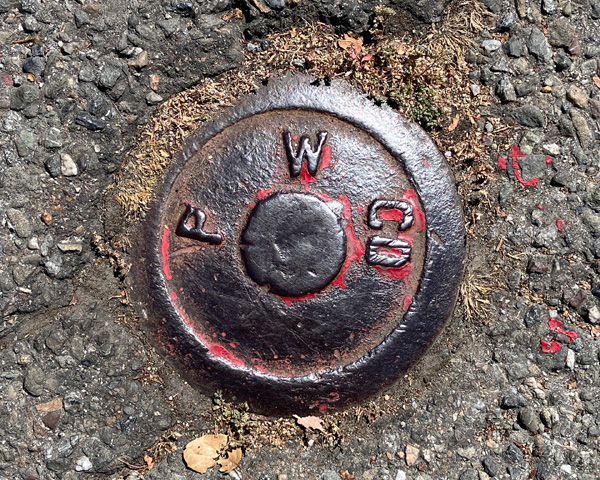
Much rarer are the caps for EBMUD’s predecessor, Peoples Water Company. It served much of Oakland and points north for the first time, an important ally for developers, but went bankrupt more than a century ago.

peopleswaterco

That one’s from Piedmont, and this one’s from Oakland at the intersection of Fleet Road and Greenwood Avenue.

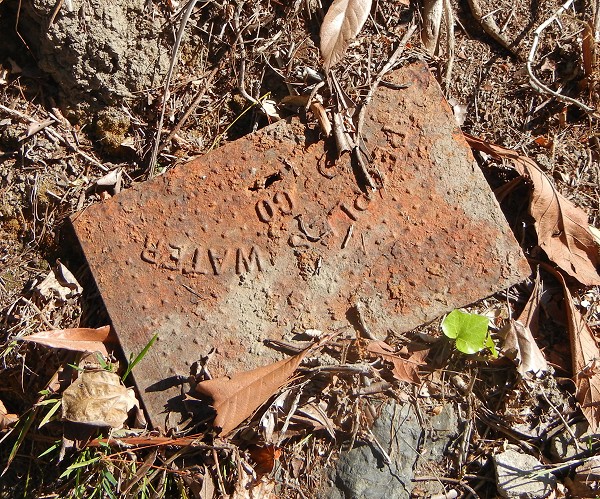
Here’s another artifact I found up in the hills.

peopleswater

In 2013 it was the subject of a post on my other blog, Oakland Geology.

Sidewalk maker: Charles A. Peterson

27 January 2017

C. A. Peterson left his mark over much of Oakland, using a stamp that showed his address at 3908 Maybelle Avenue, above the Laurel district.

c-a-peterson

The name is far too common for me to learn anything from the usual genealogy sources. All I know is what I’ve gleaned from the local business directories.

Charles A. Peterson first appeared in the 1906 directory as a cement worker at 1743 Blake Street, Berkeley. In 1907 he had the same address, along with Alfred, Arthur and George. In 1908 only he and Alfred were left. In 1909 he was listed at 96 Maybelle Avenue in Oakland, and in 1910 he was at 92 Maybelle. Presumably the house numbers changed when the area was annexed to Oakland, and from 1912 to 1925 his address remained 3908 Maybelle. This is the house at that address.

3908maybelle-capeterson

It has two nice strikes of his stamp on the sidewalk out front.

As of 1925, the directory showed that he had a wife, Adelle.

The 1928 and 1930 directories listed him as a rigger, at 3922 Maybelle. And after that I know nothing.

Some little brass lids: Greenberg, Hays, Scott

20 January 2017

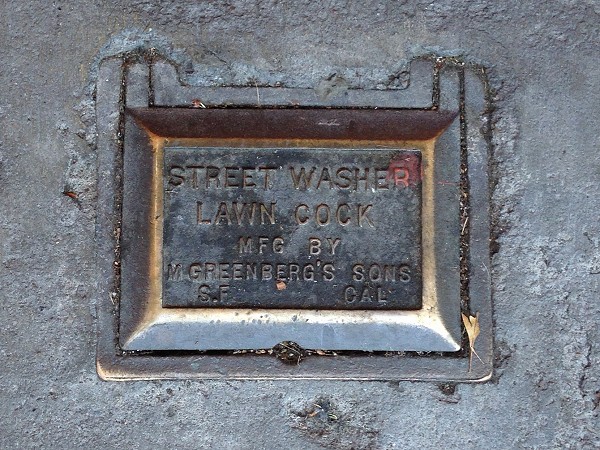
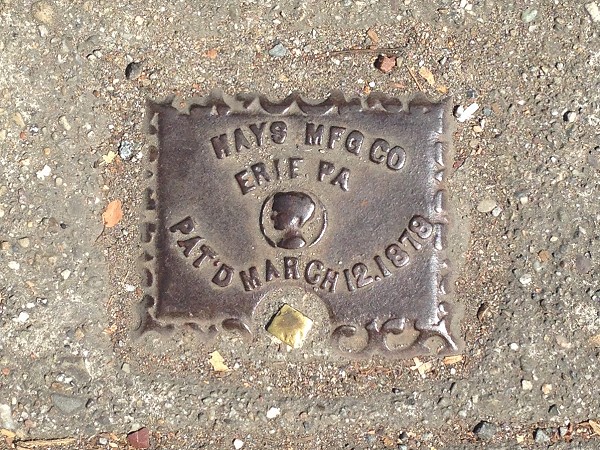
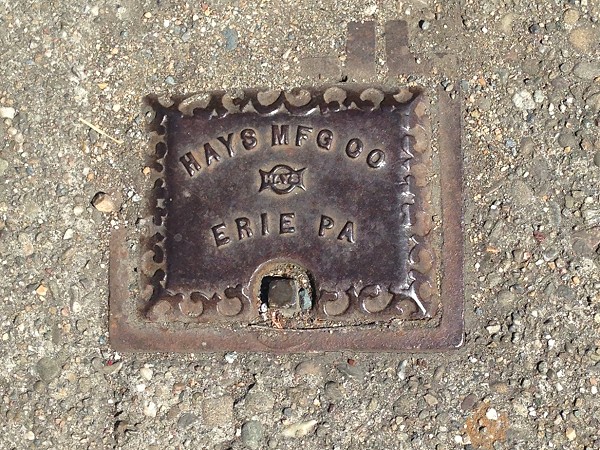
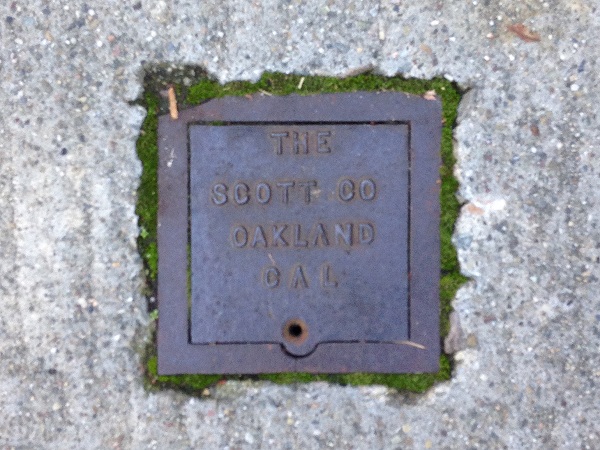
Here’s a roundup of some cute brass lids I’ve seen in our sidewalks.

M. Greenberg’s Sons, the San Francisco firm I’ve mentioned before, made this lid next to the old Fairfax Theater building, out on Foothill at Belvedere.

greenbergs-lawncock

This pair of well-preserved covers made by the Hays company is on Piedmont Avenue. The Hays company still exists and is in the same business! Read all about it at haysfluidcontrols.com.

haysplate-piedmont1

haysplate-piedmont2

And this last one is from a company I haven’t featured here before. The Scott Company specialized in heating and ventilation systems, starting about 100 years ago.

scott-co

They were headquartered at 381 11th Street. I haven’t done a big search, but I do know they lasted until at least 1938. There was another Scott Company, in San Leandro, founded in 1975, that folded after a contracting scandal in San Francisco a few years ago, but that was not these guys.

The Silent Knight

13 January 2017

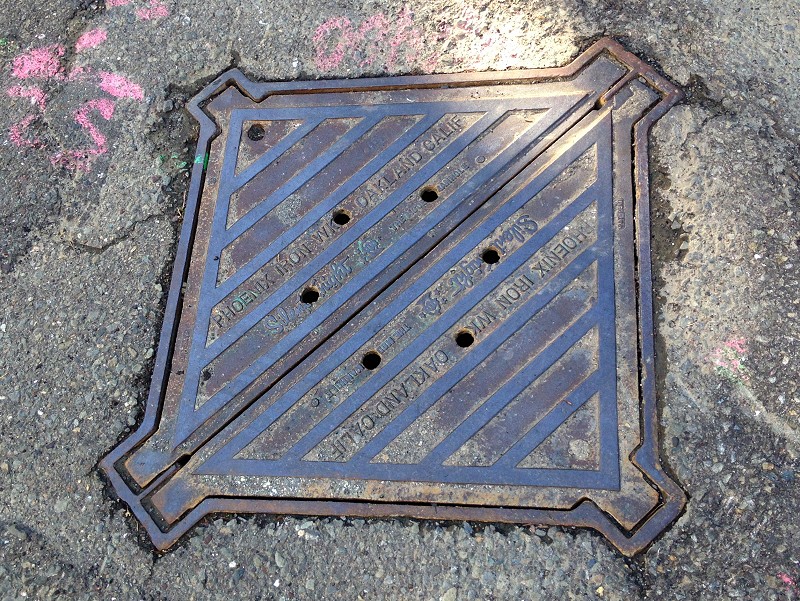
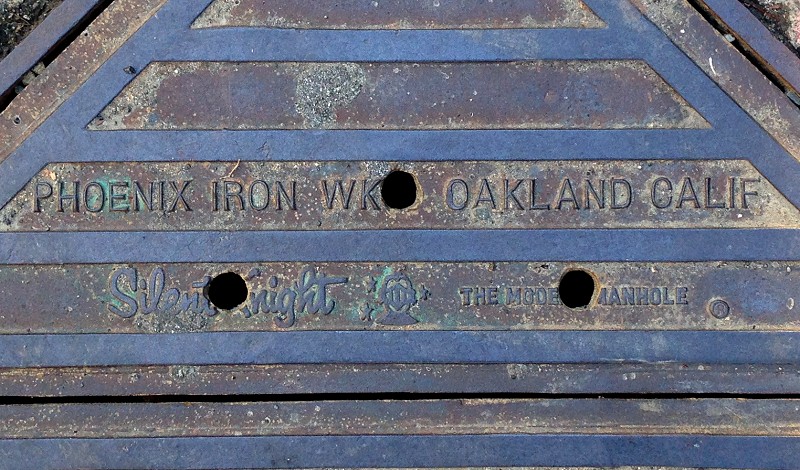
Walking around the rim of Indian Gulch (aka Trestle Glen), I poked my head up St. James Circle, ’cause that’s what I do. And there was the weirdest looking utility-hole lid: a square contraption made of two steel triangles, forged in Oakland by Phoenix Iron Works.

silentknight

This odd access cover (to use the British term) was invented by William W. Taylor, of Cincinnati, in 1959. The idea was to avoid the noisy rattling when vehicles drive over warped or clogged lids. The U.S. Tax Court described it well in 1970:

The invention was advertised as “Silent Knight — The Modern Manhole Cover. The first and only truly progressive development in manhole covers in years.” A notable feature of the device was its square shape. The frame, which was to be installed at the mouth of the manhole and upon which the manhole lid was to rest, was square, and the lid was formed by two triangular halves, which were joined by iron rods to form a square. The sides of the lid were longer than the diameter of the manhole (to ensure that the lid could not fall through the manhole). As suggested by its name, Silent Knight was advertised as “silent and safe,” as well as economical. An advertising leaflet proclaimed: “Silent Knight products are made by foundries, North, South, East and West and sell at freely competitive prices.”

Here’s a closer look at the trademark.

silentknight-close

In 1960 the National Noise Abatement Council gave Taylor its Achievement Award for the invention. Licensees in Canada and the UK produced them, and the design still has fans in places like St. John’s, Newfoundland.

I wish there were some outside my place.

Sidewalk maker: Angelo C. Sposeto

6 January 2017

Angelo Charles Sposeto was born in Pennsylvania in 1912, the son of Italian immigrants Dominic (formerly Domenico Esposito) and Frances (formerly Francesca Valenti) Sposeto. The family moved to Des Moines, Iowa the same year, and little Angelo grew up in the bootlegging business, eventually running nightclubs there. He met and married Mary Jaquinto (formerly Iaquinta) in 1931. The 1940 census records him in Des Moines, Iowa, with four children, the youngest age 1. He was recorded as looking for work. The family records say that he was looking for a way out of the Mafia life he was born to.

They came to California in 1941 and lived in Albany and El Cerrito at first. There Angelo invented a concrete mix he named Marblecrete. It was used in his Rainbow Carwash at MacArthur and Broadway. His son Dominic, an attorney, has recorded a wealth of the family’s history in a book he is now giving away free. I have relied on it for these details.

His work on Oakland sidewalks is scarce and scattered. An Oakland Tribune item mentions him as a concrete contractor in 1946. The earliest sidewalk mark I have of his is from 1947, showing that he was a member of Local 594 of the OPCFIA at the time.
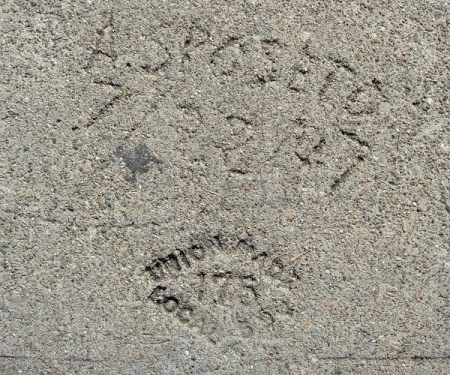
union-bug-175-sposeto

The records of the Berkeley School Board show that in 1956, he was awarded a contract to install a retaining wall and drainage system on the Berkeley High athletic field.

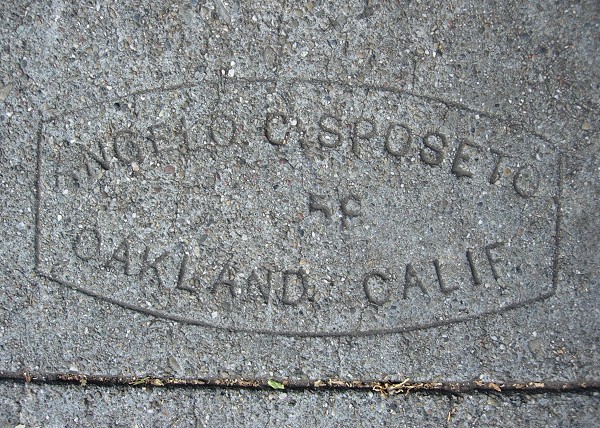
Later in the 1950s, he acquired a proper concrete stamp.
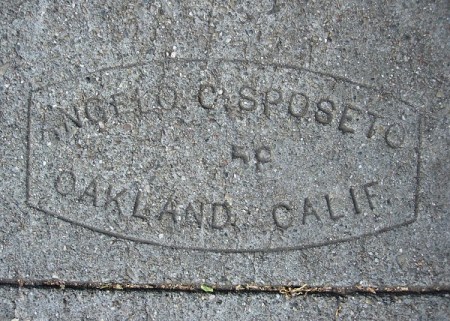
sposeto-59

The only other date I have with this mark is 1963, drawn by hand inside the stamp. He got another stamp that was used in 1970.

The 1967 business directory listed Sposeto’s business at 9300 G Street, while Angelo and Mary lived at 2655 Wallace Street, a curious little road across 14th Avenue from Highland Hospital.

Angelo died in 1975, age 62, and is buried in Lafayette at Queen of Heaven Cemetery. He and Mary Sposeto had five children; with the death of son Frank Albert last week, only Dominic survives today. Frank worked for his father’s firm after serving in the military, and I’m sure he could have shared some stories about his dad and the streets of Oakland.