Archive for the ‘ Streetscape’ Category

Vault lights

11 March 2016

vaultlight-1

Oakland’s older districts feature remnants of pre-electric technology known as vault lights. They were invented around 1850 as a way to bring daylight into vaults, or basements that extend beneath the sidewalk, by means of thick glass disks mounted in cast-iron frames. In the late 1800s, with the spread of reliable Portland cement, reinforced concrete replaced cast iron. Oakland has examples of both types.

The photo above shows what’s probably Oakland’s largest continuous set of vault lights, in front of the Jefferson Court apartment building at 581 18th Street. It goes all the way to Jefferson Street, about 120 feet. Each piece of glass is actually a block with a prism on the bottom, which bounces and spreads the light sideways into the underlying space. See a quick introduction at glassian.org.

The glass turns purple after decades of exposure to sunlight as a result of manganese in the formula, used as a clarifier. About 100 years ago manganese was replaced by selenium, and today’s glass doesn’t turn purple. (In case you need a fresh dose of outrage, look up the scandal of antique glass being garishly tinted using UV lamps.)

Here’s the only example I’ve found of a cast-iron vault light, on Telegraph near 19th Street. The ventilating panel reads, “W.L.PATD.SF.JUNE,16.1874”. The clear glass may be a later replacement of the round glass prisms.

vaultlight-2

The Haley Law Office building at San Pablo and 16th has a fine set of vault lights. I’ve walked past at night and seen the cellar lights shining up through them.

vaultlight-3

Here’s a better look at a nearly pristine set, on Telegraph near 19th. This one has the name of P. H. Jackson & Co. of San Francisco, which I’ve mentioned in my two previous posts. The plate gives their address as “418 Bryant St.”

vaultlight-4

The Carles Apartments building, on Jefferson at 10th, has handsome vault lights along its whole frontage. I don’t know the manufacturer.

vaultlight-5

Finally we have this set on 8th Street at Washington, which stands out for its large, square glass blocks. Presumably designing a set that combines maximum light and adequate strength involves careful tradeoffs. The maker was “Henry Haustein 1866 Howard St. S.F.” The 1899 San Francisco business directory lists him as “manufacturer of sidewalk lights, 1832 Howard.”
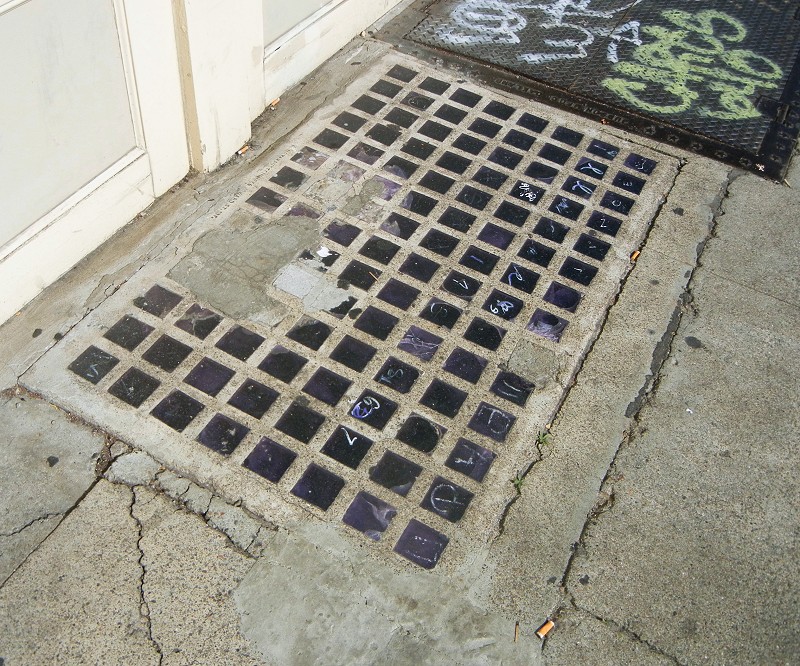
vaultlight-6

So, are these old features hopelessly ruined? Not at all! The National Park Service has a nice restoration case study from New York City, where 19th-century street tech is still abundant.
Jackson’s Device for Plentiful Ventilation

4 March 2016

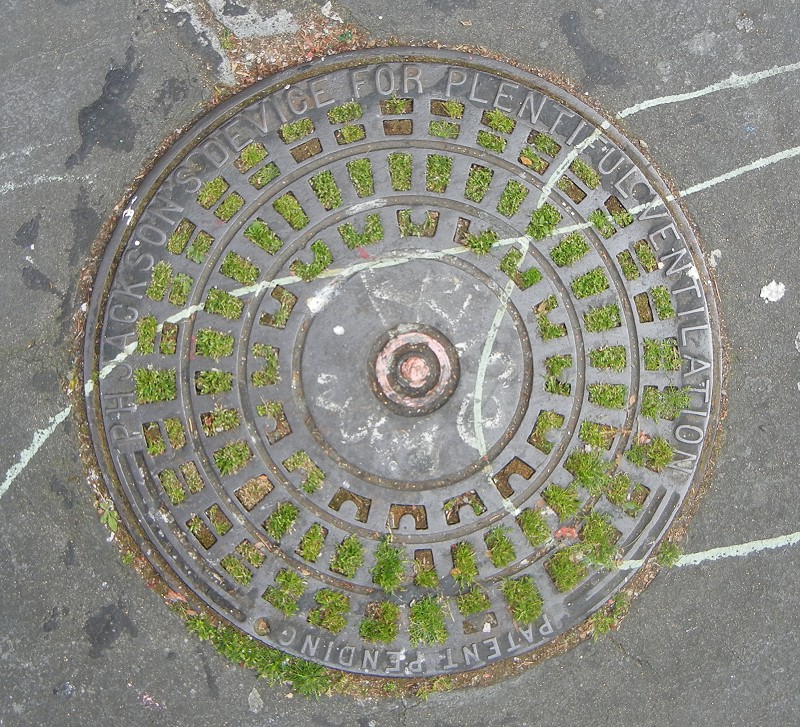
Poking around Oakland’s old downtown has yielded some more overlooked old things. Take P. H. Jackson’s Device for Plentiful Ventilation, on Harrison south of 14th Street.

jacksons-device

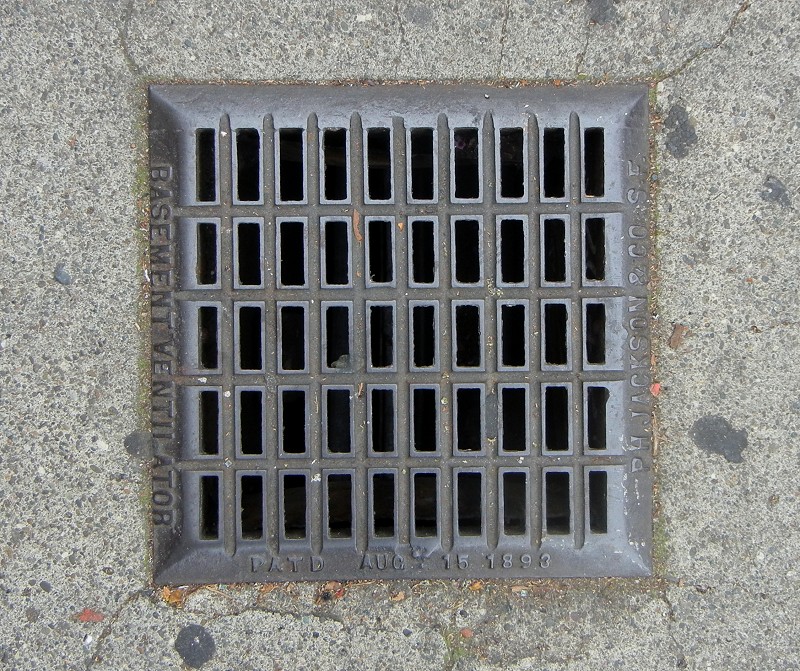
Somehow I don’t think it’s functioning any more. This is the same Jackson I featured two weeks ago. I found another configuration of ventilator from the Jackson company, this one with a patent date of 1893.

sidewalklights-jacksons-1893

Ventilator grates

19 February 2016

sidewalklights-1

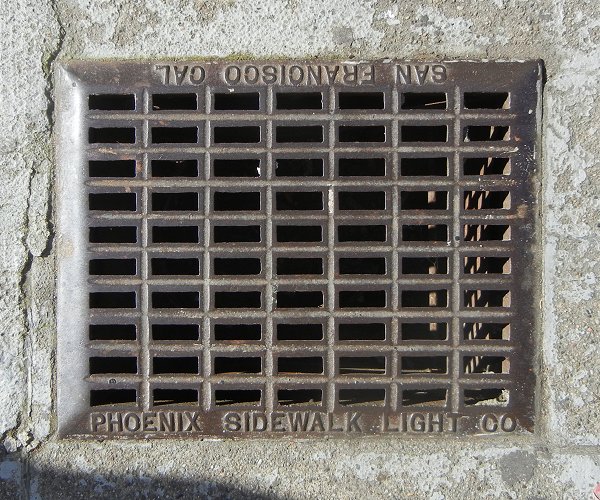
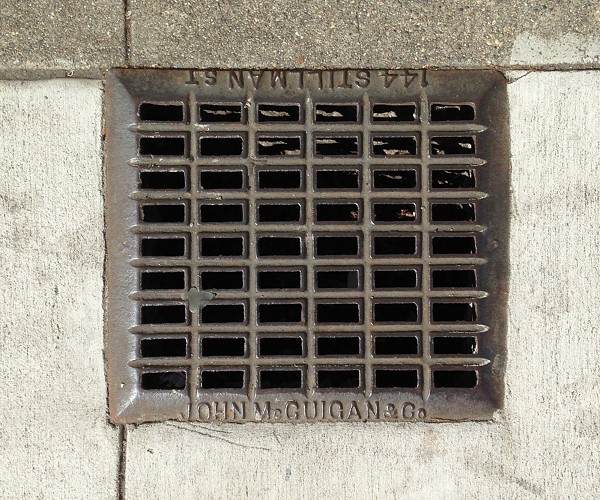
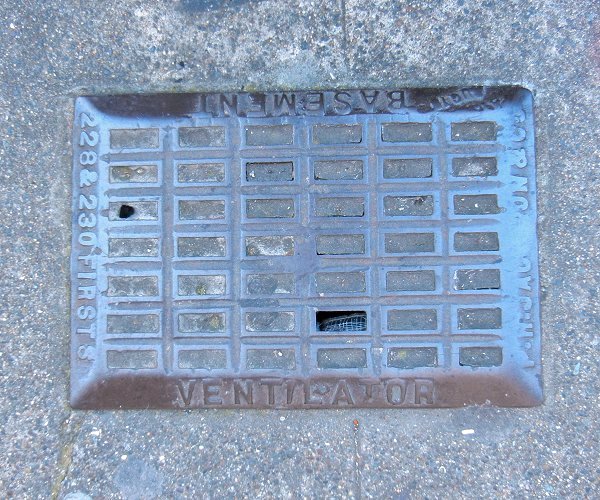
Older parts of downtown Oakland feature these iron grates in the sidewalk. Unlike the purple glass and concrete “vault lights” you’ll also see around downtown, the grates were for ventilation. I collected the following photos during an hour’s walk east of Broadway between 19th and 14th Street.

Here are two sizes of grate from the Phoenix Sidewalk Light Co. of San Francisco.

sidewalklights-2

sidewalklights-5

Please note that these are not sidewalk lights (vault lights), but ventilation grates. Phoenix made both items, according to the Historic Prism Glass Companies of the United States list on glassian.org. It was headquartered in the Monadnock Building on Market Street.

John McGuigan & Co. was also across the bay, at 144 Stillman Street. (The address is now under the freeway.)

sidewalklights-6

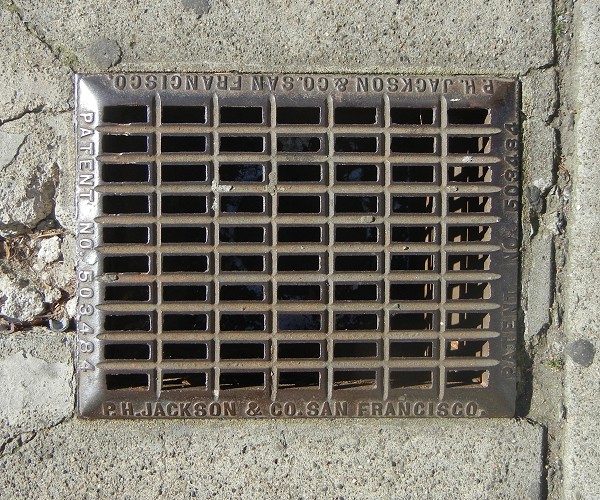
The king of the business appears to have been P. H. Jackson & Co., which was a major manufacturer of reinforced concrete and other innovative building elements beginning in the 1870s in San Francisco. The company, on the 200 block of First Street, continued business well into the 20th century. I will have more to say about the company in a future post.

Here are three different examples of their products.

sidewalklights-7

sidewalklights-4

sidewalklights-3

This is an unexpectedly deep subject!

Granite curbs

8 January 2016

granite-curb

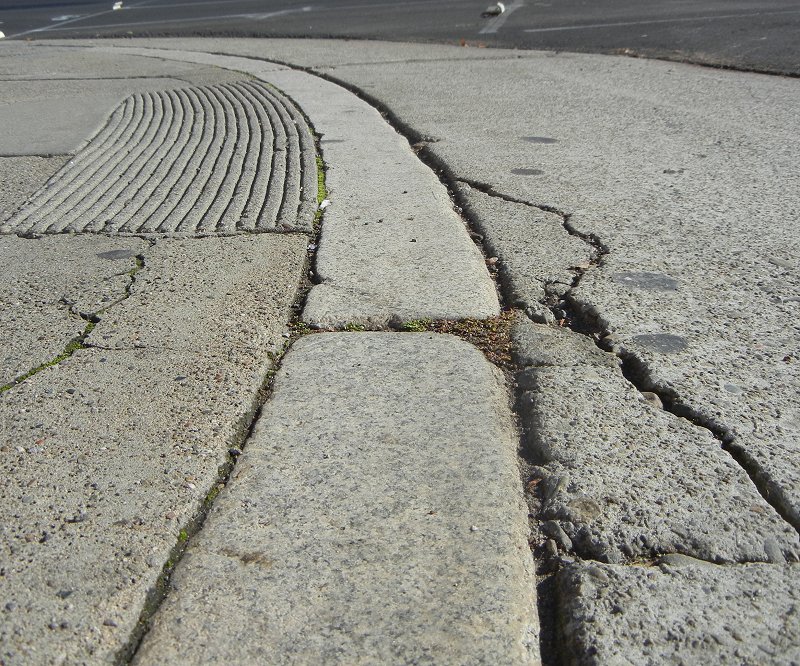
Older parts of Oakland are graced with proper curbstones — carved granite rather than molded concrete. They have the whiff of simpler times, of street trolleys and horse-drawn vehicles. They were made to last the ages, you might say.

Stone has always competed with concrete, with quality and cost both in the contest. Stone, above all, is durable, and it still beats concrete in that respect. But everything else has evolved in concrete’s favor. The skilled labor of stonecutters has waned while the strength and the convenience of concrete have grown.

A lot of downtown curbs are ironclad concrete, an early attempt to protect the curbs from chipping. I’ve never seen a new example, and I’ve seen a lot of places where the steel straps have warped.

iron-curb

Today we’re apparently okay with letting the curbs chip. In any case, chipping doesn’t seem to be a big problem. Concrete is easy to repair.

At the old YMCA building, on Telegraph at 21st Street, the curved granite corner curb appears to be part of the heritage designation.

granite-curve

You probably can’t replace these special-order stones any more. The quarries that made them are mostly long closed. And you can’t carve wheelchair-compliant curb cuts into them, either, which has led to an inelegant design on this corner with a wide concrete apron in the street. The building’s manager told me that a small pipe runs through it for street drainage, but it’s easily clogged. So the stone is preserved, but it’s not well displayed. Meanwhile the opposite corner has a nice new curb cut with the grooved concrete and the knobby yellow patch. Today’s ways really are better ways.

I’d be okay with the city replacing this corner. I wonder what the city does with the old curbstones. They should be recycled, perhaps in the parks.

Early tract markings

31 December 2015

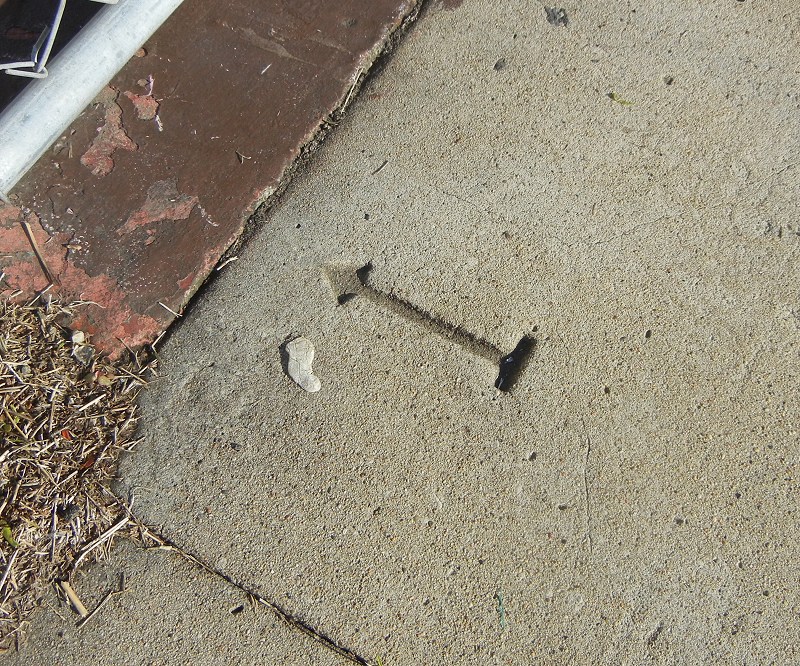
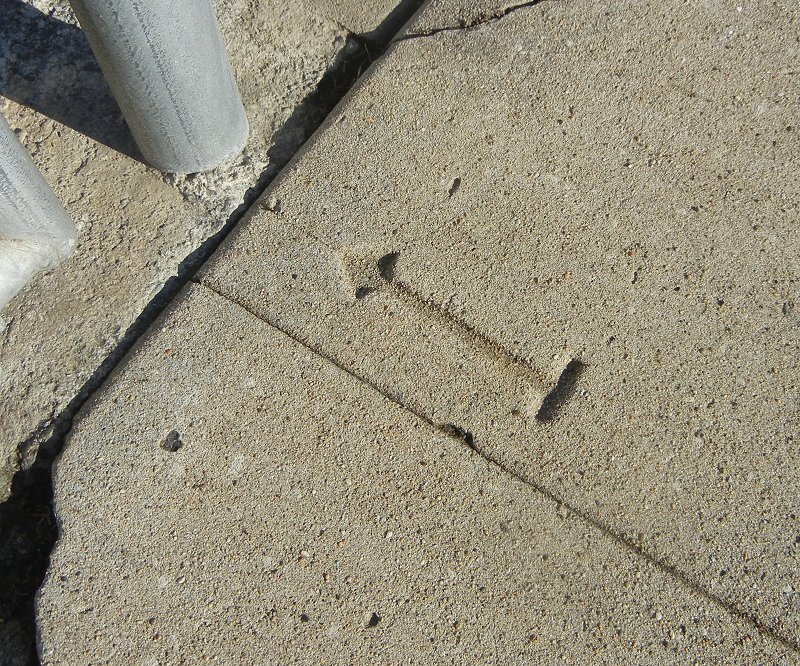
A small tract in deepest East Oakland preserves some very old sidewalks. The stretch of 104th and 103rd Avenues between International Boulevard and E Street — call it Iveywood West — features the following curiosities.

arrow-104thAve1

arrow-104thAve2

These arrows in the pavement point away from the street. On the north side of 104th, they appear to correspond to the edge of driveways. On the south side, they don’t. On 103rd they only appear on the south side.

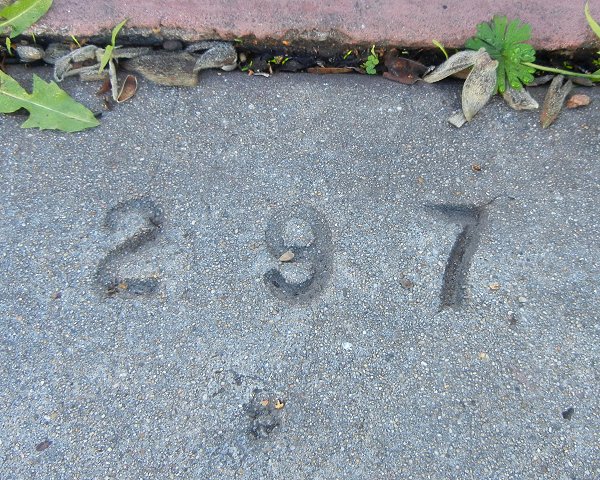
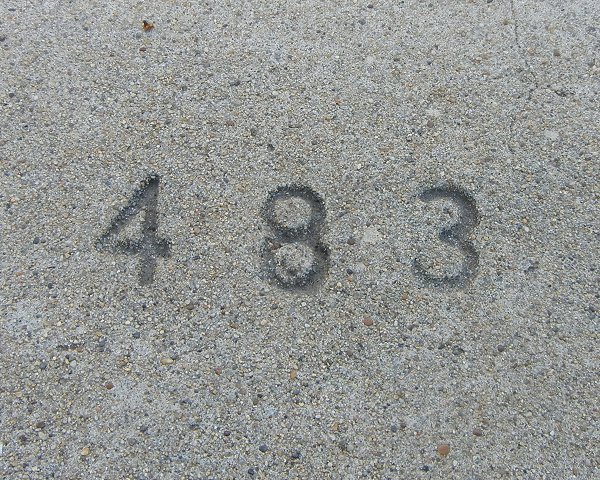
Both streets also have stamped in the concrete what I assume are lot numbers. This is on 104th.

104thAve-lot-no-297

And this is on 103rd. They don’t correspond to the addresses.

103dAve-lot-no-483

The sidewalks are very consistent in appearance. I don’t recognize the maker’s style, so I can’t say who laid them down, but I believe they date from around 1910. The 1912 map suggests that the landowner was Ludovina Ivey. She was Ygnacio Peralta’s daughter and developed large tracts of Oakland near the San Leandro line. (She also owned the undeveloped land now preserved in King Estates Open Space.) Google Maps calls the adjacent neighborhood Iveywood.

I’ve seen lot numbers and arrows in one or two other places, but I can’t recall exactly where. If one of you knows of any, please add a comment.

Another odd thing is the appearance of many of the driveways.

103dAve-driveway

They appear not to have been included in the original sidewalk, but instead were put in shortly afterward by a separate contractor. A few, like this, were made by sledgehammering the curb. Almost none are stamped by their makers, and the workmanship is often poor. I have the impression that the neighborhood was laid out without providing for driveways, under the assumption that ordinary people didn’t own cars.

Standout Streets: Castle Park Way

18 December 2015

kemble-castleparkway

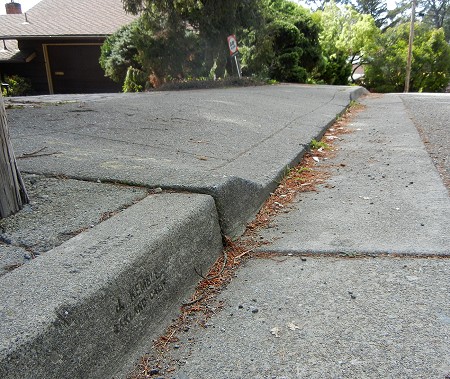
Castle Park Way is a little loop hidden off of Castle Drive, at the southern end of the Piedmont Pines neighborhood. All the concrete work was done by John R. Kemble, who did very good work all over Oakland from the mid-1920s until roughly 1941. When I surveyed this street I was struck by its unity, in which the homes and landscaping take part as well as the paving. And all this time later, it still has great integrity.

Standout Streets: Lawlor Avenue

11 December 2015

WPA-lawlor-ave

Welcome to phase 2 of this blog. I’ll be posting every Friday morning from now on, so add this to your feed, or subscribe, or whatever you do to keep up with the cool new stuff.

Oakland has lots of streets that are special for one reason or another. As I threaded its labyrinth I wished I could show them to you, but didn’t want to interrupt the parade. Now I’m getting around to them.

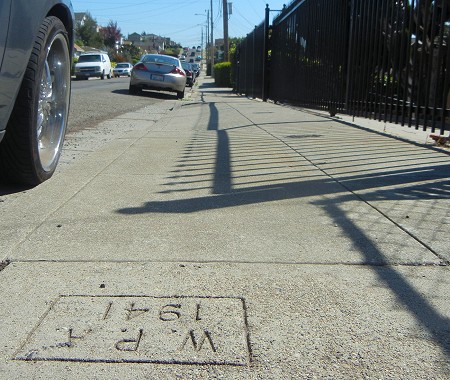
The Work Projects Administration or WPA gave millions of skilled and unskilled people jobs during the Great Depression. Their work added a great deal to Oakland’s cityscape, not least in its sidewalks. Lawlor Avenue seems to have been entirely paved by WPA workers in 1941 — curbs, sidewalks and driveways. It has an unusual unity of appearance for that reason, and the work is almost unmarred even 75 years after the last trowel was washed dry. In that respect, it’s a heritage street.