From Frank C. Merritt’s History of Alameda County (1928):
“Cement has taken its rightful place high in the list of the leading building materials and is now practically indispensable in the construction of modern business blocks and residences. One of the leading cement contracting firms in the East Bay district is that of Riechel & Bredhoff. The senior member, Olaf Riechel [1877-1946], was born in Chicago, Illinois, February 21, 1878 [sic], and received his early education in the schools of that city. When twelve years of age he accompanied his parents on their removal to Alameda, California, and in the public schools of this city completed his studies. When seventeen years of age he went to work for Powell Brothers, with whom he learned the trade of cement working. He was promoted to the position of foreman and eventually became superintendent of construction, having in charge the erection of the Orpheum Theater building and other, important business structures, as well as large apartment houses and fine residences. He remained with that firm for twenty years and in 1918, formed a partnership with H[arold]. G[eorge]. Bredhoff, under the firm name of Riechel & Bredhoff, and engaged in the cement contracting business. They are doing a large business in their line, particularly as subcontractors, besides which they have laid many miles of cement walks and curbs in the East Bay cities. They did the cement work on the Heald Business College building, the Lynn building and the Barber block, as well as apartment houses and homes, and also erected the cement walls around the Pacific Gas and Electric plant on Thirty-first street, Oakland. They have likewise been very successful in building and selling homes.
“H. G. Bredhoff [1888-1975] was born in San Francisco, California, on the 8th of March, 1888, and received his educational training in the public schools of Alameda and Oakland. On leaving school he learned the trade of cement worker and was employed on the construction of the old Realty Syndicate building in Oakland. He was with Powell Brothers for sixteen years, leaving the employ of that firm to enter into business with Mr. Riechel. He is a member of the Fraternal Order of Eagles.”
Riechel was the son of German and Danish immigrants, and Bredhoff had German grandparents.
The firm operated out of 2509 Clement Avenue, Alameda.
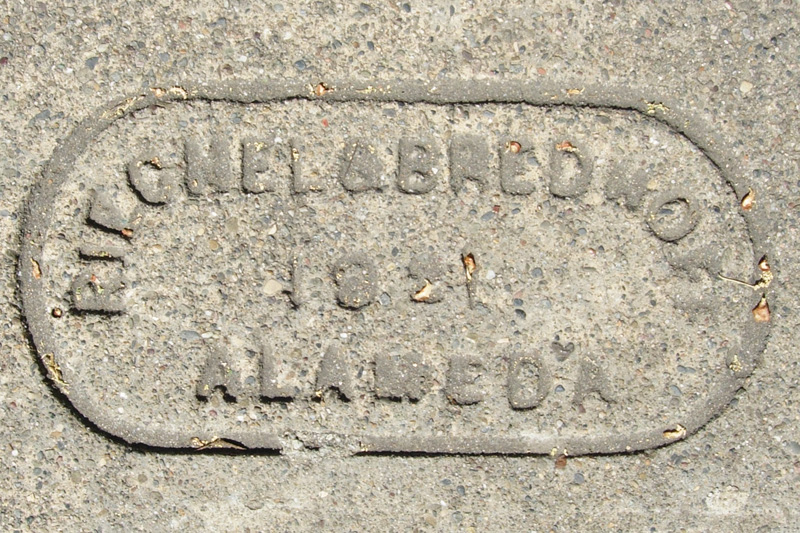
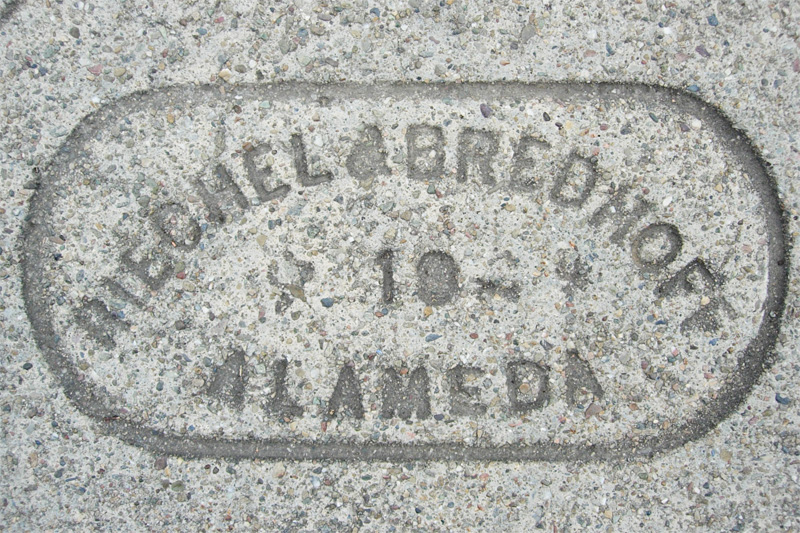
Riechel & Bredhoff stamps appear on Oakland sidewalks with dates from 1921 to 1951. They have two forms that I call the high and low arch. The low arch is much less common, but both stamps have comparable age ranges. I didn’t differentiate them at first, so there’s still more research to do.