Archive for the ‘ Profiles’ Category

Sidewalk maker: E. L. George

21 March 2025

Edwin Lewis George (1847-1920) was born in New Sharon, Maine, one of four children of farmer James P. and Betsey L. George. He moved to Oakland in 1882; he’s listed in the 1884 directory as a farmer living at 484 25th Street. He was registered to vote in Rocklyn in 1884 and in Penryn in 1886, where he must have been a quarry worker. Later in his voter registrations in Oakland, he called himself an expressman (1888-92), a gentleman (1896), a laborer (1898), and a concrete worker (1906-08). He married “Millie/Nellie” Chapman (1848-1928) in Maine in 1866; they had no children. The couple occupy separate niches at Chapel of the Chimes.

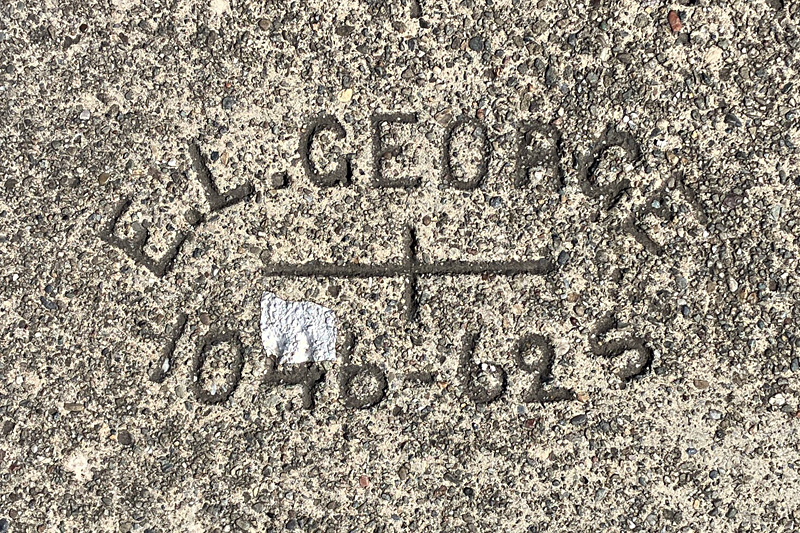
As of 1900, Mr. George was carrying out his concrete business at 1046 62nd Street, where the couple moved in 1891. The house numbers appear to have been changed since then, though.

E. L. George marks are almost nonexistent in Oakland, and I’ve found only one with a date of 1912. This example is at 1229 55th Street in Emeryville, one of two on the property.
Sidewalk makers: Triberti & Massaro

22 February 2025

Joe Triberti and Frank Massaro were another of many Italian immigrants who left their mark on our sidewalks.

Giuseppe Triberti (1887-1940) was born in Castelnuovo, Italy. He and his wife Concettina had one child, a daughter.

Fiorentino Massaro (1894-1981) was born in Montaldo Scarampi, Italy. He and his wife Adele had three children, two daughters and a son. He immigrated in 1910 or 1913 (sources differ), worked on a farm in Chowchilla for a while, then turned up in San Francisco as of 1916. Later the family lived in various East Bay cities.

Both men lived in North Oakland when their partnership began and were tight with the East Bay Italian community by marriage and association. Frank Massaro made quite a name in the 1950s-1960s in local bowling leagues. Both are buried in St. Mary’s Cemetery.

Triberti & Massaro first show up in the papers in 1924 in a notice awarding them the contract to build the Carrington Stairs, centerpiece of the Jungle Hill area. Their first newspaper ad, in 1926, gave their address as 635 44th Street, an address now under route 24. They soon expanded outside Oakland and took on bigger jobs. In the ads Triberti always called himself Joe while Massaro used his initial, though later in life he went as Frank.

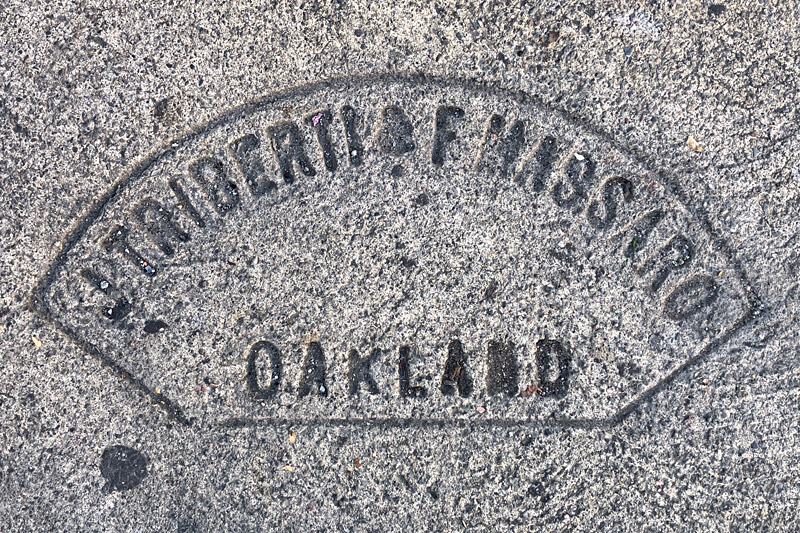
The Triberti & Massaro stamp never changed. The mark is usually lightly incised, and many are almost indecipherable. Their work is widespread but infrequently dated; dates are always scrawled inside the mark by hand. I’m confident of dates between 1924 and 1940, the year Joe Triberti died.

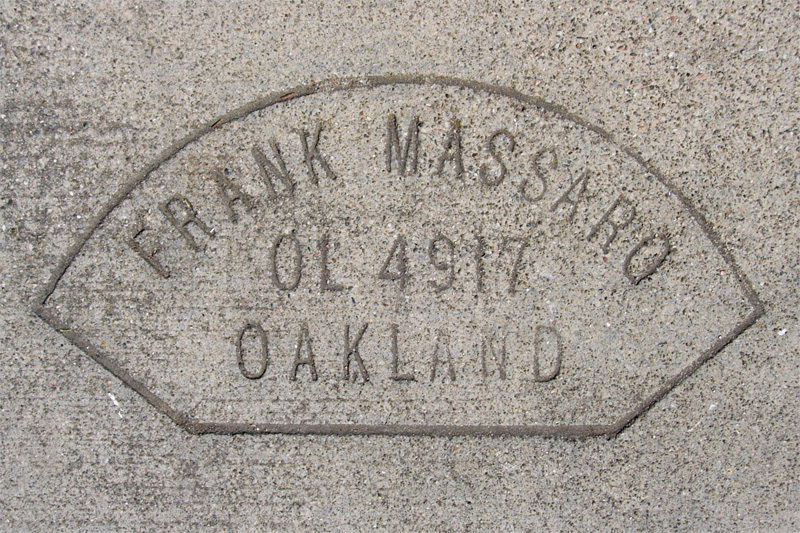
After Triberti’s death, Frank Massaro continued to lay sidewalks under his own name, headquartered in Oakland, but he apparently lived elsewhere. In the mid-1950s he started business in El Cerrito with his son Giovanni “John” as Massaro & Son Cement Construction Company, continuing until his death.

The solo Massaro stamp used the same escutcheon as Triberti & Massaro, but I’ve found no examples with a date. They are quite scarce.

Sidewalk maker: John Astorino

12 December 2024

John Astorino (1891-1982) has a sparse record but a familiar story among Oakland’s concrete contractors. He was born Giovanni Astorino in San Giovanni in Fiore, a town at the foot of Italy. He emigrated to Utah in 1923, after his father died, and in 1925 married Caterina Fratto (1903-1978), another native of San Giovanni in Fiore. He worked in the coal business at the time. Eventually they had eight children. It appears that they moved west after the war. The 1950 census states that two of their sons were concrete workers, who presumably worked with him. He later moved to Dublin and died there.

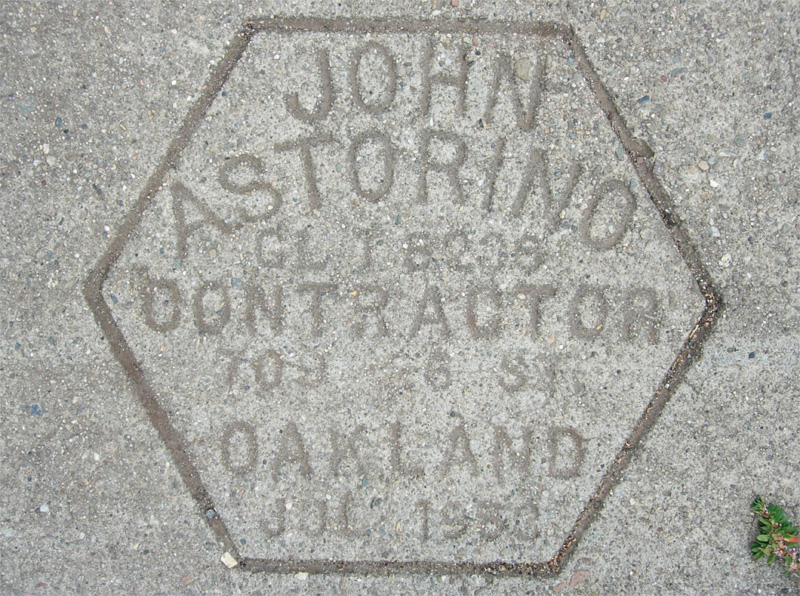
Astorino stamps are usually light and rarely show all the characters, including the phone number GL1-5236 and the address 709 26th Street, where the family lived as of 1949. But his marks are unmistakable — he’s the only sidewalk maker in Oakland who used a hexagonal stamp. I have documented seven different dates from 1951 to 1962.

Sidewalk maker: Ensor H. Buel

8 December 2024

Ensor Harrison Buel (1908-1992) was a prominent contractor in Berkeley for many years. Ensor was the maiden surname of his mother, Viola May Buel, and Harrison was the middle name of his father Emmanuel “Harry” Buel. His uncle was sidewalk maker W. E. Ensor, who also used a horseshoe stamp. He married Edna Potts (1917-?) in 1944, a schoolteacher. They had no children. They lived at 45 Edgecroft Road, up by the Arlington, but by 1980 he’d moved to Vacaville, where he’s buried.

Besides laying sidewalks, Buel constructed buildings and worked with Bernard Maybeck on several projects. He mastered the technique, advocated by Maybeck, of casting concrete walls containing lattices of glass bricks. Several examples survive in Berkeley, such as 1025 Carleton shown here (also 1007 University and 805 Camellia and around the foot of Bancroft Way).

He was a member of the Master Concrete Contractors Association in 1934, although I haven’t found an example yet of his Concrete Master number (3, 9, 10, 11 and 15 are unattested so far). His firm was prosperous enough to field a baseball team in the late 1930s.

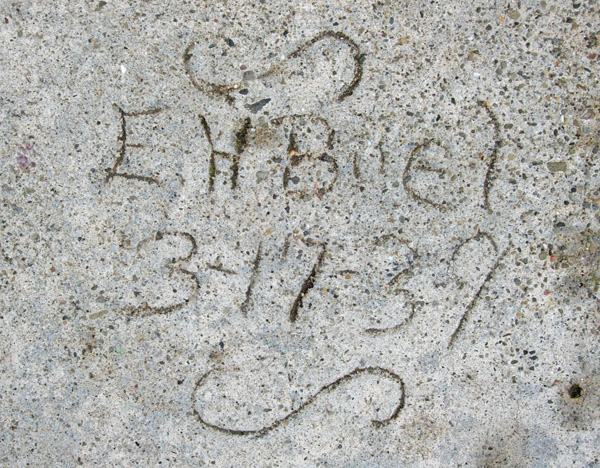
I have documented Ensor Buel marks with dates from 1934 to 1949. At first his were hand-drawn scratches, but by the late 1930s he’d cultivated an elegant hand-drawn mark with distinctive flourishes.

In 1940 he adopted a horseshoe stamp similar but not identical to that of his late uncle W. E. Ensor. I’m sure there’s lots more of his work in parts of Berkeley I haven’t visited yet.

Sidewalk maker: W. E. Ensor

7 December 2024

William Edwin Ensor (1881-1931) was a Maryland native who came to San Francisco with his wife, the former Mary Agnes Lewis (1874-1961). It was just after the 1906 earthquake, and concrete work was abundant. By 1911 they’d moved permanently to 2708 Tenth Street, Berkeley. They had eight children; their son Charles was also a concrete worker. He and Mary are buried at Sunset View Cemetery in El Cerrito.

In Berkeley he worked at first for the Esterly Construction Company, then later at the Navy yard on Mare Island. His concrete business is first recorded in the 1926 directory, but his sidewalk stamp first appeared in 1922.

I have recorded Ensor’s horseshoe stamp with dates from 1922 to 1931. His nephew Ensor H. Buel adopted the same format for his stamp. He also drew a mark by hand, a rectangle with “ENSOR” inside in large, blocky letters.

Sidewalk maker: Nat Lena

16 November 2024

Natale Lena (1885-1977) was born on a farm near Lucca, Italy, and came to America in 1902, arriving in the Bay area five years later. By then he knew enough about the concrete trade to get work in San Francisco. In 1908 he moved to Alameda and worked for the contractor Alexander LaPlant. He went solo in 1914, but a few “Lena & Helling Makers” stamps exist in Oakland from a collaboration with William G. Helling with dates of 1913 and 1915.

Merritt’s 1928 History of Alameda County states, “When he started in business for himself in Alameda he began in a small way. All concrete at that time was mixed on boards with a shovel, and a wheelbarrow was used to transport it to the concrete forms. The people of Alameda can well remember Nat Lena and his start in the cement contracting business but he laid a fine foundation for his future enterprise, and today he ranks as one of the largest and best known cement contractors in the Bay cities, while his equipment is modern and up to date in his line.” By the early 1930s his company operated from a compound in Oakland at 1174 19th Street, which still survives.

Nat and his wife Emma (1888-1954), who married in 1907, had no children. He was a member of the venerable Oakland Rotary Club for 46 years, and a Mason as well. Commenter Linda Hamilton recalled, “In 1978, following his death, Nat left $85,000 to the Club’s scholarship fund started with funds left by Sugar and Rice Manufacturer Al Saroni upon his death in 1961. By 2009, the Saroni-Lena Scholarship Fund provided one million dollars to over 600 Oakland teens to go to college.” And it’s still going strong.

Lena marks in Oakland run from 1920 to 1953. At first he used a racetrack-format stamp, though he would sometimes draw a mark by hand.

During 1934 he switched to an arched-text stamp with the name “Nat. Lena,” and he got a new stamp without the period after “Nat” in 1946.

Merritt’s history also notes, “He is one of the prominent members of the Cheese Rollers Club of San Francisco, an Italian organization, in which the members play a game similar to the American game of bowling, excepting that they use balls of cheese instead of wooden balls. Mr. Lena is an expert player and has won a number of prizes at this game.”

Sidewalk maker: L. Scaramelli

14 November 2024

Livio Giovanni Scaramelli (1902–1969) was born in Lucca and emigrated from Italy at age five to Alameda with his mother Maria, joining his father Pietro who had emigrated five years before. He went by Lee John Scaramelli off and on during his life. He married Alma Ballwanz at age 22, at which time he worked as a welder. His father died in 1915 and in 1923 his mother married tile worker Antonio “Anthony” Falcier (1870–1949), another Italian immigrant, who trained Livio in his business, and in 1924 he appeared in the directory as a tilesetter. By 1926 he’d changed his listing to cement contractor and started to advertise in the papers. He moved a few times in Alameda, but from 1934 to 1949 he was at 815 Santa Clara Avenue before relocating to Walnut Creek. He advertised his services (for patios and floors) as late as 1957. He died in Carson City, Nevada.

In 1938 a newspaper puff piece said about him, “‘Lasting Satisfaction’ is his motto, and the only order he gives the five men working for him is: ‘The best is none too good.’ . . . [He] has the gold of kindness in his nature . . . is never a backslider in boosting the home town and would find friends even on Robinson Crusoe’s island.”

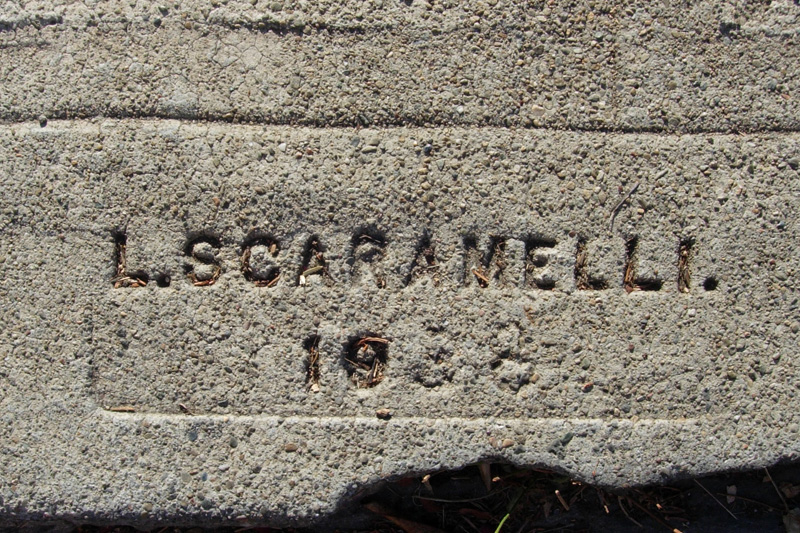
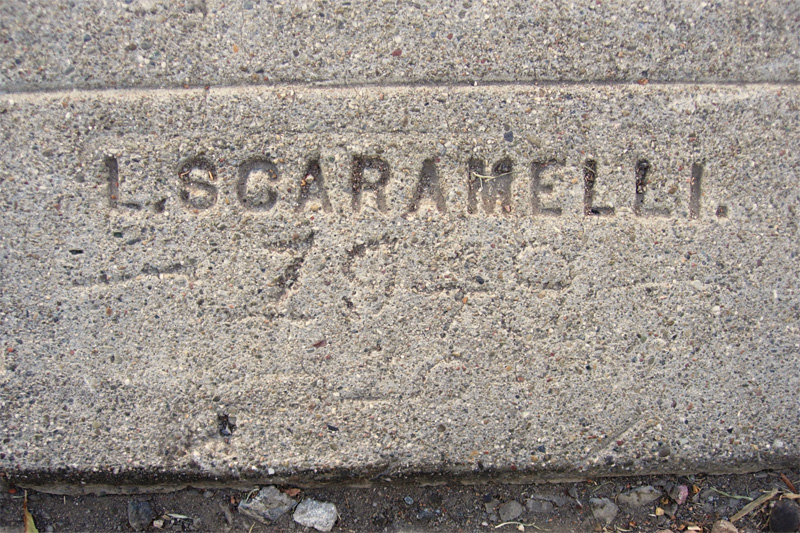
L. Scaramelli sidewalk stamps have dates from 1927 to 1954. In the 1940s he drew his dates by hand in a sure, elegant script.

They all have a period—“Scaramelli.”—at the end.