Archive for the ‘ Access covers’ Category

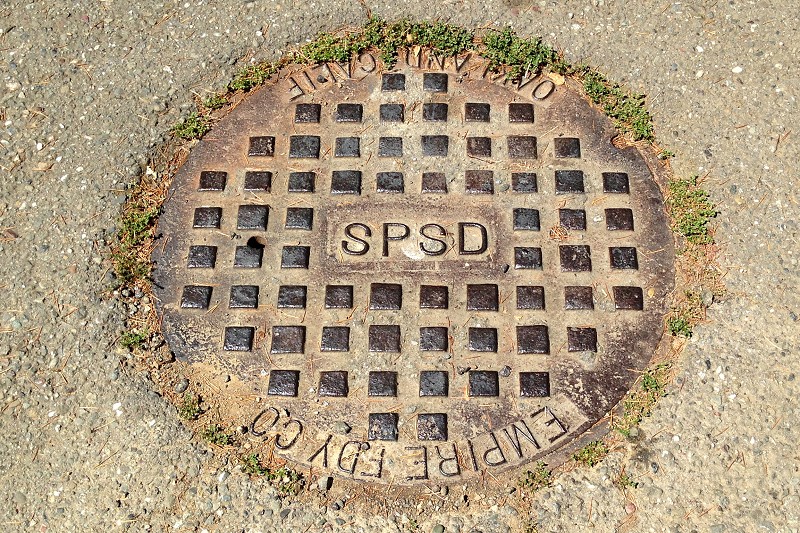
SPSD

26 May 2017

This utility hole cover sits on Keswick Court, on the south side of Shepherd Canyon. My searches for any information about SPSD have drawn a total blank. It might stand for the San Pablo Sanitary District, which existed from 1921 to 1978 when it became the West County Wastewater District. Maybe whoever installed the sewer line down Keswick bought SPSD’s outdated hardware, or the Empire Foundry had a stack lying around. I mean, who would care?

I have few other clues. Keswick was shown as unpaved on the 1947 topo map and paved on the 1959 edition, so the lid may date from the fifties. And yet Beaconsfield Road, just up the hill, contains a water main cap from Peoples Water Company, which ceased to exist in 1914. I can only assume that EBMUD used old PWC inventory when it pushed water service into the area.

For more clues, I must rely on the kindness of my readers.
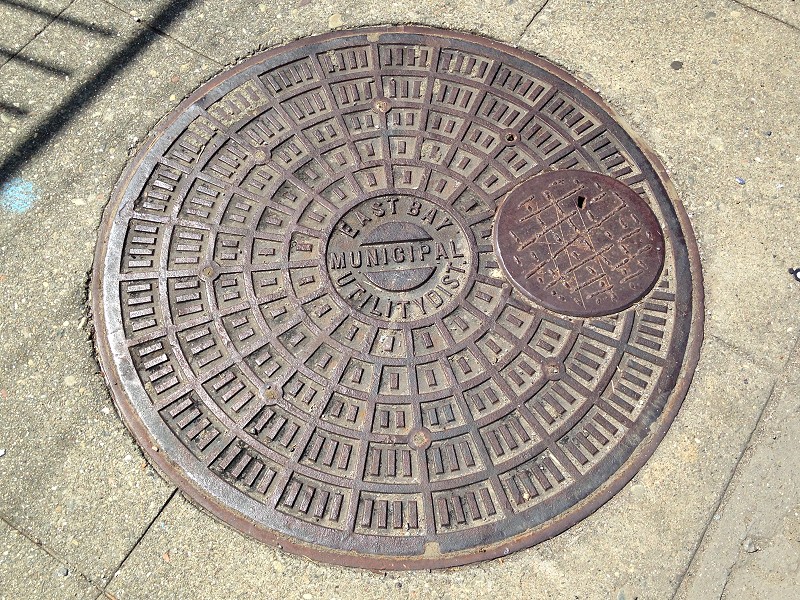
Access cover anatomy

5 May 2017

This large and elaborate East Bay MUD access cover, on San Leandro Avenue in deep East Oakland, displays a lovely radial design. It also includes good examples of some typical features of access covers.

At the top and bottom edges, at 12 and 6 o’clock, are lifting notches, where a worker attaches the hooks to raise the lid safely. Halfway out from the center is a ring of aeration holes, arranged on the major compass points. They happen to be filled with dirt, except for the one marking Northeast. Their function is to equalize the pressure between the hole and the atmosphere, guarding against the effects of unusual events, like a tornado in the air or a sudden flood or explosion down below, that might push the lid out of its rim.

The smaller lid on the right side has its own lifting hole. Presumably it allows access so someone can monitor conditions in the shaft without going through the chore of pulling off the large lid. Because a smooth finish could present a slipping hazard, the secondary lid was textured by a welder. Perhaps there’s an arcane pattern in it representing a message, but it’s more likely to be a random set of metal bits, a scribble arranged by eye and intuition.

The A.C.F.C. & W.C.D.

28 April 2017

The owner of this access cover has a name that rolls off the tongue: the Alameda County Flood Control & Water Conservation District. They’re the people who manage much of the East Bay’s runoff. One of our streams is buried here, along San Leandro Avenue — probably Stonehurst Creek, the little branch of San Leandro Creek that runs along the railroad tracks by 105th Avenue.

San Francisco Gas & Electric Company

31 March 2017

If I recall correctly, this access lid is on Jefferson or Martin Luther King down around 10th Street. It belonged to the San Francisco Gas & Electric Company, which was in existence from 1896 to 1906. SFG&E merged with the California Gas and Electric Corporation to form Pacific Gas & Electric, still in business today as PG&E.

The company opened a gas manufacturing plant in Oakland in 1905, down where Howard Terminal is today.

The six cleverly placed lifting holes are a nice touch.

The Silent Knight

13 January 2017

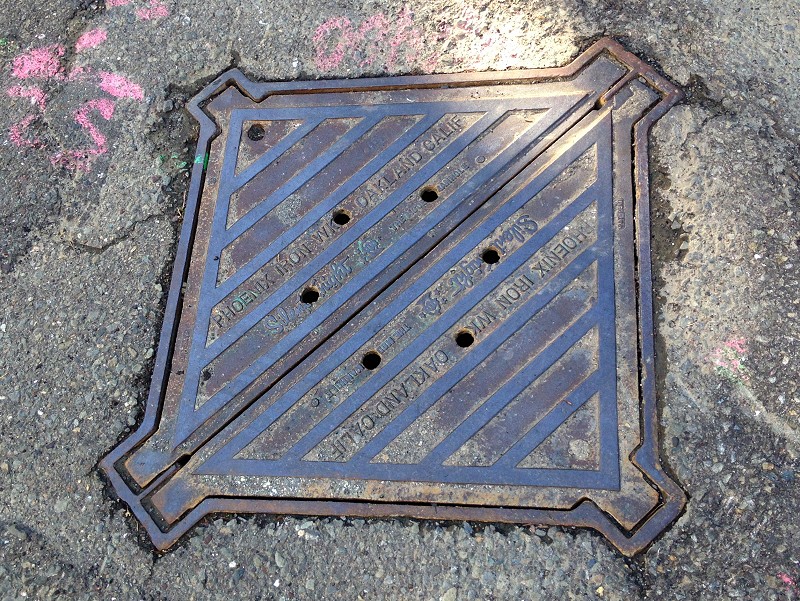
Walking around the rim of Indian Gulch (aka Trestle Glen), I poked my head up St. James Circle, ’cause that’s what I do. And there was the weirdest looking utility-hole lid: a square contraption made of two steel triangles, forged in Oakland by Phoenix Iron Works.

silentknight

This odd access cover (to use the British term) was invented by William W. Taylor, of Cincinnati, in 1959. The idea was to avoid the noisy rattling when vehicles drive over warped or clogged lids. The U.S. Tax Court described it well in 1970:

The invention was advertised as “Silent Knight — The Modern Manhole Cover. The first and only truly progressive development in manhole covers in years.” A notable feature of the device was its square shape. The frame, which was to be installed at the mouth of the manhole and upon which the manhole lid was to rest, was square, and the lid was formed by two triangular halves, which were joined by iron rods to form a square. The sides of the lid were longer than the diameter of the manhole (to ensure that the lid could not fall through the manhole). As suggested by its name, Silent Knight was advertised as “silent and safe,” as well as economical. An advertising leaflet proclaimed: “Silent Knight products are made by foundries, North, South, East and West and sell at freely competitive prices.”

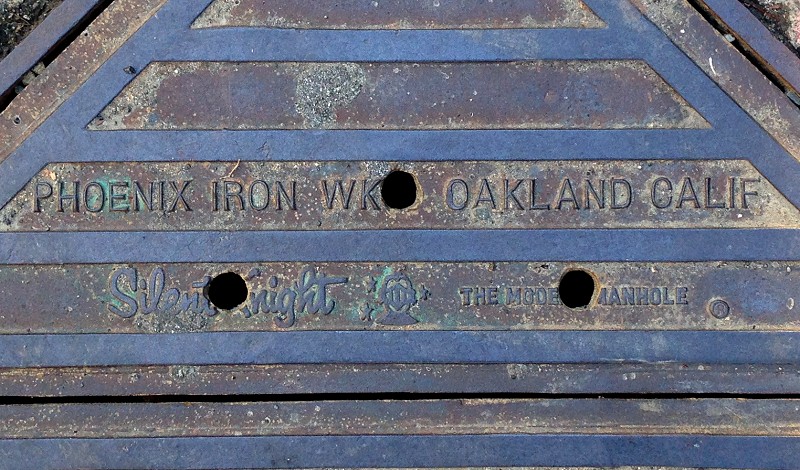
Here’s a closer look at the trademark.

silentknight-close

In 1960 the National Noise Abatement Council gave Taylor its Achievement Award for the invention. Licensees in Canada and the UK produced them, and the design still has fans in places like St. John’s, Newfoundland.

I wish there were some outside my place.

Oakland’s lid makers I: Best, Empire, Phoenix

16 December 2016

This week I focused on utility-hole covers again, with an eye on the different foundries that manufactured them.

best-steel

Best Steel Casting Company used to have a huge plant in farthest East Oakland, by the railroad tracks at 105th Avenue. I think this is on Broadway around 29th Street.

empire-and-wutelco

Empire Foundry was founded in 1905, but it seems to be defunct. Its last address was 1950 Embarcadero. It produced a great many lids in a wide range of designs. This example on Harrison Street, made for Western Union, is an unusual one for both companies. Perhaps it’s related to Empire Road, down south of Hegenberger.

phoenix-ironworks

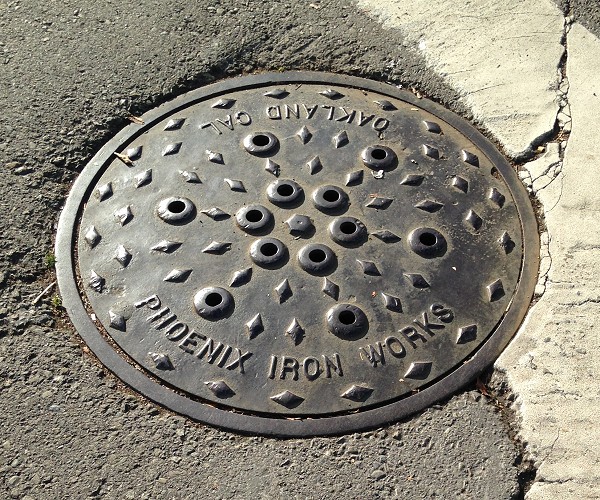
And then there’s Phoenix Iron Works, in Oakland since 1901. Today it’s a shadow of its former self in a funky building in the 5th Avenue Marina, flying the Jolly Roger out front. See more of its work at the Oakland Wiki.

Vestiges of Western Union 2

21 October 2016

westernunion

Another variant of the Western Union utility-hole lid, at 14th and Broadway. (Here’s the first.)

And another one on Broadway at 3rd Street.

There’s always something new to see, no matter where you are.