Special marks: “Permission to pass over”

22 January 2016

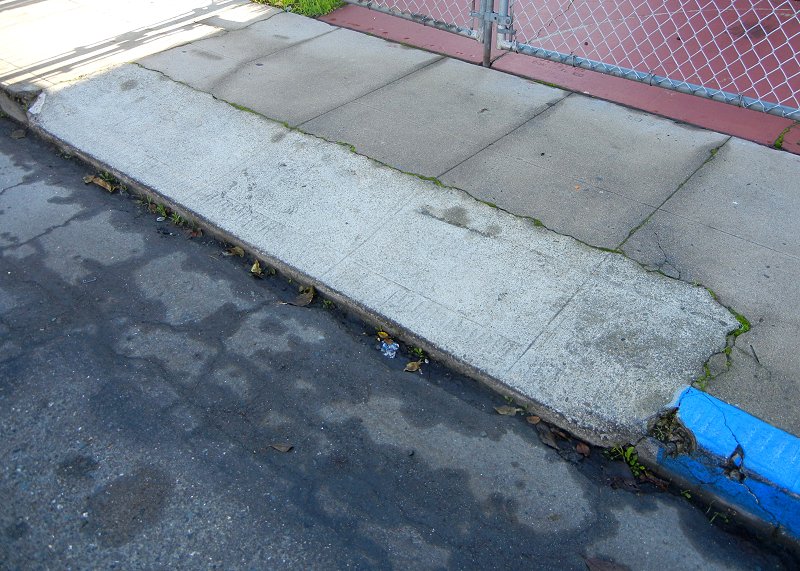
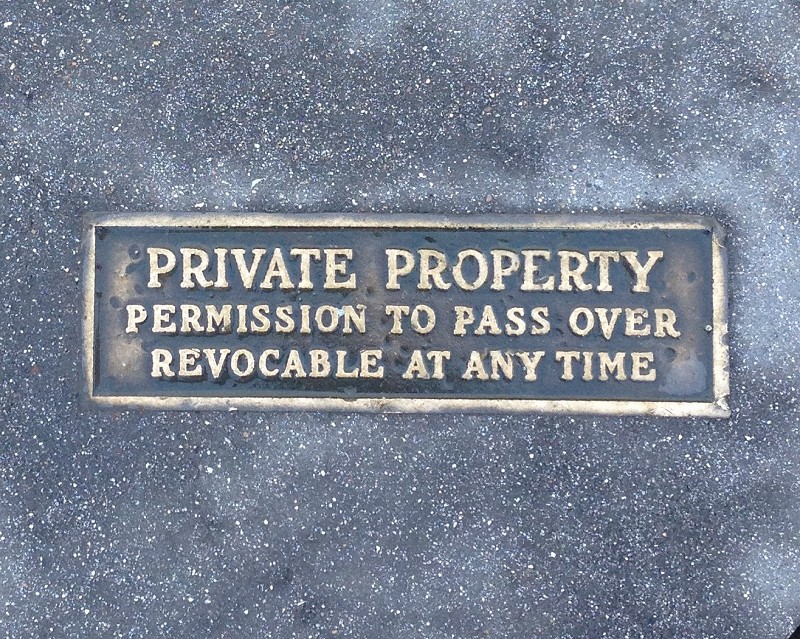
These are all over the place, but you stop noticing them because they make no sense. Several of these plaques surround the Emporium/Sears/Uber building.
uber-license

From looking at the material for an online real-estate course, I gather that property owners post these notices to prevent people from encroaching upon their rights by asserting an “easement by prescription.” Shopping malls used to claim that notices like these allow them to prevent people from leafletting, for instance. That got overturned. It seems like overkill, and unenforceable, to treat a sidewalk the same way, but then I’m not a lawyer.

The examples I’ve seen are pretty old. Here’s one from an address on Claremont Avenue.

concrete-license

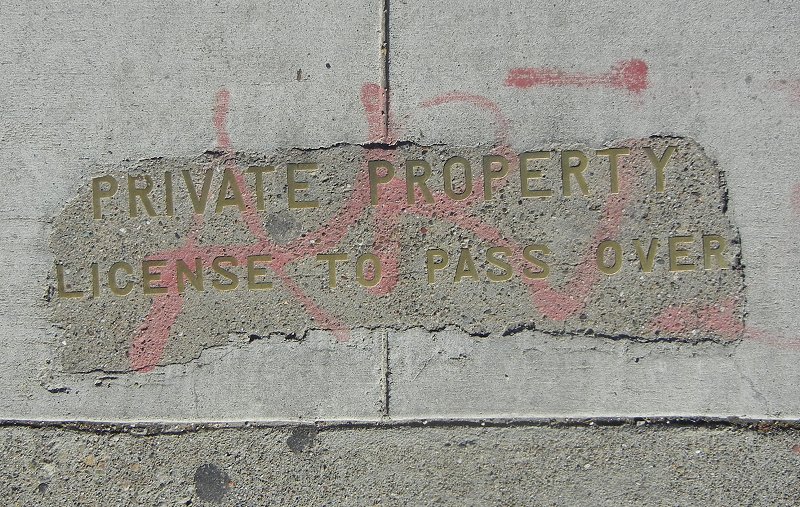
And this one’s in front of the Hutch, on Telegraph near 20th Street.
brass-license

It looks like there wasn’t a third line of text. Maybe the lawyers said this wording was sufficient. Maybe it cost too much for a skilled laborer to hand-set individual brass letters spelling out the whole notice.

Special marks: Oakland sidewalk unions

15 January 2016

The people who left their marks on the sidewalks they made in Oakland were a mix of workers. Some were individuals, and some were small businesses by today’s standards. But unions were there, too, in contention and in cooperation. The American Brotherhood of Cement Workers was the first of these.

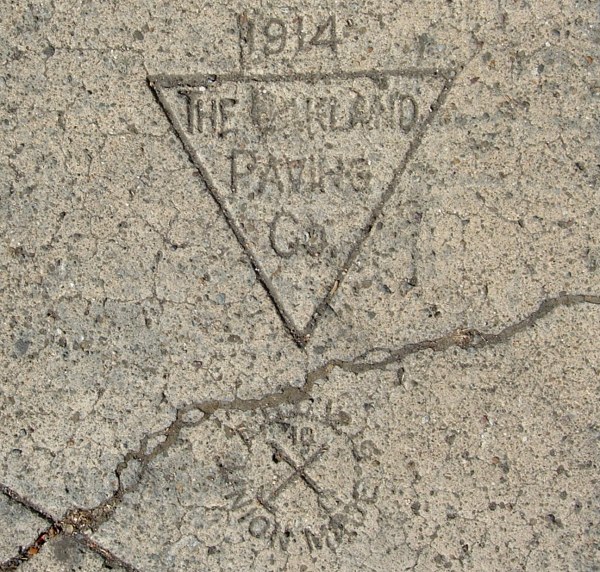
The ABCW’s stamp consisted of a pair of cement worker’s tools, crossed, inside a circle made of the words “Union Made” plus the union’s initials and the local number 19. I’ve photographed four examples in Oakland, all of them accompanying marks by the Oakland Paving Company. The one above, in Berkeley, is from 1913, the one below is from 1914, and this one is from 1913. The number 10 inside the symbol refers to the master finisher.

union-made-oakpaveco

Lincoln Cushing knows more about Bay area labor history than I ever will. His site tells how the ABCW tangled with the Laborers International Union of North America (LIUNA) in 1913. LIUNA prevailed upon the American Federation of Labor (the AFL in the AFL-CIO) to let it poach the ABCW’s members. After that, concrete workers were represented by LIUNA or by the Operative Plasterers’ and Cement Finishers’ International Association, which is now named the Operative Plasterers’ and Cement Masons’ International Association (OPCMIA). I’ve only seen the stamp of OPCFIA Local 594 on Oakland’s sidewalks. (Today OPCMIA’s Local 66 represents the central Bay area and doesn’t do sidewalks.)

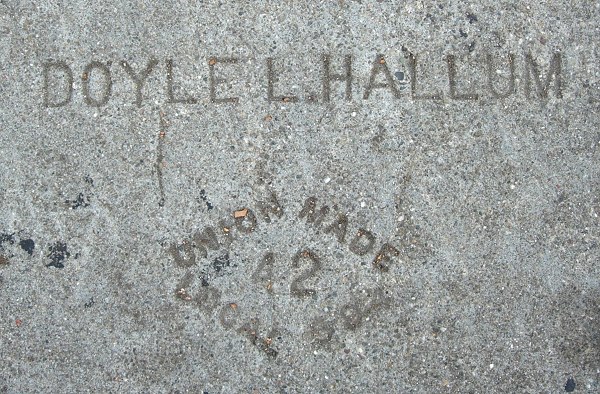
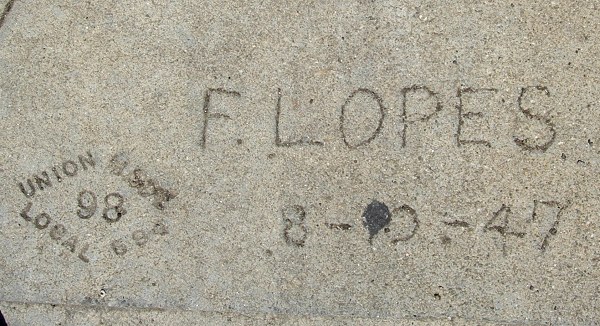
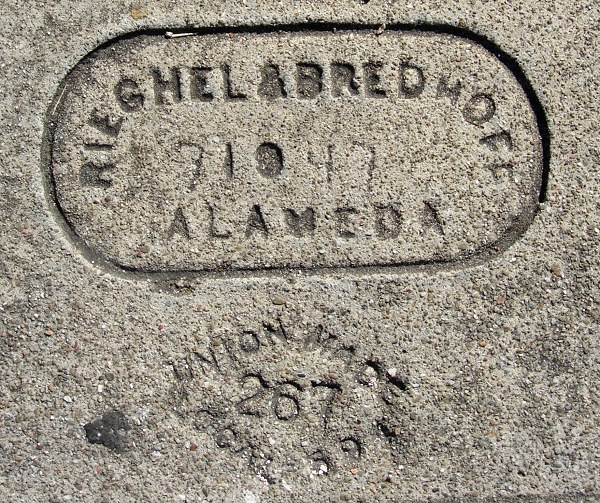
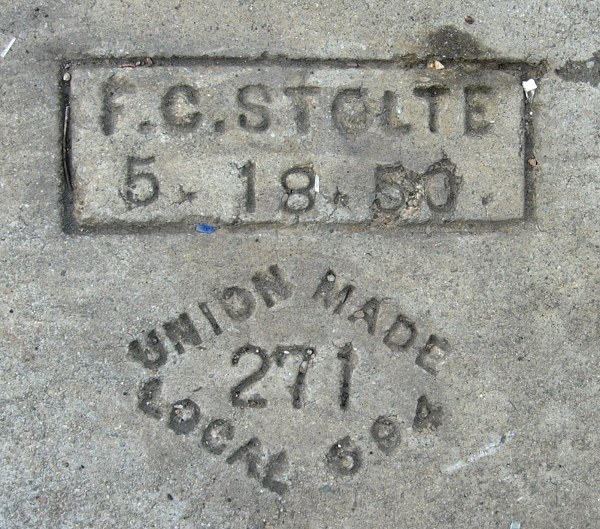
Here are seven different Local 594 bugs. The number inside is that of the master finisher. They’re mainly from the 1940s.

union-made-doylehallum

union-made-steadmanpowell

union-made-lopes

union-made-h-o-mart

union-made-somers

union-made-RnB

union-made-stolte

I did find one other union stamp. It’s somewhere in the Sheffield Village neighborhood — I no longer have the address.

union-made-shef-village

Anyone know more about this one?

I want to end with an apology for not being a better documenter of these. I usually tried to avoid photographing the union bug as I shot the maker’s stamp, so there are surely more of these out there. But I looked at all of my thousands of photos in preparing this post, and I think nearly all of the different union bugs in this city worked their way into my collection.

Granite curbs

8 January 2016

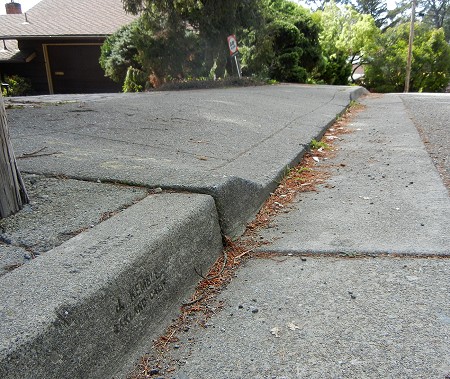
granite-curb

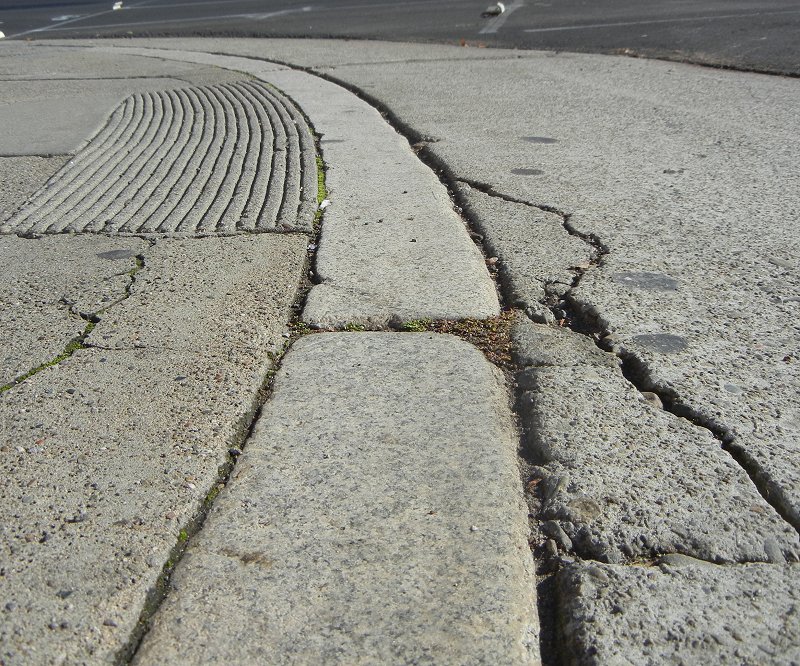
Older parts of Oakland are graced with proper curbstones — carved granite rather than molded concrete. They have the whiff of simpler times, of street trolleys and horse-drawn vehicles. They were made to last the ages, you might say.

Stone has always competed with concrete, with quality and cost both in the contest. Stone, above all, is durable, and it still beats concrete in that respect. But everything else has evolved in concrete’s favor. The skilled labor of stonecutters has waned while the strength and the convenience of concrete have grown.

A lot of downtown curbs are ironclad concrete, an early attempt to protect the curbs from chipping. I’ve never seen a new example, and I’ve seen a lot of places where the steel straps have warped.

iron-curb

Today we’re apparently okay with letting the curbs chip. In any case, chipping doesn’t seem to be a big problem. Concrete is easy to repair.

At the old YMCA building, on Telegraph at 21st Street, the curved granite corner curb appears to be part of the heritage designation.

granite-curve

You probably can’t replace these special-order stones any more. The quarries that made them are mostly long closed. And you can’t carve wheelchair-compliant curb cuts into them, either, which has led to an inelegant design on this corner with a wide concrete apron in the street. The building’s manager told me that a small pipe runs through it for street drainage, but it’s easily clogged. So the stone is preserved, but it’s not well displayed. Meanwhile the opposite corner has a nice new curb cut with the grooved concrete and the knobby yellow patch. Today’s ways really are better ways.

I’d be okay with the city replacing this corner. I wonder what the city does with the old curbstones. They should be recycled, perhaps in the parks.

Early tract markings

31 December 2015

A small tract in deepest East Oakland preserves some very old sidewalks. The stretch of 104th and 103rd Avenues between International Boulevard and E Street — call it Iveywood West — features the following curiosities.

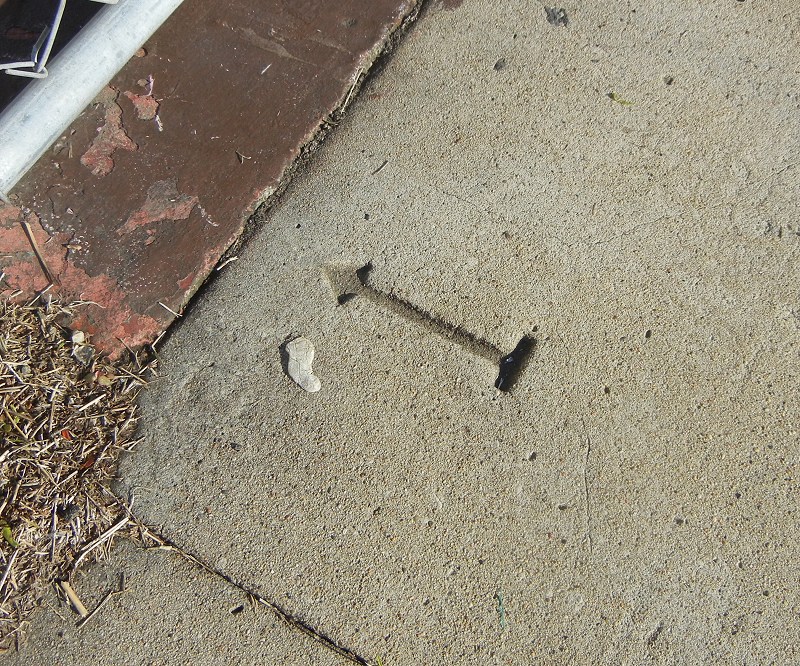
arrow-104thAve1

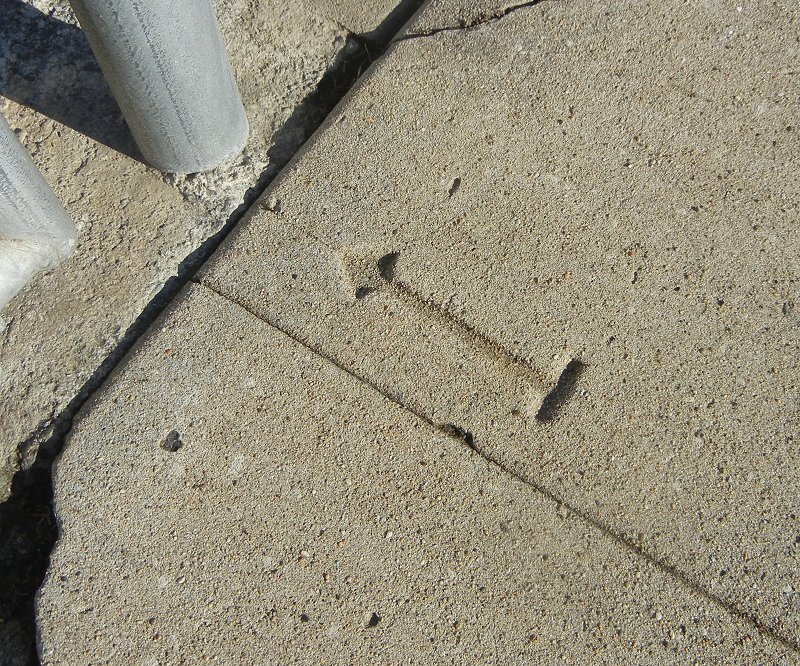
arrow-104thAve2

These arrows in the pavement point away from the street. On the north side of 104th, they appear to correspond to the edge of driveways. On the south side, they don’t. On 103rd they only appear on the south side.

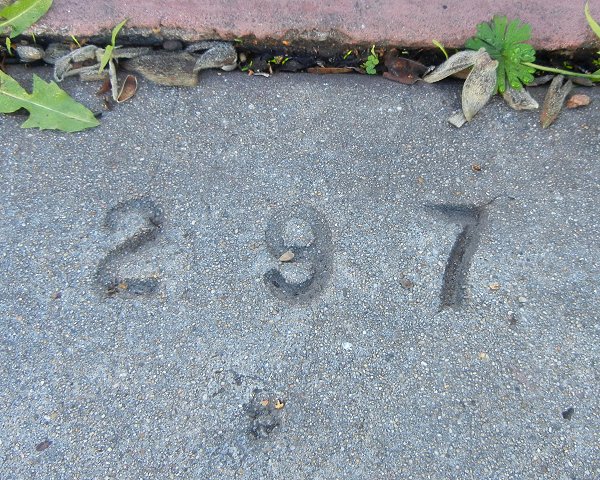
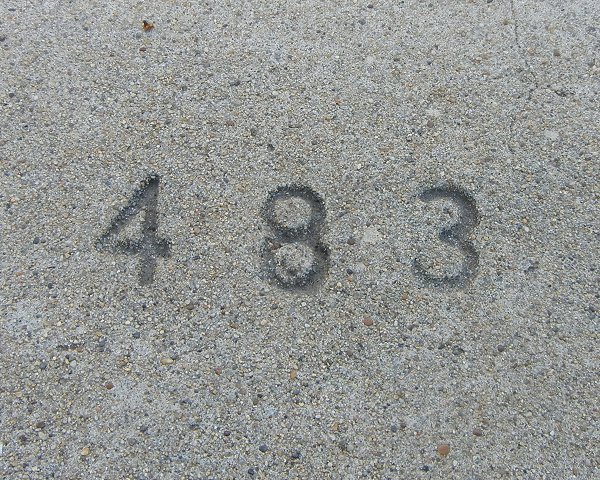
Both streets also have stamped in the concrete what I assume are lot numbers. This is on 104th.

104thAve-lot-no-297

And this is on 103rd. They don’t correspond to the addresses.

103dAve-lot-no-483

The sidewalks are very consistent in appearance. I don’t recognize the maker’s style, so I can’t say who laid them down, but I believe they date from around 1910. The 1912 map suggests that the landowner was Ludovina Ivey. She was Ygnacio Peralta’s daughter and developed large tracts of Oakland near the San Leandro line. (She also owned the undeveloped land now preserved in King Estates Open Space.) Google Maps calls the adjacent neighborhood Iveywood.

I’ve seen lot numbers and arrows in one or two other places, but I can’t recall exactly where. If one of you knows of any, please add a comment.

Another odd thing is the appearance of many of the driveways.

103dAve-driveway

They appear not to have been included in the original sidewalk, but instead were put in shortly afterward by a separate contractor. A few, like this, were made by sledgehammering the curb. Almost none are stamped by their makers, and the workmanship is often poor. I have the impression that the neighborhood was laid out without providing for driveways, under the assumption that ordinary people didn’t own cars.

Oakland sidewalk makers: A century in a graph

25 December 2015

maker-graph

Since my survey of every Oakland street finished, my attention has turned to digesting the results. This histogram presents the number of different concrete workers who left their names on the sidewalks of Oakland during a given five-year period. The number reflects just the presence of their names, not the amount of sidewalks they built. The graph is based on about 90 percent of the city. We can’t take its significance very far, but it’s still interesting.

Beyond the bluntness of the conceptual tool, we have to keep in mind what the data misses. Many concrete workers did not date their work. Presumably most of the oldest marks have been paved over. Of course I’ve missed many of the most recent marks put in place after I’d passed by. No doubt some marks were obscured by fallen leaves, parked cars, poor lighting conditions etc. when I visited the street. My attention surely lapsed now and then. Contractors’ practices and city policies have changed. Dealing with that stuff is why historians go to college.

That said, the bones of the data are pretty clear. The Era of Artisanal Sidewalks spanned some momentous times: the post-1906 earthquake boom, the Roaring Twenties, the Great Depression, World War II and the Great Acceleration that followed, which is not in the textbooks yet but surely will be soon. I look forward to your thoughts.

I prepared this graph for a talk to the Oakland Heritage Alliance in January 2015. (The Alliance website lost its past in a redesign, so as the lady said there’s no there there.) The talk was fun; I could give a new version to your organization.

Standout Streets: Castle Park Way

18 December 2015

kemble-castleparkway

Castle Park Way is a little loop hidden off of Castle Drive, at the southern end of the Piedmont Pines neighborhood. All the concrete work was done by John R. Kemble, who did very good work all over Oakland from the mid-1920s until roughly 1941. When I surveyed this street I was struck by its unity, in which the homes and landscaping take part as well as the paving. And all this time later, it still has great integrity.

Standout Streets: Lawlor Avenue

11 December 2015

WPA-lawlor-ave

Welcome to phase 2 of this blog. I’ll be posting every Friday morning from now on, so add this to your feed, or subscribe, or whatever you do to keep up with the cool new stuff.

Oakland has lots of streets that are special for one reason or another. As I threaded its labyrinth I wished I could show them to you, but didn’t want to interrupt the parade. Now I’m getting around to them.

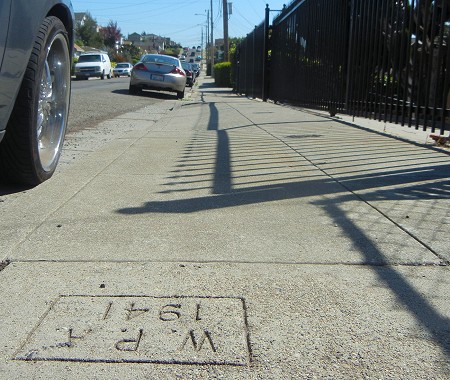
The Work Projects Administration or WPA gave millions of skilled and unskilled people jobs during the Great Depression. Their work added a great deal to Oakland’s cityscape, not least in its sidewalks. Lawlor Avenue seems to have been entirely paved by WPA workers in 1941 — curbs, sidewalks and driveways. It has an unusual unity of appearance for that reason, and the work is almost unmarred even 75 years after the last trowel was washed dry. In that respect, it’s a heritage street.