Sidewalk maker: Joe B. Silva

30 June 2017

Joe B. Silva was born in the Azores and later became part of the East Bay’s thriving Portuguese community. I know little of his life because my sources are limited and because “Joe Silva” is an extremely common name. I just know he was born in 1876 and died in 1962. His first wife, Mary Rose, bore seven children and died in 1938. She was to be buried in St. Mary’s, but FindaGrave has no record of her or Joe. His second wife was named Gertrude. Both were Portuguese.

The Portuguese have a long and complex history in America, as summarized in a timeline from the Library of Congress. The same is true for California. There were divisions between the continental and Azorean/Madeiran Portuguese, who came here at different times for different reasons. The Oakland Tribune named Silva as the Grand President of the “Protective Association Union Madeiran Society” (Associação Protectora União Madeirense do Estado da Califórnia, or União Madeirense for short), which was founded in 1913 in West Oakland. A continental Portuguese society was founded here four years later.

Silva was first listed in the Oakland business directory as a cement worker in 1922, living at 3408 E. 18th Street. However, his first sidewalk stamp looked like this:

I’ve seen only three of these in Oakland, one of which is dated 1922. Why did such a proud and prominent Azorean use an Anglicized name? There were Portuguese concrete contractors before this, like the Azorean Construction Company (1909), Francisco Comachao (1912) and M. Gonçalves (1914), but most Portuguese names did not emerge on our sidewalks until the mid-1920s and later. Be that as it may, Silva soon came out with a new stamp using his real name. The earliest of these I’ve found is from June 1924, and the latest is 1937.

Oakland directories from 1923 to 1940 listed Silva at 2209 E. 15th Street.

He may also have collaborated with Albert Moniz, who hand-drew several different “Moniz-Silva” marks without dates, but I think that was more likely the much younger A. J. Silva.
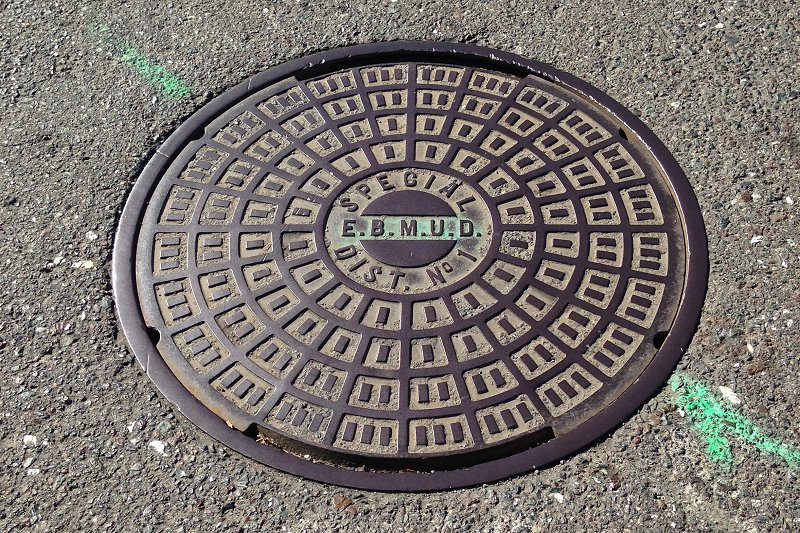
EBMUD Special District No. 1

23 June 2017

These handsome access covers are few and far between. They’re part of East Bay Mud’s sewage service.

Special District No. 1 was established in 1944 by elections in six East Bay cities and started operating in 1951. It serves a smaller area inside the region where EBMUD provides water service, as shown on this map from the utility’s site.

Wastewater from nine East Bay cities flows from city sewers to the District’s interceptors — large pipes that carry the water to the treatment plant near the Bay Bridge. From there the treated water goes into the Bay.

1939 – WPA (Dimond Canyon)

16 June 2017

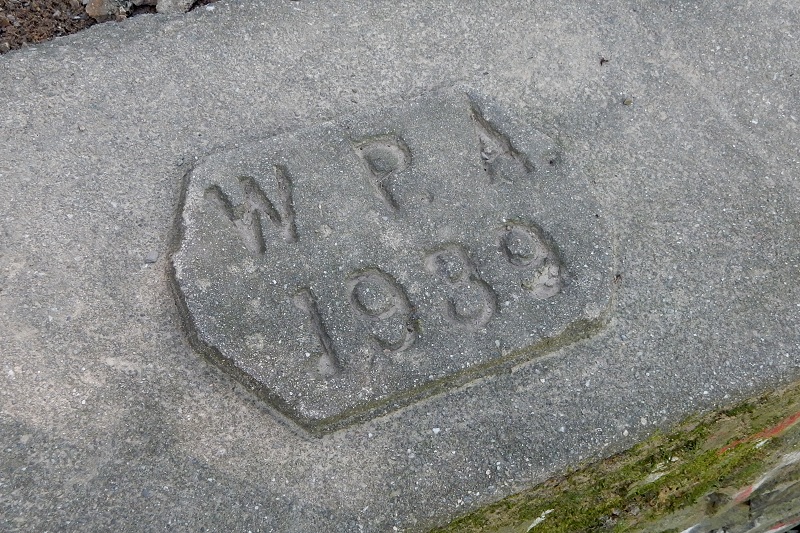
The Works Progress Administration employed hundreds of thousands of people during the Great Depression. A lot of those works involved concrete, and many well-made sidewalks and gutters around Oakland bear the “WPA” stamp from 1939, 1940 and 1941.

In Dimond Canyon, WPA projects were funded to remove landslides, build fire trails and run a sewer line down the bed of Sausal Creek. Finally, the WPA paid crews to put in a bunch of concrete channels and culverts for flood and erosion control. That was in 1939.

A lot of that work has been undermined by erosion. Eventually the stream will have its way again, unless the authorities find a need there and fill it again.

Sidewalk maker: P. M. Henning

9 June 2017

Paul Max Henning was born in 1886 in Giebichenstein, Germany. He served in the German navy for three years and then emigrated to America.

As of 1917, he was a PG&E employee living in Sacramento, where he requested an exemption from the draft, claiming a wife and father as dependents. His registration card recorded him as a man of medium height and build with light-blue eyes and light-brown hair. He also described himself as a German citizen.

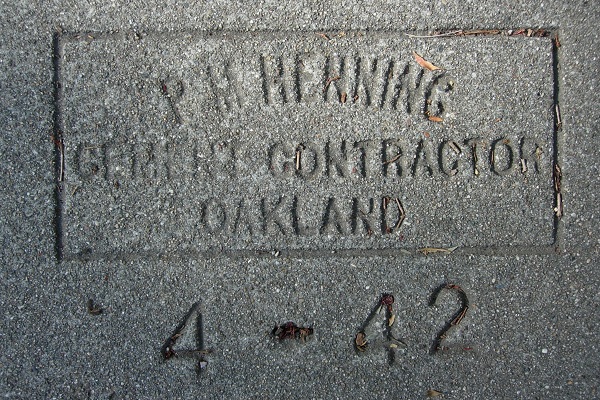
By 1921 he was living in Oakland, working as a clerk. The 1924 directory was the first to list him as a cement contractor, living at 726 15th Street. The next year he was at 5228 Lawton Avenue. The oldest mark of his I’ve found is from 1927. He ran ads in the Oakland Tribune in the late 1920s that would point readers to the address of a recent job, so you could go look at it or talk to the proud new homeowner. His mark was always sturdy.

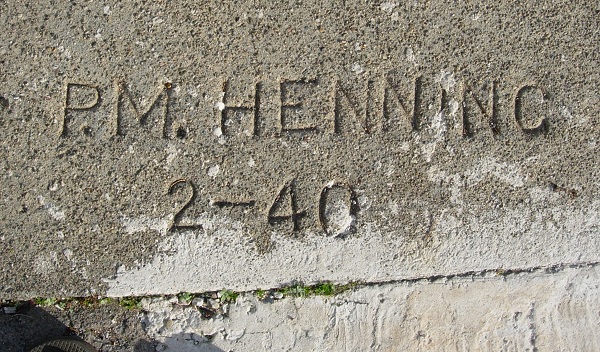
His mark never changed, with one exception — this single example from 1940.

In 1942 he gave the draft board an address at 333 Park View Terrace.

The latest date of his I have found is 1949.

Henning died in 1975, and his remains are encrypted in Mountain View Cemetery.

Union concrete masters IV

2 June 2017

Since posting my last set of OPCFIA union bugs from Local 594, I’ve found a few more.

I’ve profiled Nat Lena.

This one, you’ll know by the horseshoe and date, is from Ensor H. Buel. I’ll put together his story soon. But this shows what happens to so many marks as the years pass. When the parking-meter post at upper left was installed the workers smeared mortar on Buel’s mark, then more damage occurred when it was cut down, and sawcuts on the right were the latest insult.

After years of observing our sidewalk stamps, I notice when they disappear. Some are wiped out entirely as a whole lot is resurfaced, and others die gradually by a thousand cuts.

SPSD

26 May 2017

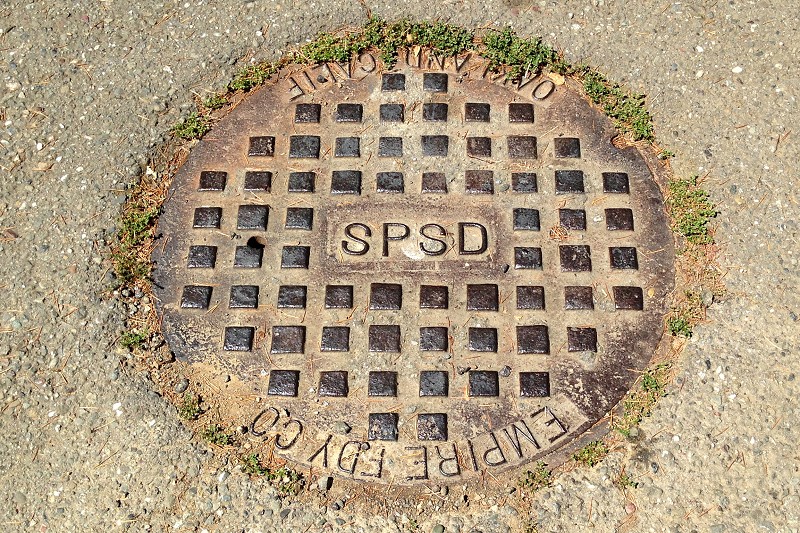
This utility hole cover sits on Keswick Court, on the south side of Shepherd Canyon. My searches for any information about SPSD have drawn a total blank. It might stand for the San Pablo Sanitary District, which existed from 1921 to 1978 when it became the West County Wastewater District. Maybe whoever installed the sewer line down Keswick bought SPSD’s outdated hardware, or the Empire Foundry had a stack lying around. I mean, who would care?

I have few other clues. Keswick was shown as unpaved on the 1947 topo map and paved on the 1959 edition, so the lid may date from the fifties. And yet Beaconsfield Road, just up the hill, contains a water main cap from Peoples Water Company, which ceased to exist in 1914. I can only assume that EBMUD used old PWC inventory when it pushed water service into the area.

For more clues, I must rely on the kindness of my readers.

Sidewalk maker: J. C. Estey

19 May 2017

The worn, unobtrusive stamp of J. C. Estey can be seen wherever the pavement is oldest. But this man left a rich record.

John Crowell Estey was born in 1842 in Londonderry, New Hampshire. Some sources spelled the family name “Esty.” He served in the Union Army during the Civil War. A letter he wrote to his parents in 1865 is extant, in which he told them of the death of his brother Charles in a Confederate prison. He added, “It won’t do for me to live single much longer. In 1868 if I live and nothing happens before, then I think I will take a wife.”

The 1870 census listed him as a farmer, married to the former Harriet “Hattie” Evans and father of two-year-old Minnie, living in Manhattan Township, Kansas.

By 1876 he was registered to vote in San Francisco. In 1878 he was awarded a patent on a scheme to extract power from inside a water line.

As of 1879 Estey had moved to Oakland. The 1880 census listed him as a coal dealer with three children, including a son Charles. In 1882 the Daily Alta California reported that he had been elected Assistant Superintendent of the Central Mission Sunday School in Oakland. That same year the Oakland Tribune reported that he was moving his coal yard to 16th and San Pablo. In 1886 he was listed as a farmer in the rolls of the State Anti-Riparian Irrigation Organization of California, living at 535 17th Street, where the Oakland Ice Center is today. He was listed as an officer in the Civil War veterans association that same year.

Voter records show that between 1892 and 1896 he relocated to 458 E. 17th Street in East Oakland. In 1896 he was active in the People’s Party.

The 1900 census listed him as a cement contractor, and so did the 1901 Directory of American Cement Industries. He advertised in the Tribune in 1901 as “Contractor for all kinds of Cement Work, Concrete and Stone Walls.” This is significant because it pins him down as one of Oakland’s earliest sidewalk makers. It is conceivable that some of the pavement bearing his mark dates from before 1900. However, I have found only a few dated examples, all from 1912. Baker Street, in the Golden Gate neighborhood, has a bunch of them.

Estey died in 1919. I have no information on his gravesite, but he qualified for a Civil War veteran’s grave.