This rarity sits in the street where Highland and Wildwood Avenues meet, in Piedmont. Port Chicago was the former town just west of Bay Point where the terrible explosion of 17 July 1944 occurred. The Baypoint Iron Works existed at that time, but I have found no information about it beyond that fact. The town was taken over by the government and demolished in 1968.
Baypoint Iron Works access cover
20 October 2017Sidewalk maker: A. Soda
13 October 2017Andrea Soda was born in southern Italy, near Provenza, in 1877, and came to America in 1907 with his wife Margherita (nee Argenta). He was listed in the 1908 directory as a cement worker. By 1912 he was living at 1137 65th Street, the address shown in his sidewalk stamps, and was the father of three children. He went by the name Andre or Andrew, and his wife likewise was called Marguerite or Margarita.
His draft form from 1917 described him as a man of medium height and build, with blue eyes and dark hair and not yet a naturalized citizen.
I have documented his marks from 1913 to 1937, all using the stamp shown above. The Tribune records him bidding on various jobs under the name A. Soda Company from 1928 to 1931 and A. Soda & Son (or Sons) from 1932 to the 1950s. (His sons were Yster Charles (“Y. C.” or Chester), born in 1908, and Stephen, born in 1912.) The company’s contracts grew in size over the years and came to focus on small bridges around Northern California.
On 5 November 1936, the firm was retimbering the old high-level tunnel above today’s Caldecott Tunnel when a collapse killed one of his workers. The paper quoted Y.C. as saying the firm had never, not once had such an accident before, and also noted that his workers kept photographers away from the scene. By this time Andrea had moved to Sacramento Street in Berkeley, with Chester still living at the old homestead.
By the 1940s Andrea had retired from the Soda firm and was running a liquor store at 6324 San Pablo Avenue. He died in 1948. Several family members, including Margherita, are entombed in a family crypt at Holy Sepulchre Cemetery in Hayward, but I can’t tell if he’s there too.
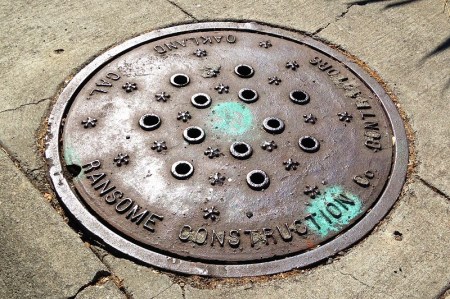
Ransome Construction Company access cover
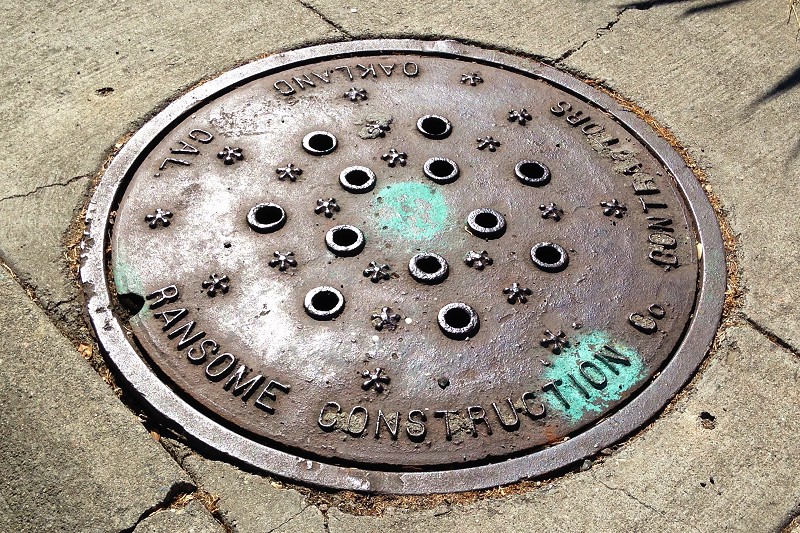
6 October 2017When I featured the Ransome Company here a few weeks ago, that post showed the firm’s various sidewalk stamps. But they also made steel things — at least, they made access covers. This one, on La Salle Avenue in Piedmont, is really pleasant to look at.
Which point is the top?
Access covers are typically busy with “treads” and symmetrical in pattern. The treads are mandatory (for traction, cleanliness and protection against wear), but symmetry is just an aesthetic preference. Back in geology school when I took my mandatory semester of crystallography, we were trained to look at patterns of dots, say, and detect all the ways they were symmetrical. Some arrangements of atoms in a crystal, or the faces of a crystal, look the same after you rotate them by 180 degrees, others after rotations of 120 degrees — or 90 or 60 degrees. Or if you imagine placing a mirror, on edge, across the center of the pattern, the reflection may exactly duplicate the side behind the mirror — that would be mirror symmetry. Every crystal on Earth exhibits one or more of these basic symmetries.
So I often find myself looking at the symmetry of an access cover to determine up and down. Looking only at the sets of holes, seven and five, at the center, you can picture two different lines running through the center that would split them into mirror-image halves. One line would run through the two blue paint spots; the other, at right angles to it, would run from the R in Ransome to the second T in Contractors.
Of course, the words around the rim are symmetrical across the first line, so that rules out the second. That would put the top of the lid between “Oakland” and “Cal.” Ransome was real particular about those five and seven holes.
But then there are the stars. They would be symmetrical across the first line too, except that a single star is missing. The designer of the mold either overlooked that, or decided to mess with our heads. (I think someone at Phoenix Iron Works played the same trick.)
Now PG&E and Great Western Power Company were both very meticulous about their symmetry, but Ransome’s access covers were just a little funky.
Union Water Company
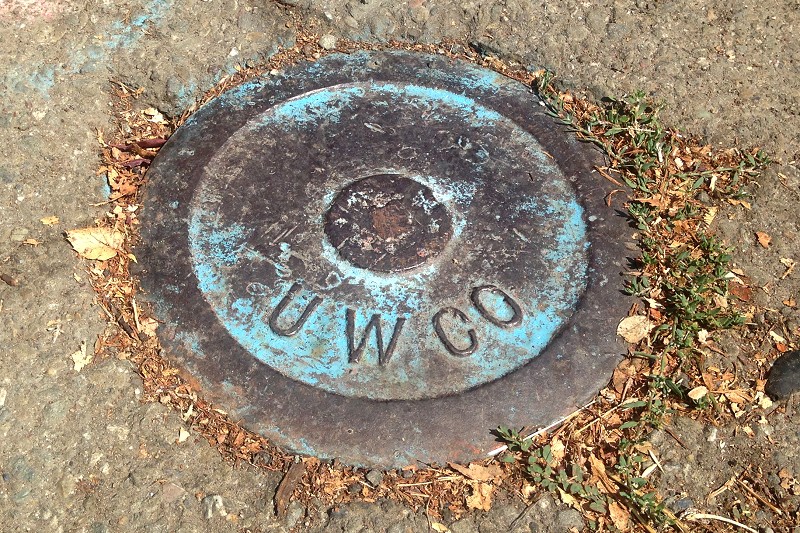
29 September 2017The Union Water Company was a short-lived private water provider that served a territory from Richmond to San Leandro starting in 1910. As of 1916, it got its water from a network of 103 wells near the Bay shore between Newark and San Pablo, but mostly around 98th Avenue. It was acquired by the East Bay Water Company in 1921.
Examples like these, from the neighborhood of Codornices Park and Francisco Street at Shattuck in Berkeley, respectively, must be quite rare.
Standard Gas Engine Company
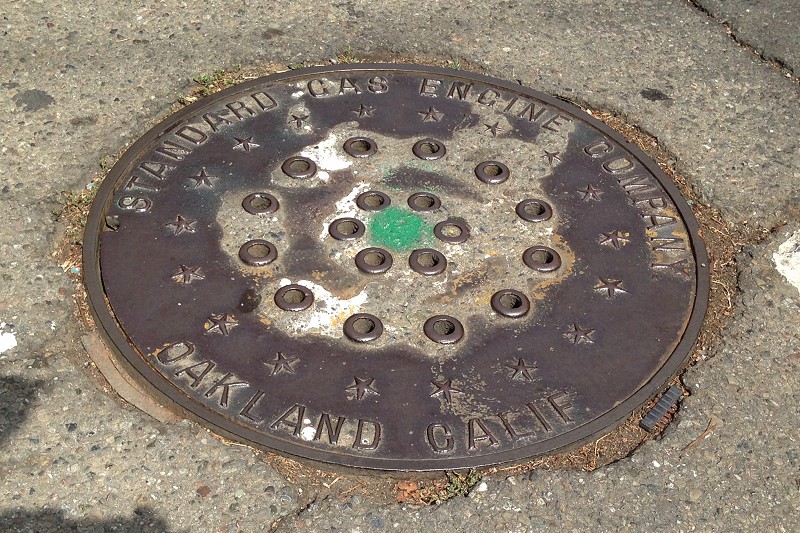
22 September 2017The Standard Gas Engine Company was a major player in the Bay area, a center of innovation that dominated the Pacific coast in pioneering internal-combustion engines for marine applications. It was founded around 1900 but relocated to Oakland in the wake of the 1906 earthquake, on property it had fortuitously leased from the Port of Oakland a month earlier.
It thrived at this location, on the shore of Brooklyn Basin at the foot of Dennison Street, where ships could have their engines installed or repaired at the company’s wharf. The Standard Gas baseball team was part of the Industrial Intercounty League in the mid-teens. The plant expanded in 1916 after the acquisition of the Corlis Gas Engine Company. In 1917 the Tribune reported that the company was paying its employees a quarterly dividend from its profits. (Labor activists regard this kind of “company union” as a typical management trick to prevent real unions from forming.)
In the 1920s the Ford Motor Company contracted with the company to build parts for its products, such as the new Hamilton transmission for the Fordson line of tractors. In 1933 it began making engines for the American Diesel Engine company. The last reference to the company in the Oakland Tribune was in 1942.
Standard Gas Engine made stationary engines as well as boat and vehicle engines. Perhaps one of those, possibly a water pump, lies beneath this access cover.
Sidewalk maker: George McConnell
15 September 2017George Caswell McConnell was born in northern Ireland (records conflict on the exact place) in 1889. He married Isabelle Gibson Brown, a native of Dykehead, Scotland, in 1908 and emigrated to America in 1911. Their son William George was born in Chicago in 1912. A second baby, George, died in infancy in 1914.
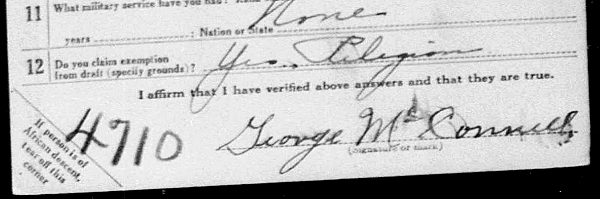
His World War I draft record described him as tall and slender, with brown hair and eyes. He was working as a streetcar conductor in Chicago. His citizenship status was “declarant,” an interesting concept to consider in light of current events, and he claimed a religious exemption to the draft (not an easy thing at the time).
McConnell first appeared in the Oakland directory in 1923, the same year the breakup of his partnership with John Ogden was announced in the Tribune. The directories listed him as a cement worker, placing him and Isabelle at 2315 E. 27th Street (1923-25), 4070 Santa Rita Road (1926-27), and 2221 E. 27th Street (1928-30). In 1930 he was listed as an engraver for the jeweler Andrew Raust. His final appearance was in the 1933 directory, as a cement finisher living at 2637 23rd Avenue. This is 4070 Santa Rita Road, a charming street.
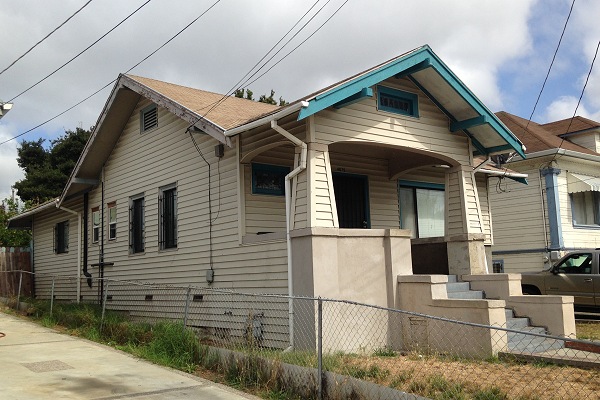
And this is 2221 E. 27th Street. Working people here could live well then.
Few of McConnell’s sidewalk marks bear dates. One from 1927 is hand-written. A few 1928 dates survive, like this one at 2215 E. 29th Street.
He made these one letter at a time, as evidenced by this botched mark.
As of 1931 he had adopted a more professional stamp.
At some point he used this arc-shaped stamp, but I have seen none with dates.
McConnell died in 1933 and is buried in Evergreen Cemetery.