Sidewalk maker: Anthony Anaclerio

15 December 2017

Anthony Edwin Anaclerio (1904-1981) was born in or near Palermo, Italy, and christened Antonio. He immigrated in 1905 with his mother “Rosy” and two siblings, preceded the year before by his father “Frank,” and the family showed up in the 1920 census living in Berkeley with two more children born in America. At that time “Tony” and his older brother Charles worked at California Foundries with their father, and his mother was a clerk-typist at a syrup factory.

He rose in the world to become a contractor working in the fresh air, and sidewalks stamped with his name are found all over Berkeley, dating from the 1950s and 1960s (thanks to Hannah Berman’s long-inactive Sidewalk Secrets blog for that documentation). And Lincoln Cushing has recorded another example in Albany.

I have not found an Anaclerio mark in Oakland — the photo here is from Los Angeles Avenue in Berkeley — so ordinarily I wouldn’t record it in Oakland Underfoot. But his work inspired David Woeller and Peter Tracy to write “Mr. Anaclerio’s Sidewalk,” a song about a sidewalk maker and the pavement that’s his posterity:

There’s a sidewalk in North Berkeley that moves up ‘n’ down just like a roller coaster ride,
Roots of the camphor tree are pushing it up from the underside
The people in the neighborhood have learned where to step high and low
On the sidewalk built in 1954 by Mister Anaclerio

While I can supply a few bare facts about guys like Anthony Anaclerio in a blog like this, it takes a poet’s song to evoke their living lives. And my few notes here aren’t really that important, any more than Anaclerio’s name, chosen for its rhyme. The point is that he’s an emblem of hundreds of sidewalk makers who helped build our East Bay by hand, square by square.

I can see him bending to his labor in the early morning East Bay fog
One hand on the floating trowel and one eye watchin’ the prowling dog
He knows nothin’ lasts forever and especially the monuments of man
And the pride in his eye is the completion of the labors of his hand

That was their craft and their trade. I bow to them wherever I walk. And I keep in mind that their work may outlive mine.
Sidewalk maker: Arthur G. Moniz

8 December 2017

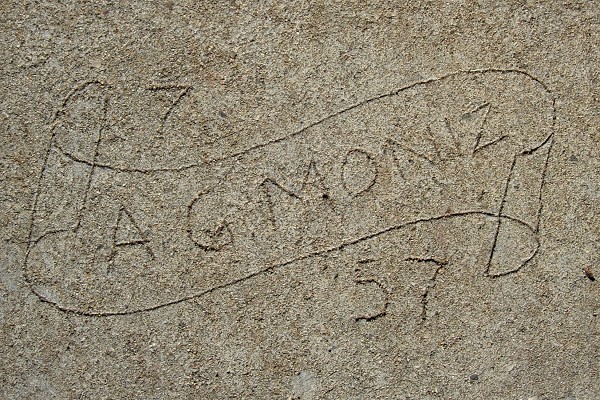
Arthur G. Moniz (1911-1973) grew up in East Oakland, the son of Hawaiian parents of Portuguese ancestry. His father George was a shipbuilder, and at age 19 Arthur was listed in the 1930 census as a cabinetmaker. In the 1940 census he was listed as a cemetery caretaker, married to Rose (another Hawaiian native) and the father of Arthur Jr., born in 1939. Various records have him as a mariner in 1934, a shipbuilder in 1935, an ironworker in 1936, 1938 and 1940, a laborer in 1939, a shipfitter in 1944 and a cement contractor in 1967.

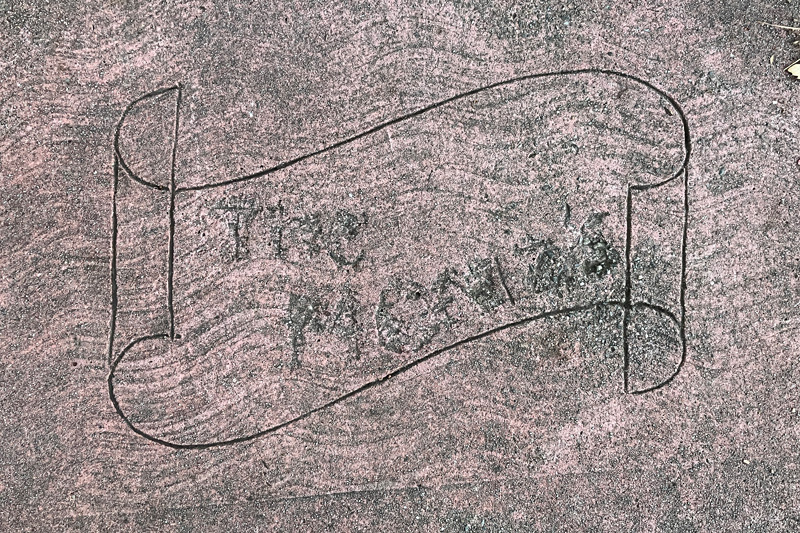
He never used a metal stamp. His trademark was the hand-drawn scroll; I have examples dating from the 1930s into the 1960s. I have two examples from the 1950s consisting of the scroll with “Moniz + Moniz” inside. Perhaps Arthur Jr. helped, or a relative. He also left hand-drawn marks consisting of his name and various partners:

Moniz & Johnson (perhaps R. W. Johnson or R. E. Johnson)

Moniz & Chaves (probably L. F. Chaves)

Andrade & Moniz (William Andrade)

Moniz-Silva-Chaves (there are several possible Silvas)

J + J & Moniz

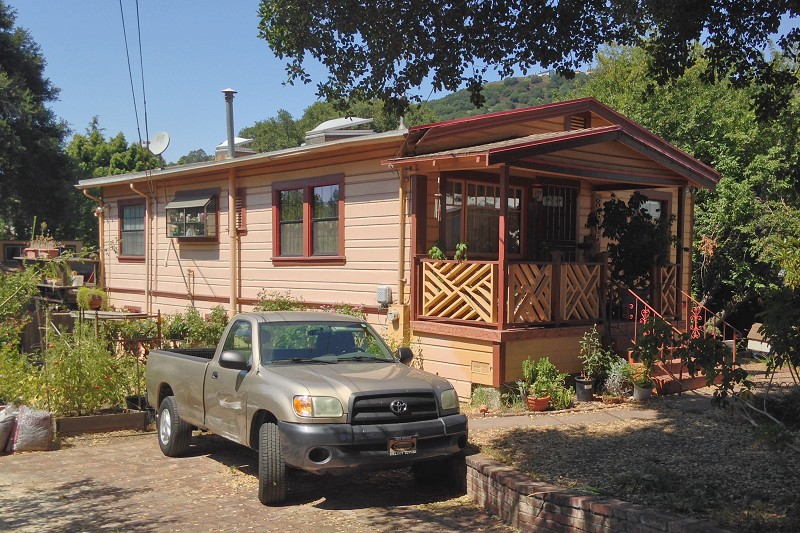
He lived at several addresses in East Oakland, but I think of his home being at 3955 Burckhalter Avenue, where he lived in the 1950s.

It’s because of this panel at the front gate.

I wish I knew more about him; I think he must have been a character.

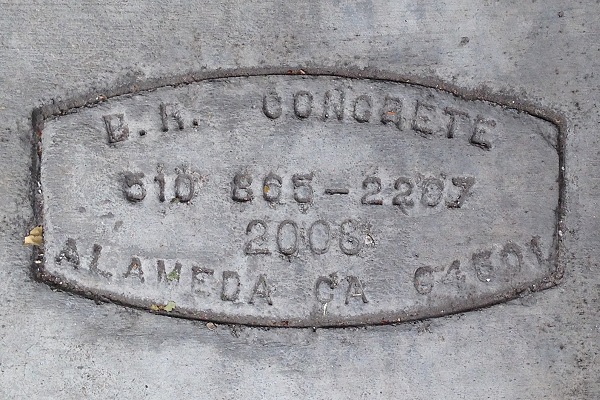
2008 – B. R. Concrete

1 December 2017

Highland Way and Highland Avenue, Piedmont

This is on the floor of the little bus station where the 33 line pauses.

As I push into Piedmont, I hope to find a few marks to include in Oakland’s compilation. This is the first, but I don’t think there will be many.

In other news, I still have not found a mark from 2017 (still true as of 4 April 2018). That’s pretty unusual, so if you have seen one please add a comment and tell me where it is.

BART

24 November 2017

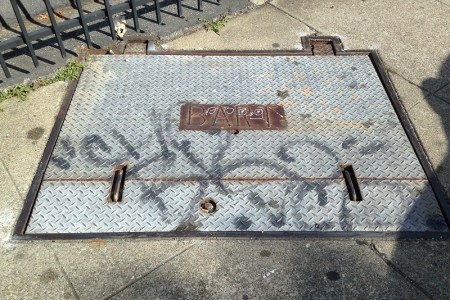
North of the 19th Street BART station, the tracks curve left and emerge on the north side of 23rd Street. This is one of two access covers on 22nd Street, right next to the parking structure, that lead into the underground. I never really noticed them until one day I heard a train go by down below. Haven’t heard one since.

Perhaps there are other examples elsewhere in the system. Let’s keep track here in the comments.

Tessellations in concrete

10 November 2017

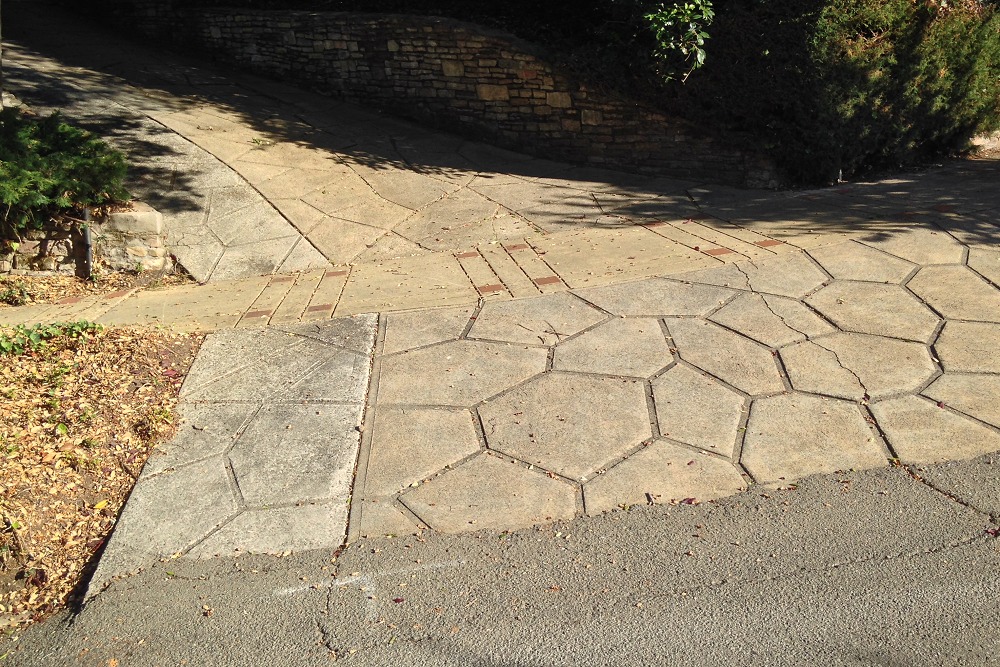
A tessellation is a set of polygons that fills a plane without gaps or overlaps. Pavement makers often draw grooves in patterns like this example from Piedmont; I think one reason is to help the concrete break unobtrusively, along the grooves, rather than spiderwebbing all over a nice clean driveway. Another reason would be to help out the next worker who has to patch or repair the job by enabling them to cut the old concrete neatly. But mainly I think it’s just to show artisanship and decorate something utilitarian.

As a geologist, I look at this and infer a sequence of events. First came the sidewalk, installed by the developer. Then came the main part of the driveway, where the concrete worker tried to tie the tessellation to the divisions in the sidewalk and also tried to match the sidewalk’s color. Then came the worker who widened the driveway. He exercised less care in matching the colors, and less creativity in drawing grooves. Finally came the asphalt.

I also like the pattern of stones in the wall behind the driveway. Wallmaking is a whole nother expert art.

Here’s another example, also from Piedmont, showing the styles of two artisans.

Mathematicians don’t care about haphazard tessellations like these. They’re fascinated by more challenging tessellations with some degree of order, or tessellations that can extend to infinity or wrap around curved surfaces and so on. You can get a dizzying taste of the subject at Wikipedia.

Polygons, by definition, have straight sides. Many sidewalk makers cover their work with curved grooves, and some time I’ll post a few examples. Those might conceivably be called tessellations, but I think I’ll just call them space-filling exercises.

American Brotherhood of Cement Workers

3 November 2017

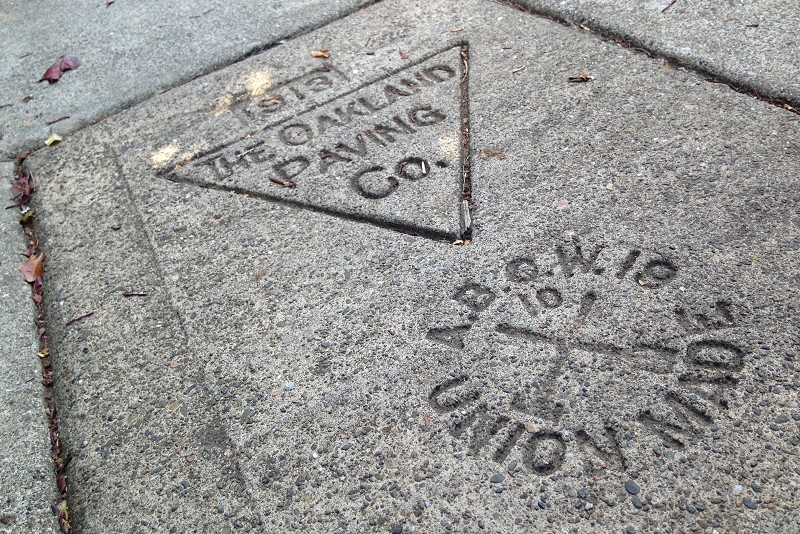
I know I’ve talked about the A.B.C.W. before — read that post for the living connection to today — but this week’s post is just to record a splendid example of the sidewalk stamp, in Berkeley at the corner of Shasta and Tamalpais Roads.

The sidewalks paved by the Oakland Paving Company’s union workers, everywhere I’ve seen them, are second to none. A hundred years old and they’re strong as ever. And the design shows such pride. A hundred years from now the concrete being poured today might match this old stuff in strength, but the new sidewalks will never match the old ones in character.

Sidewalk maker: J. O. Adler

27 October 2017

John Olaf Adler was born in Sweden in 1857 and emigrated to the United States around 1880. He soon made his way to the thriving port city of San Francisco, where he became a citizen in 1886 and married Helena (Lena) Nilson in 1887. They were to have two daughters, Hulda and Mamie.

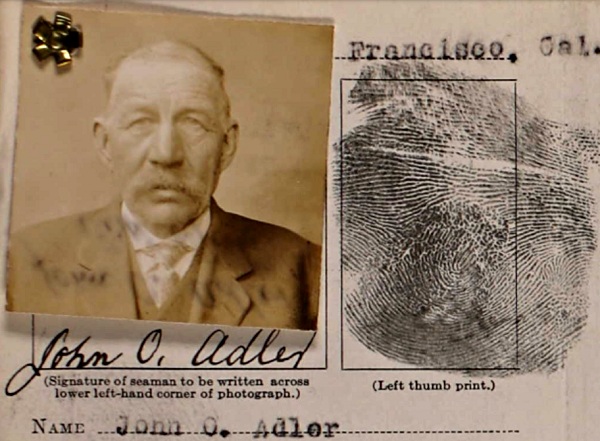
He was a career seaman, mentioned in the Call or listed in the San Francisco directories for 20 years as a ship’s officer on many different steamers serving the west coast ports: the San Vicente in 1887, the Point Arena in 1891, the Eureka in 1896, the Del Norte in 1899, the Celia in 1901, the Coquille River in 1905 and the Greenwood as of March 1906. He kept up his master’s license as late as 1919, when this photo was taken (thanks, Ancestry.com). He had blue eyes and tattoos on both forearms.

By 1896 he had moved his family across the bay to the town of Lorin, which became part of Berkeley soon after. The Adlers lived at 3040 Adeline, where the Ashby BART station sits, from 1900 until his death in 1926.

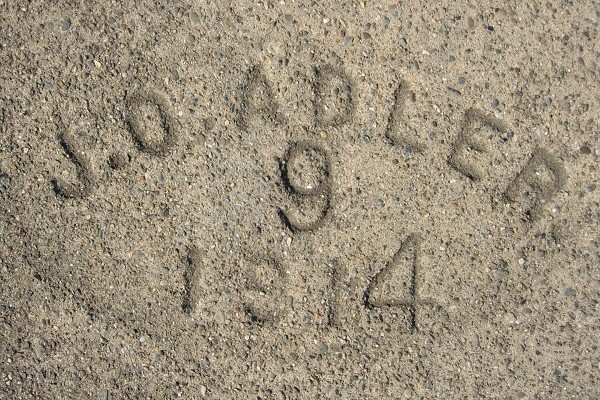
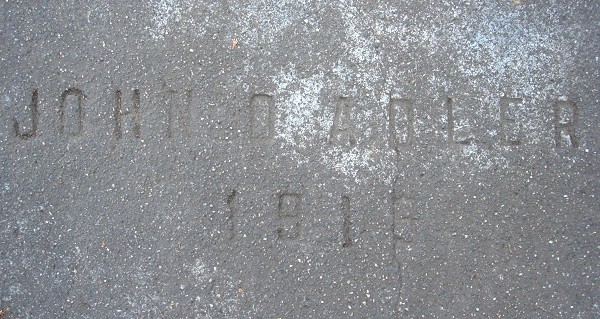
Around this time he got into the concrete business, according to the city directories. I’ve recorded his stamp in Oakland with dates from 1910 to 1916. Presumably other years are preserved in Berkeley. All of them look like the example above, except for this outlier from 1915.

I suspect, but cannot yet confirm, that he was the Adler of Adler and Peterson, the firm that left Oakland’s oldest surviving sidewalk stamps (from 1901 and 1907).

John and Lena Adler are buried at Mountain View Cemetery. She died in 1924, and it appears that her gravestone was moved on top of his when he died. He had remarried by the time of his death, and Anna survived him.