
737 Park Street, Berkeley
737 Park Street, Berkeley

1008 Channing Street, Berkeley
Citragno-Indelicato stamps are rare. I’ve found only a handful, dated 1924 to 1927.

2741 California Street, Berkeley
As I expected, Berkeley has more C. B. Burnham stamps.

1002 Channing Street, Berkeley
There are more of these nearby at 936 and 840 Channing.
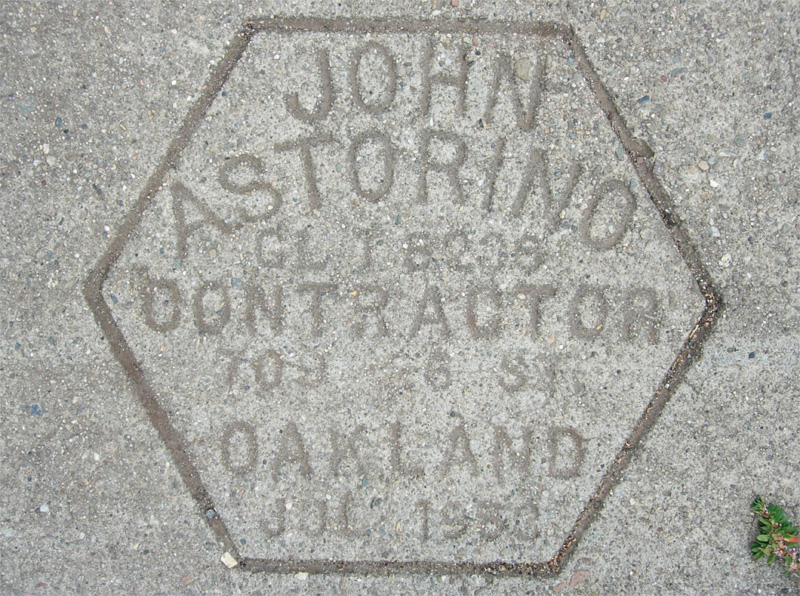
John Astorino (1891-1982) has a sparse record but a familiar story among Oakland’s concrete contractors. He was born Giovanni Astorino in San Giovanni in Fiore, a town at the foot of Italy. He emigrated to Utah in 1923, after his father died, and in 1925 married Caterina Fratto (1903-1978), another native of San Giovanni in Fiore. He worked in the coal business at the time. Eventually they had eight children. It appears that they moved west after the war. The 1950 census states that two of their sons were concrete workers, who presumably worked with him. He later moved to Dublin and died there.
Astorino stamps are usually light and rarely show all the characters, including the phone number GL1-5236 and the address 709 26th Street, where the family lived as of 1949. But his marks are unmistakable — he’s the only sidewalk maker in Oakland who used a hexagonal stamp. I have documented seven different dates from 1951 to 1962.

2426 Tenth Street, Berkeley
This pretty much has to be Esterly.

Ensor Harrison Buel (1908-1992) was a prominent contractor in Berkeley for many years. Ensor was the maiden surname of his mother, Viola May Buel, and Harrison was the middle name of his father Emmanuel “Harry” Buel. His uncle was sidewalk maker W. E. Ensor, who also used a horseshoe stamp. He married Edna Potts (1917-?) in 1944, a schoolteacher. They had no children. They lived at 45 Edgecroft Road, up by the Arlington, but by 1980 he’d moved to Vacaville, where he’s buried.
Besides laying sidewalks, Buel constructed buildings and worked with Bernard Maybeck on several projects. He mastered the technique, advocated by Maybeck, of casting concrete walls containing lattices of glass bricks. Several examples survive in Berkeley, such as 1025 Carleton shown here (also 1007 University and 805 Camellia and around the foot of Bancroft Way).

He was a member of the Master Concrete Contractors Association in 1934, although I haven’t found an example yet of his Concrete Master number (3, 9, 10, 11 and 15 are unattested so far). His firm was prosperous enough to field a baseball team in the late 1930s.
I have documented Ensor Buel marks with dates from 1934 to 1949. At first his were hand-drawn scratches, but by the late 1930s he’d cultivated an elegant hand-drawn mark with distinctive flourishes.
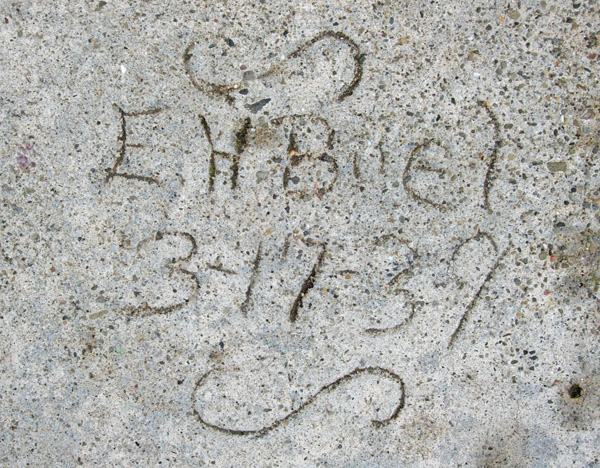
In 1940 he adopted a horseshoe stamp similar but not identical to that of his late uncle W. E. Ensor. I’m sure there’s lots more of his work in parts of Berkeley I haven’t visited yet.
 Oakland Underfoot