Archive for the ‘ Streetscape’ Category

C. G. Janson

7 July 2017

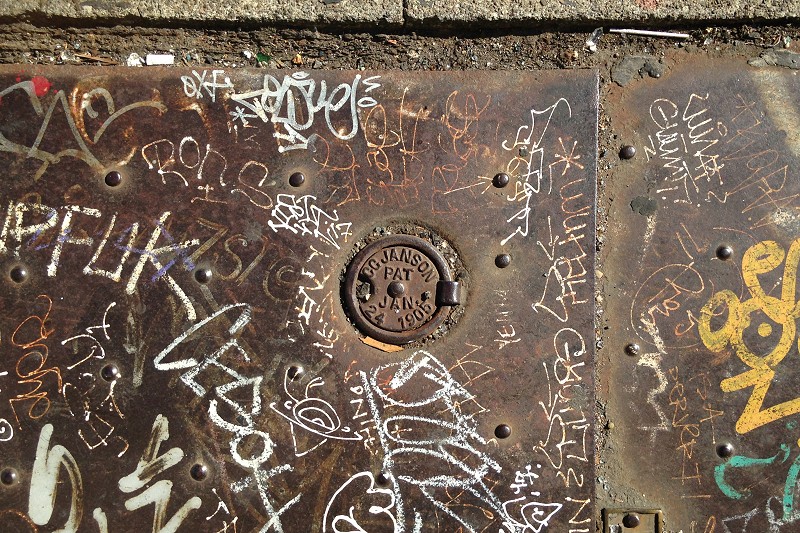
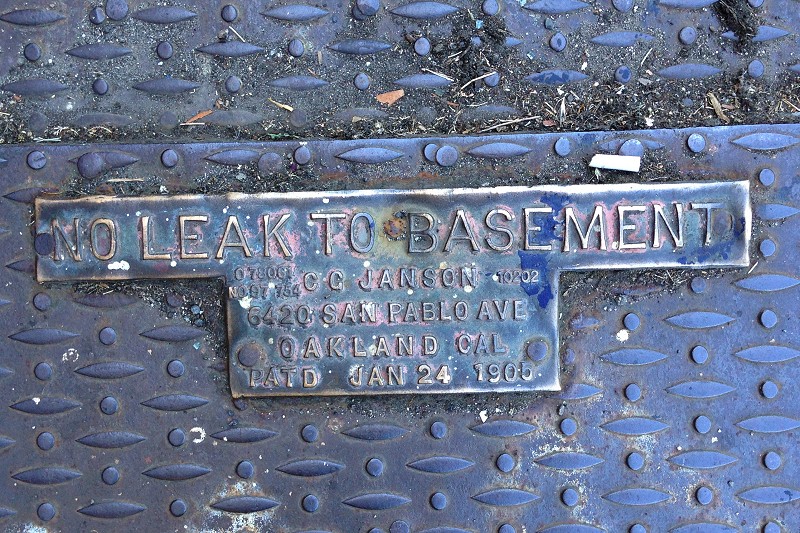
You’ve seen the sidewalk elevators in old Oakland sidewalks, with their ancient battered steel doors. Most of them came from San Francisco companies, but Carl G. Janson manufactured them in Oakland, at 6420 San Pablo Avenue.

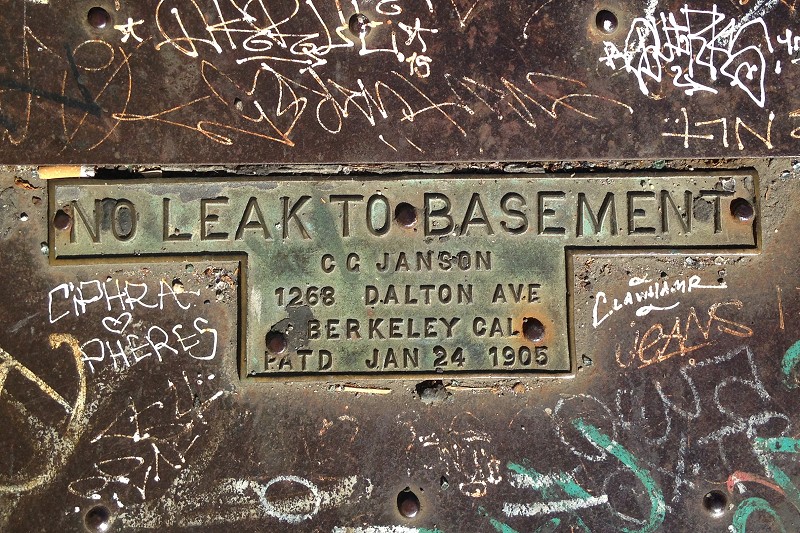
I haven’t done a big search for Janson’s biography, but he was granted several patents, one for a sidewalk-elevator door frame in 1912 and another for a bunk in 1921. The 1905 patent referred to on this door doesn’t turn up.

This Janson door on 13th Street indicates that his firm was in Berkeley for a time.

And maybe it was because I’d just left the Oakland Museum after seeing the Roy De Forest show, but the door struck me as unexpectedly attractive.

L. D. Frazee Heating

21 April 2017

Leonard D. Frazee was born in Illinois in 1870. The 1920 census listed his family at 699 36th Street, with his wife Ellen and three children who were born in Kentucky, Missouri and California respectively. The second child was Leonard Jr.

The Oakland business directories list Frazee between 1907 and 1928. At first he called himself a steamfitter, first in Emeryville and, as of 1910, at an address that became 3230 Courtland Street. From the 1914 to 1928 directories he was listed as a heating contractor at 699 36th Street, where he raised his family.

In 1919 he was granted half of a patent for an innovative damper design.

Frazee died in 1930. I’m not sure if he is related to the owners of the Frazee Paints business, but probably not.

Oakland sawblade

14 April 2017

659 15th Street is the nondescript butt-end of the building whose main space, facing Martin Luther King Jr. Way, houses the East Bay Fencers Gym.

The web offers me almost no information on what’s here. That’s OK. I think I know something about the person. The evidence in the concrete suggests a small-time artisan or artist, someone skilled and obsessive enough to create these objects, proud enough to mark the place, yet self-effacing too.

As a fruit is to the tree that bears it, so are artists to the community that nourishes them. As a fellow Oaklander, I accept and return the salute with this post.

Relics of the Oakland water wars

9 March 2017

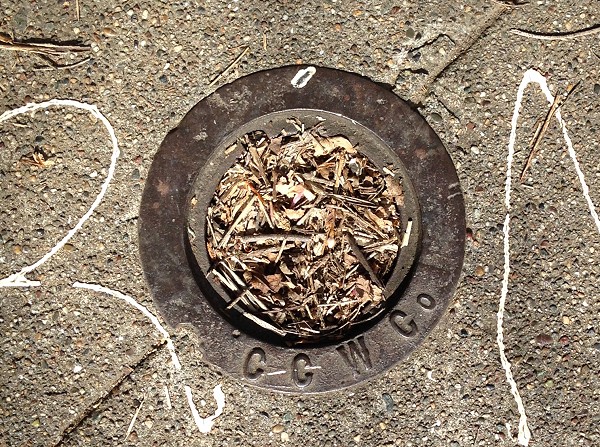
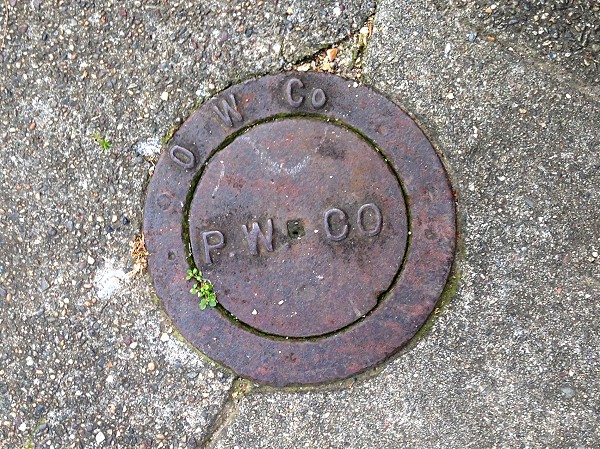
54th Street preserves some very old streetscape to go with its old houses. Both of these water-main lids are on the same block.
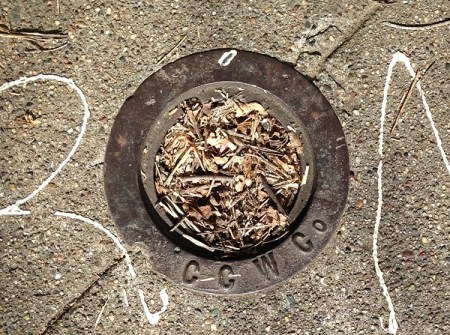
The Contra Costa Water Company was Anthony Chabot’s baby, founded in 1866. That was the company that built the two dams at Lake Temescal and Lake Chabot Reservoir. It got involved in Oakland’s nasty “water war” during the 1890s. In short, Chabot’s company turned down William Dingee’s request to extend water service to his properties in Montclair and Piedmont, and in 1893 Dingee formed the Oakland Water Company in response, tapping wells in upper Shepherd Canyon.

The competition grew heated, then ugly. Mutual disparagement escalated to mutual accusations of sabotage. Customers of both companies suffered poor service.

In 1898 the two firms were obliged to merge, with Dingee in charge under his former rival’s name. Less than a decade later, the Peoples Water Company devoured the Contra Costa Water Company. I think this lid used hardware from both Peoples and Oakland water companies, perhaps a fresh cap in an old ring or just mixed inventory in the Peoples warehouse.
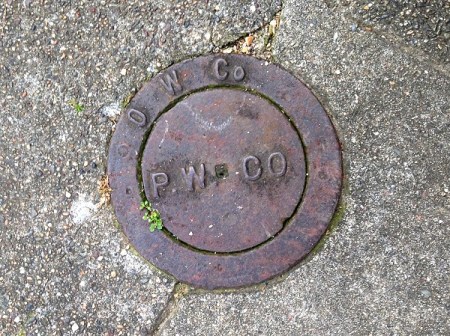
Peoples Water Company collapsed within a decade, too, with the short-lived East Bay Water Company springing from its wreckage. Only after the East Bay Municipal Utility District was formed did Oakland get good, reliable water service. Remember the water wars whenever someone tells you private enterprise can do everything better and cheaper.
W. S. Snook & Son Plumbers

24 February 2017

snook-and-son

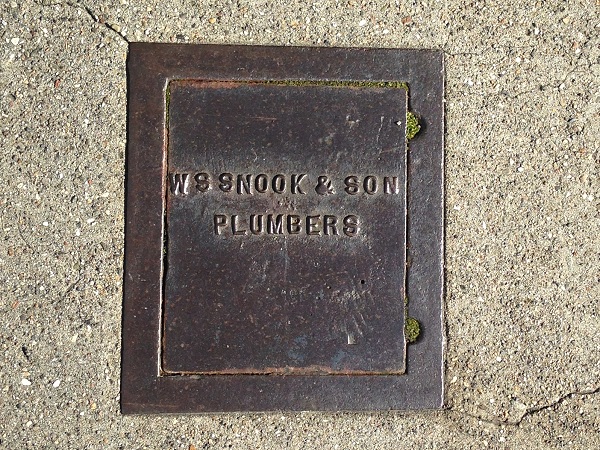
You don’t often see a brass sidewalk plate placed by a plumbing firm, but the block of Clay Street between 14th and 15th Street was a prestigious address: the new H. C. Capwell store, built between 1910 and 1912 right behind the site of the new City Hall. There are more of these on the 14th Street side.

William S. Snook was a prominent Oaklander in his time, as recorded in Oakwiki. The 1911 directory lists his eldest son Frederick as a plumber, so we can assume that Frederick was the “Son” of the firm. The elder Snook died that same year.

There may be older Snook plates extant, which would read “W. S. Snook & Sons.”

Bricks and cobblestones

17 February 2017

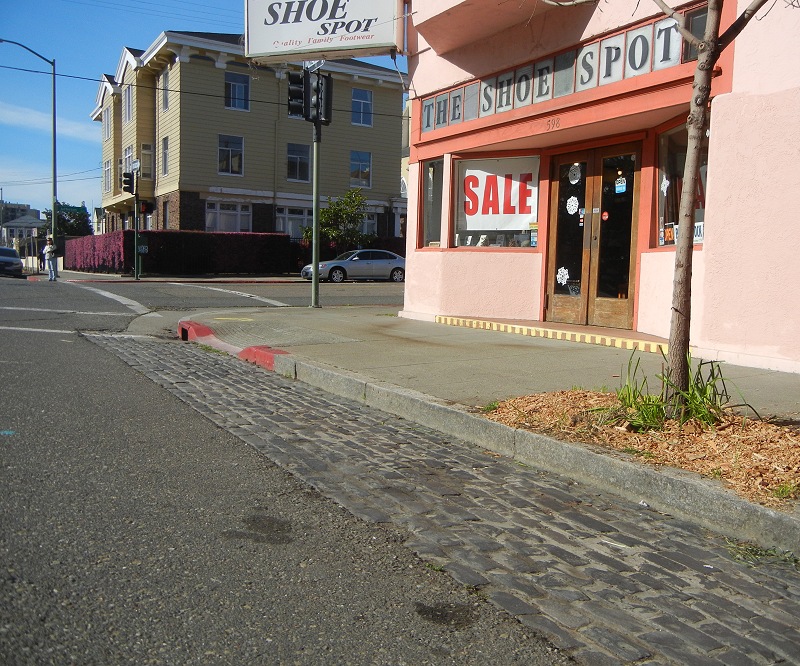
Older parts of Oakland feature gutter strips of brick and cobblestone.

bricks1

Cobblestones are rough blocks of solid stone that essentially never wear out. The most important thing in keeping cobblestone paving sound is the mortar. You don’t want loose cobblestones knocking around in the street.

bricks2

The material itself is tough, nondescript basalt or argillite or gneiss. Some of it could have been quarried locally, but I doubt it.

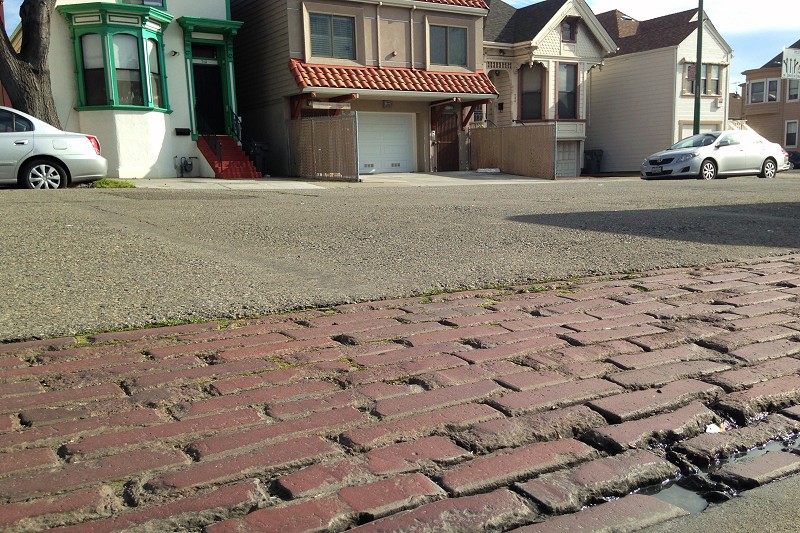
Then there’s good old brick.

bricks3

It’s easier to work with, but it doesn’t wear as well. I think that paving brick is a different grade of material than your wall-building brick.

People out there know a lot more about this stuff than me — people like Dan Mosier, creator of the California Bricks site.

East Bay Water Company

10 February 2017

eastbaywaterco

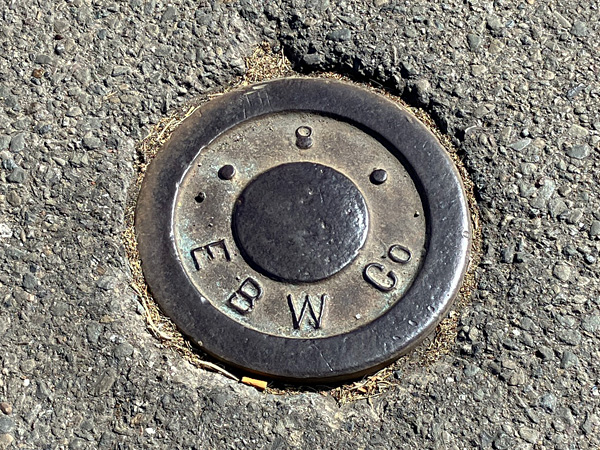
The East Bay Water Company was a private water provider formed in 1916 from the wreckage of the Peoples Water Company, but it struggled under the high costs for materials during World War I and insufficient water for its customers. Oakland and the East Bay were experiencing a boom at the time, and the company couldn’t expand fast enough despite having some 80 square miles of watershed land in Alameda and Contra Costa Counties. It owned Lake Chabot and other reservoirs in Richmond, too. It pumped water from a wellfield in Alvarado. It built the San Pablo Dam in 1919. It ran a long series of informational ads in all the East Bay newspapers in 1920. It took over a competitor, the faltering Union Water Company, in 1921 for $1.1 million. It built the Upper San Leandro Dam in 1926 and the Lafayette Dam in 1928.

Nevertheless, in 1921 fed-up East Bay leaders pushed for the state to enact a law allowing a new type of special government agency — public utilities of regional size. The Municipal Utility District Act having passed, East Bay MUD was established by an overwhelming vote in 1923, and the new utility bought out East Bay Water in 1928 with $26 million in bond money.

That was 12 tumultuous years for this ambitious company. East Bay Water’s excess watershed lands were the core of the East Bay Regional Parks District formed in 1934, also under the state municipal utility district law.