Union concrete masters II

25 March 2016

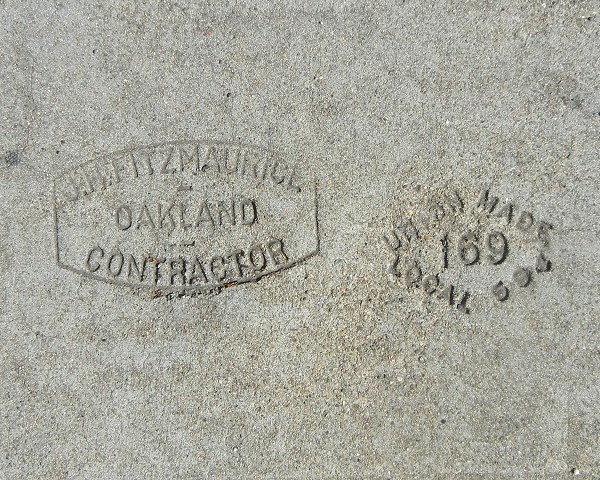
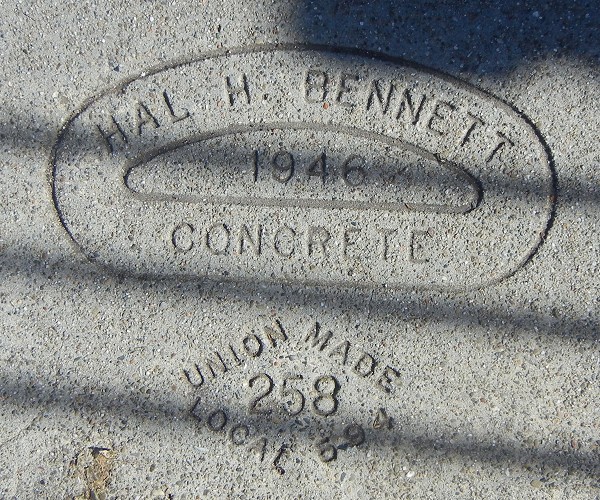
In the last few weeks I’ve spotted five more numbers in the OPCFIA union bug. The last three are interesting to me in a new way.

union-made-nat-lena-235

union-made-hal-bennett-258

union-made-fitzmaurice-60

union-made-fitzmaurice-90

union-made-fitzmaurice-169

What’s interesting about the last three? First, J. H. Fitzmaurice employed several master craftsmen, although that’s not a surprise. It was a big firm, probably accounting for more Oakland pavement than any other. Second, students of Fitzmaurice marks will note that the first is the fourth configuration used by this longtime Oakland company, and the other two are the fifth and last. The older mark was made by an earlier registered master, as indicated by the lower number.

The master number ought to be a secondary clue to the ages of marks, like Fitzmaurice’s, that rarely bear dates. Paleontologists will be familiar with this problem because fossils never bear dates — all we know is their position on the stratigraphic column. That’s an idealized stack of sedimentary rocks built by noting what rocks overlie or underlie other rocks. The stratigraphic position obviously corresponds to some true age, measured in years, but the only way to estimate it, even partially, is to find a secondary clue, like a bed of fresh volcanic ash that yields an absolute date with isotopic (radiometric) methods, like the uranium-lead or potassium-argon or carbon-14 techniques. If we have that, then we can say that a nearby fossil has a comparable age.

In the case of sidewalk stamps, we can safely assume that the numbers of the master concrete workers were assigned in numerical order. But those numbers aren’t dates. We need marks that have both a date and a master number to help establish the timeline of masters. And that won’t tell us much. A single example will only tell us that the master was active that year, not the year he earned his number or the year he retired. With enough data, we can zero in on those years but never know them for sure. I’ll see what comes up as I look around. Because as the saying goes, “What songs the Syrens sang, or what name Achilles assumed when he hid himself among women, although puzzling questions are not beyond all conjecture.”

Vault lights con’d.

18 March 2016

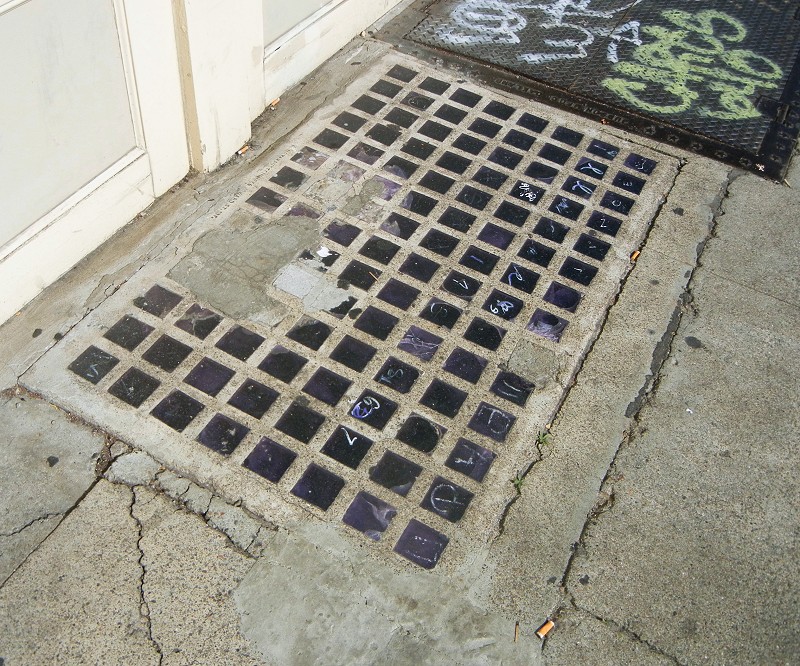
It was exciting to see so much interest in last week’s post about Oakland’s old vault lights. I went back to the Jefferson Court Apartment building at a different time of day, hoping to catch the daylight in the vault lights I showed last week. Success!

Jeffersonlights-lit

We’re facing east on 18th Street. The building’s sunken courtyard is on the right, and the brightly lit concrete floor there is shining up through the prism faces on the bottom of the glass vault lights. I knew you’d get a thrill.

Here’s the combination of ventilator and vault lights that surrounds the Leamington Hotel building. Those are a P. H. Jackson production.

leamingtonlights

Vault lights

11 March 2016

vaultlight-1

Oakland’s older districts feature remnants of pre-electric technology known as vault lights. They were invented around 1850 as a way to bring daylight into vaults, or basements that extend beneath the sidewalk, by means of thick glass disks mounted in cast-iron frames. In the late 1800s, with the spread of reliable Portland cement, reinforced concrete replaced cast iron. Oakland has examples of both types.

The photo above shows what’s probably Oakland’s largest continuous set of vault lights, in front of the Jefferson Court apartment building at 581 18th Street. It goes all the way to Jefferson Street, about 120 feet. Each piece of glass is actually a block with a prism on the bottom, which bounces and spreads the light sideways into the underlying space. See a quick introduction at glassian.org.

The glass turns purple after decades of exposure to sunlight as a result of manganese in the formula, used as a clarifier. About 100 years ago manganese was replaced by selenium, and today’s glass doesn’t turn purple. (In case you need a fresh dose of outrage, look up the scandal of antique glass being garishly tinted using UV lamps.)

Here’s the only example I’ve found of a cast-iron vault light, on Telegraph near 19th Street. The ventilating panel reads, “W.L.PATD.SF.JUNE,16.1874”. The clear glass may be a later replacement of the round glass prisms.

vaultlight-2

The Haley Law Office building at San Pablo and 16th has a fine set of vault lights. I’ve walked past at night and seen the cellar lights shining up through them.

vaultlight-3

Here’s a better look at a nearly pristine set, on Telegraph near 19th. This one has the name of P. H. Jackson & Co. of San Francisco, which I’ve mentioned in my two previous posts. The plate gives their address as “418 Bryant St.”

vaultlight-4

The Carles Apartments building, on Jefferson at 10th, has handsome vault lights along its whole frontage. I don’t know the manufacturer.

vaultlight-5

Finally we have this set on 8th Street at Washington, which stands out for its large, square glass blocks. Presumably designing a set that combines maximum light and adequate strength involves careful tradeoffs. The maker was “Henry Haustein 1866 Howard St. S.F.” The 1899 San Francisco business directory lists him as “manufacturer of sidewalk lights, 1832 Howard.”

vaultlight-6

So, are these old features hopelessly ruined? Not at all! The National Park Service has a nice restoration case study from New York City, where 19th-century street tech is still abundant.

Jackson’s Device for Plentiful Ventilation

4 March 2016

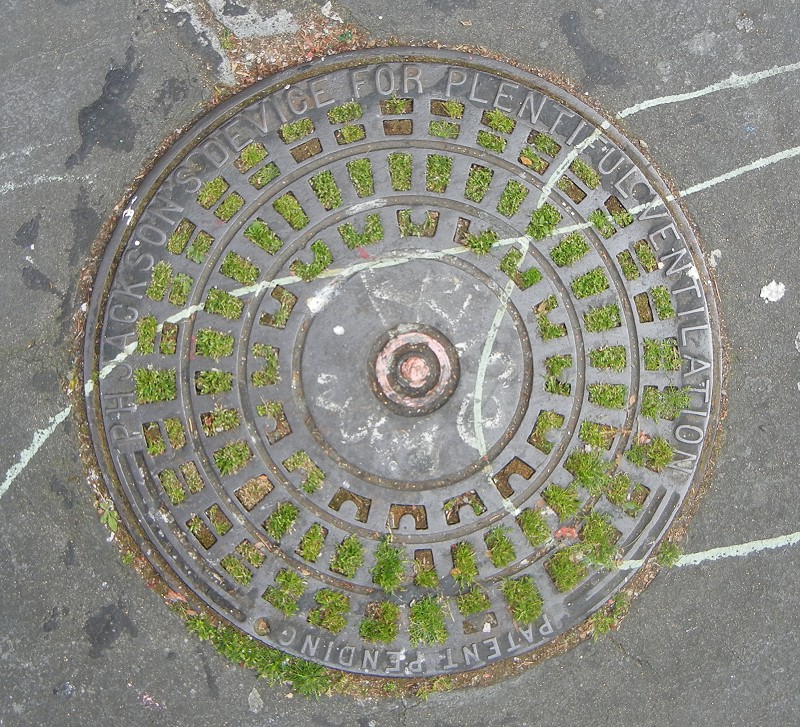
Poking around Oakland’s old downtown has yielded some more overlooked old things. Take P. H. Jackson’s Device for Plentiful Ventilation, on Harrison south of 14th Street.

jacksons-device

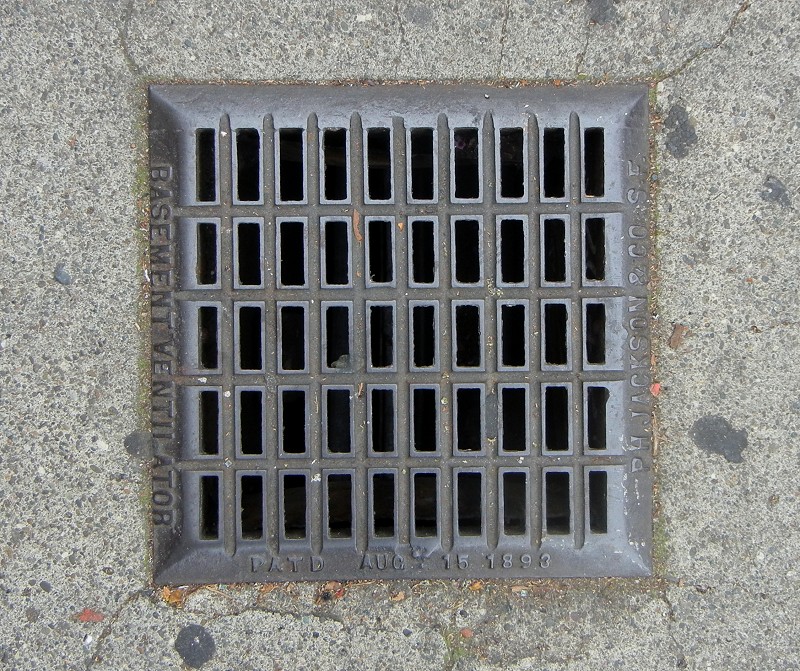
Somehow I don’t think it’s functioning any more. This is the same Jackson I featured two weeks ago. I found another configuration of ventilator from the Jackson company, this one with a patent date of 1893.

sidewalklights-jacksons-1893

Bay City Iron Works

26 February 2016

baycityironworks

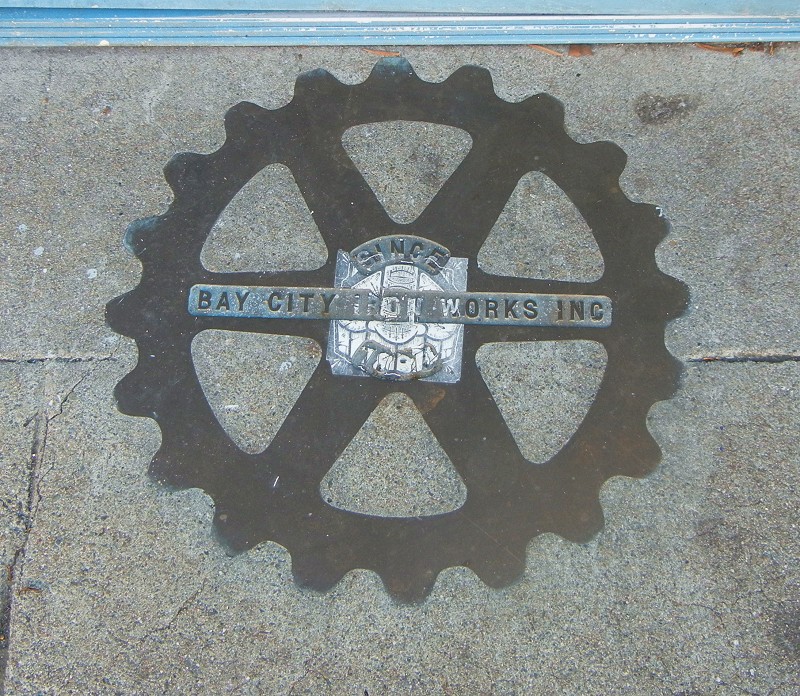
Oakland has many old businesses that have left their mark on the pavement. This marker for Bay City Iron Works is at 475 4th Street, a building that houses Ion Cars today. But the marker says, “Since 1885.” Perhaps this was its first home.

If you look up the company’s name today, Google points you to an empty lot at 2897 Chapman Street, in Jingletown. But the company’s earlier home was near the docks, at the corner of 3rd and Washington Streets (221 Washington). See this family biography of Harry Melville Thornally, who used to work there, for photos and letterhead of the place. In The Iron Age issue of October 3, 1901, the firm is reported to be in the process of building it. Today the sign on the building says “Parker Electric Mfg. Co.” I’m not sure what this website has to do with it, but check it out.

Alameda County, the Eden of the Pacific; the Flower Garden of California (Oakland Tribune, 1898) says of the firm, “The enterprise is located at 521 to 525 Third Street. It turns out all kinds of agricultural work, general jobbing in machine work, threshers, machine engines with straw-burning boilers, and irrigating pumps of the M. B. Schutzell design.”

Ventilator grates

19 February 2016

sidewalklights-1

Older parts of downtown Oakland feature these iron grates in the sidewalk. Unlike the purple glass and concrete “vault lights” you’ll also see around downtown, the grates were for ventilation. I collected the following photos during an hour’s walk east of Broadway between 19th and 14th Street.

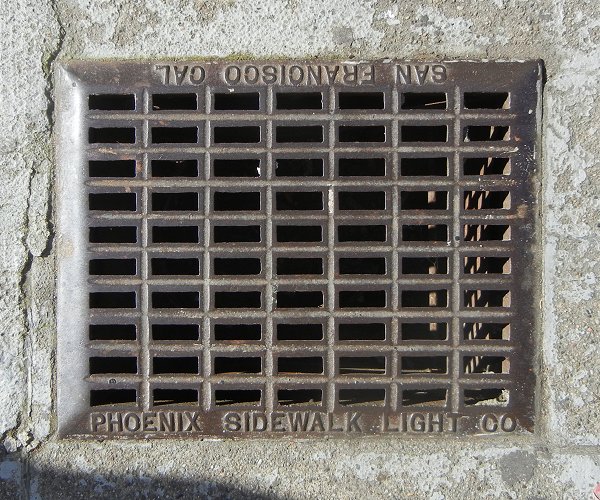
Here are two sizes of grate from the Phoenix Sidewalk Light Co. of San Francisco.

sidewalklights-2

sidewalklights-5

Please note that these are not sidewalk lights (vault lights), but ventilation grates. Phoenix made both items, according to the Historic Prism Glass Companies of the United States list on glassian.org. It was headquartered in the Monadnock Building on Market Street.

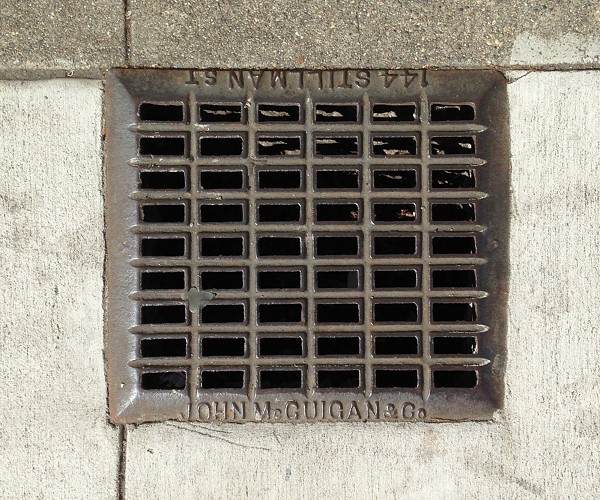
John McGuigan & Co. was also across the bay, at 144 Stillman Street. (The address is now under the freeway.)

sidewalklights-6

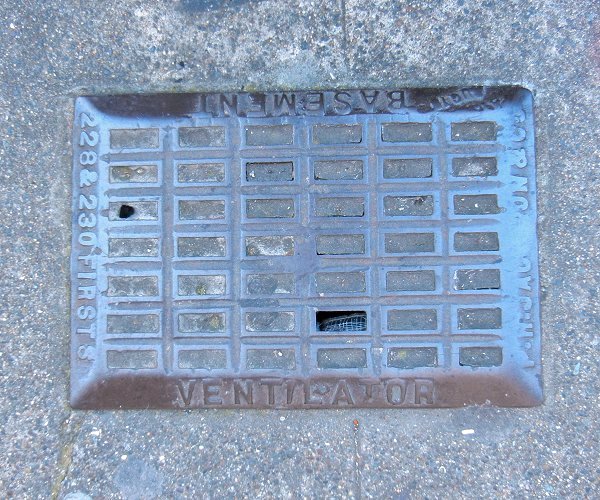
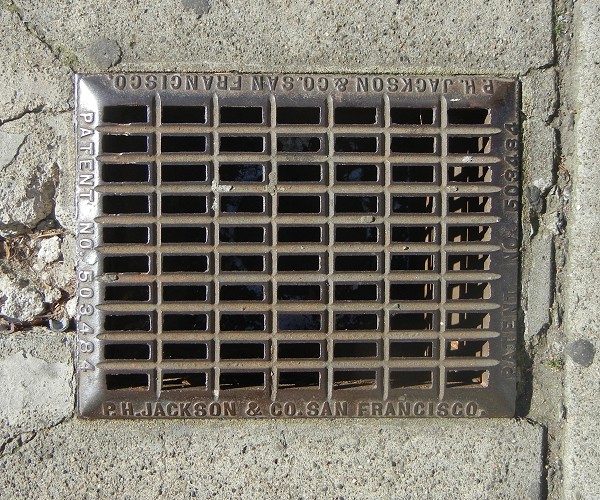
The king of the business appears to have been P. H. Jackson & Co., which was a major manufacturer of reinforced concrete and other innovative building elements beginning in the 1870s in San Francisco. The company, on the 200 block of First Street, continued business well into the 20th century. I will have more to say about the company in a future post.

Here are three different examples of their products.

sidewalklights-7

sidewalklights-4

sidewalklights-3

This is an unexpectedly deep subject!

The Lyon building

12 February 2016

As you walk up Broadway past the old Saw Mill building, you might notice two bronze letters in the sidewalk spelling out the word “NO.” That’s because you’re looking at it backward. Things make sense at the building’s main entrance, where a large stone/concrete lion with a dozen layers of paint looms over the door and the word “LYON” is spelled out in metal.

LYONsign

With that in mind, you can set out downhill from the doorway and see the letters rightly as the second half of LYON.

LYON-ONsign

Or go uphill instead to see their counterpart. I have to assume that both of these once had four letters.

LYON-LYsign

The building began in 1916 as Lyon Moving & Storage. It was quite grand, in the old Oakland style. Today, there are 53,000 storage companies in America, most of them quite bland and not a single one, I’m sure, with its name on the sidewalk in bronze.