
Another variant of the Western Union utility-hole lid, at 14th and Broadway. (Here’s the first.)
And another one on Broadway at 3rd Street.

There’s always something new to see, no matter where you are.
Another variant of the Western Union utility-hole lid, at 14th and Broadway. (Here’s the first.)
And another one on Broadway at 3rd Street.
There’s always something new to see, no matter where you are.
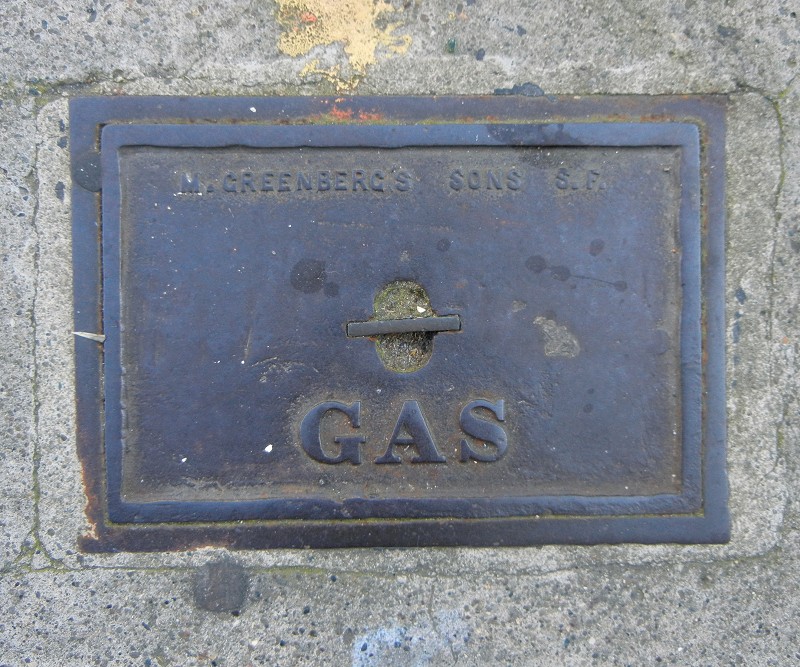
Over at firehydrant.org, they say that Morris Greenberg invented the “California” type of fire hydrant, and already I’m dizzy at this glimpse of obscure industrial history. That was decades after Greenberg, a Jewish immigrant born in Warsaw, Poland, in 1823, had started the Eagle Brass Foundry in 1854. The Jewish Museum of the American West devotes a page to Morris Greenberg that includes a photo.
Greenberg’s foundry, an essential building block of San Francisco, made all manner of metalwork. It was especially prized for its mastery of ship’s fittings, including the demanding art of casting bells.
When Morris died in 1884, his sons Leon and Joseph carried on, renaming the firm M. Greenberg’s Sons. The firm was going strong a hundred years later under the same name with Morris’s grandson Stuart in charge. But in 1969 they sold themselves to the Rich Valve Company, and that was that. Rich Valve was acquired by Clow Valve, adding Greenberg’s “wet barrel” hydrant design to its portfolio.

The peculiar round mark of the Golden Gate Construction Co. is so rare that I had to document this example, one of two at 5519 and 5527 Market Street. The company was in existence in the first decade of the 20th century. Another one is next to Lois the Pie Queen.
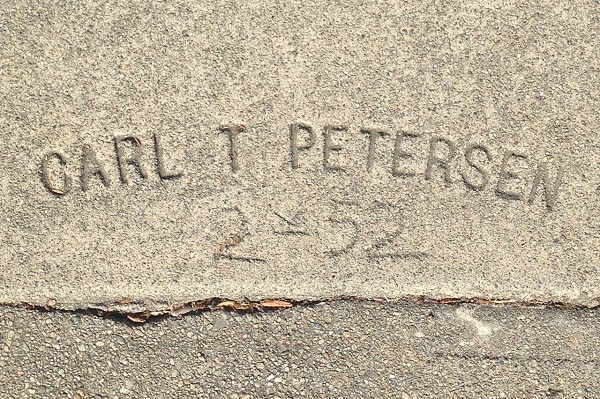
Carl T. Petersen paved a lot of Oakland over the years, and he had many years, starting in the mid-1920s and lasting into the 1950s. This 1952 mark at 2009 Capp Street is a good example of his later marks.
Born in Denmark in 1888 or 1889, Petersen was working as a concrete contractor in Oakland as of 1923, at 1318 E. 12th Street. At that time he and his wife Hazel had one son, Carl Jr. They were there in 1924 as well.
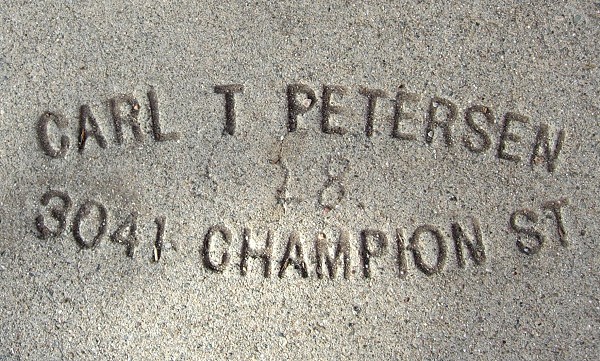
The earliest surviving marks of his are from 1925. Those included his address at 3041 Champion Street, in the lower Dimond near the St. Jarlath’s church.
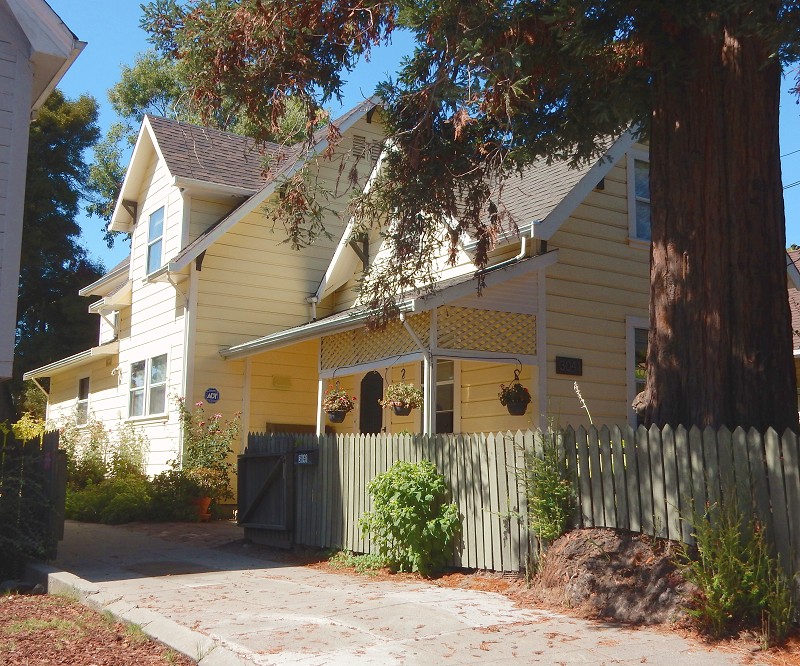
The house at that address is from that period, and the redwood tree is one Petersen could have planted himself.
In the driveway is an example of that early mark.
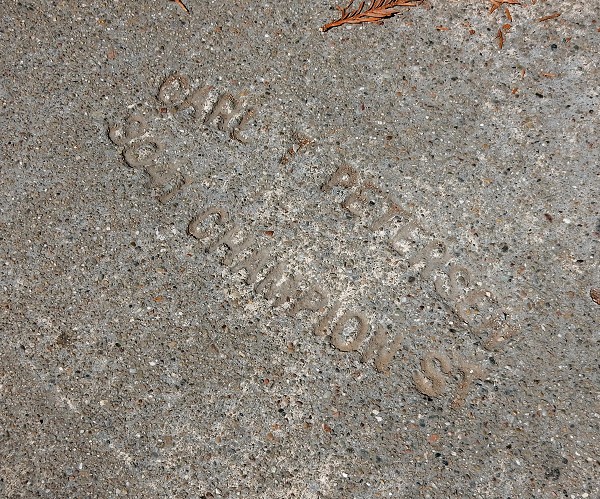
The latest example I have with that configuration is from 1929. During their time on Champion Street, Carl and Hazel had a second son, Eugene. Afterward Petersen’s marks consisted of only the upper line of text, lightly incised and placed right at the edge of the pavement.
As of 1930 the directory had the Petersens at 2324 E. 20th Street. The 1940 census listed them and their two sons. In the 1967 directory he and Hazel were listed at that address as “retired”. A Hazel Petersen, with the dates 1894-1971, is buried at Mountain View.
The sidewalks of Oakland were not paved with concrete until the late 1800s. Before that, pedestrians were shielded from the dust and mud of the roadside with gravel paths or timber boardwalks, at best. It was a point of pride in Oakland, regularly mentioned in promotional literature, when the sidewalks began to be widely paved.
In some old sidewalk stamps you’ll see the abbreviation “A.S.P.”

That stands for “Artificial Stone Paving,” the early term of art for sidewalk concrete. Starting in 1887, the San Francisco directories had a classified section for artificial stone manufacturers. It included George F. and Harry N. Gray, the notorious Gray Brothers, at 316 Montgomery Street. The Grays operated three quarries in the city at 26th and Douglass streets (Diamond Heights), 29th and Castro streets (Corona Heights) and Green and Sansome streets (Telegraph Hill).
The same directory listed an Oakland firm, Oakland Artificial Stone Company, at 454 Ninth Street. If it ever produced sidewalks in this town, they do not survive.
You may wonder about the “Schillinger Patent.” It was a method, patented by John J. Schillinger in 1870, of making pavements that involved inserting tarpaper or similar materials between blocks of concrete. No less a person than Frederick Law Olmsted made the name famous among Supreme Court scholars when he designed some concrete paving for the U.S. Capitol grounds, specifying a technique of this type, and took the chance that Schillinger’s patent wouldn’t stand up in court. Schillinger sued the government in the federal Court of Claims, and in 1894 the Supreme Court ruled in Schillinger v. United States that because the offense was merely a tort the claims court had no jurisdiction.
Another San Francisco artificial stone manufacturer, George Goodman, was listed in the 1893 directory as a Schillinger Patent specialist.
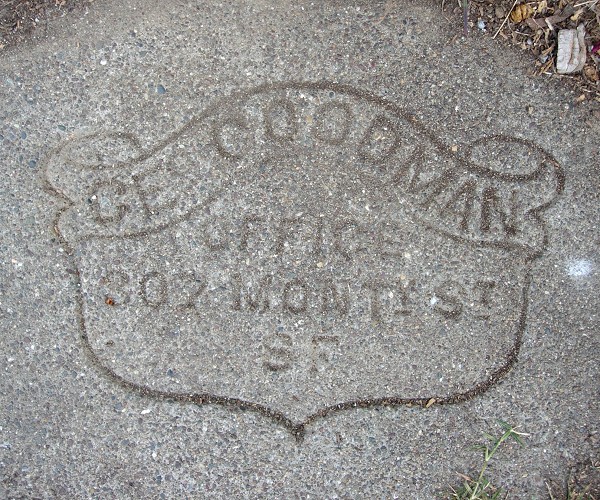
One of his lovely marks survives here, at 1028 E. 17th Street.
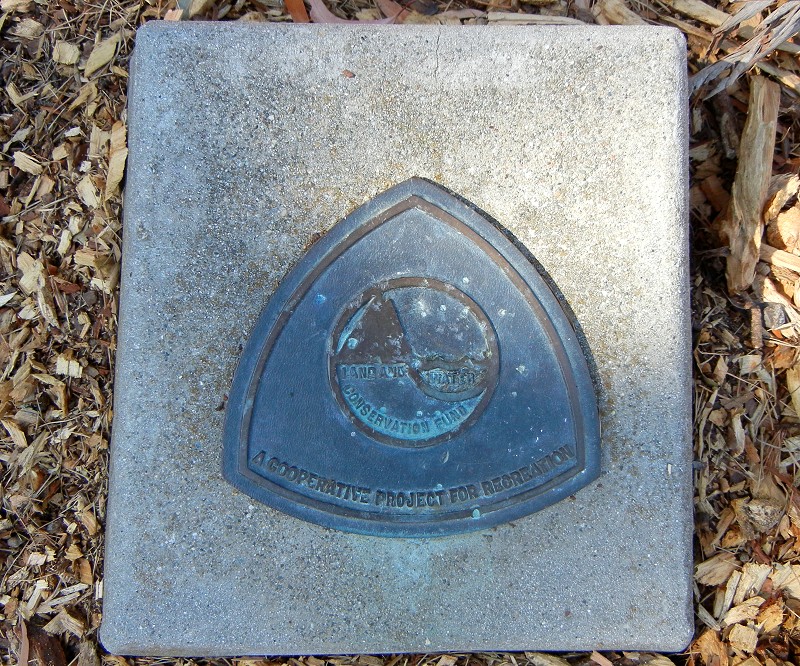
When I featured a Land and Water Conservation Fund plaque here a few weeks ago, I had a nagging feeling I’d seen one elsewhere, and there it was in my photos from March 2013. Oakland’s second LWCF site is tucked away next to the covered Central Reservoir, which I wrote about a few years ago in Oakland Geology. With a total of $70,000 from the fund to acquire 4 acres and help develop it, the Central Reservoir project took shape in the early 1970s. That may account for the maturity of the palm allee leading in from East 29th Street — or more likely a suburban estate once occupied this spot.

The park is small but well equipped for kids’ teams to play daytime softball and soccer. It also has picnic tables, bathrooms, a basketball court and views of the steel-roofed reservoir.

I’m glad they left a plaque behind. As the podcaster Roman Mars says, always read the plaque.

I came upon this mark by a house somewhere around 90th Avenue and Thermal Street last year. Gene Anderson, one of the ever-helpful guys behind the Oakland Wiki, sleuthed out the identity of Potter: Arthur W. Potter, who operated the California Mission Realty Co. in Oakland on High Street during the 1920s. In the 1923 directory he was listed as a carpenter living on 41st Avenue; in 1925 he had started the company and lived in Berkeley. By the 1950s he was in business with two of his sons, Irving and Harvey, in Castro Valley as A.W. Potter and Sons.
A 1926 advertisement referred to “Potter Built Homes,” built with “oodles of built-ins, hardwood floors throughout, tile sink and bath, the latest in home construction.” Buyers could pick their own paint, wallpaper and electrical fixtures while their house was being built. This custom sidewalk stamp is another sign of the pride and care Potter must have taken at the time, during Oakland’s wave of expansion after World War I.
This is the only such mark I’ve found in Oakland, and I’m not sure it still exists. Nor do I know if others survive in San Leandro or points south. Red concrete was in vogue during the 1920s and 1930s.
 Oakland Underfoot