Sidewalk maker: Robert Appleby

12 May 2017

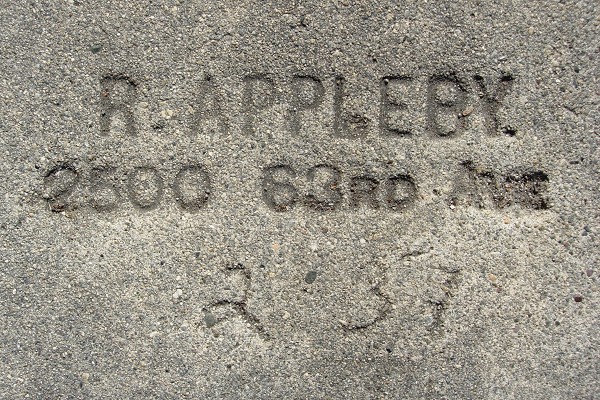
Robert O. Appleby was born in Newbottle, County Durham, England, in 1883, where the 1901 census listed him as a “horse shoer above and below ground,” presumably in the coal mines. He escaped that miserable life to America in 1905, where he married Winifred E., another English immigrant who came to America in 1907. The 1910 census listed the couple and their first child as living in Linda township in Yuba County, where he and all his neighbors were gold dredgers.

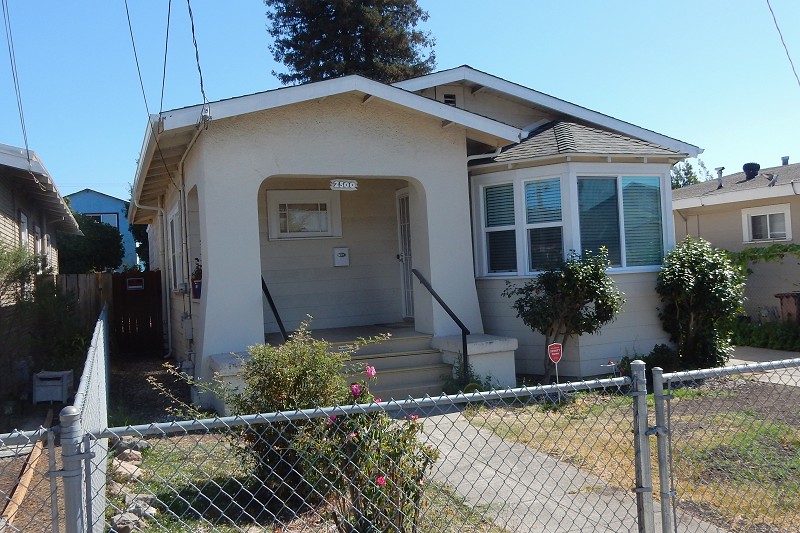
Appleby showed up in the Oakland business directory in 1917. The 1920 census listed him as a blacksmith at the shipyards, living at 2500 63rd Avenue with Winifred and their two daughters. Looks like the house is still there.
In 1925 he changed his directory listing from blacksmith to cement contractor, a status he kept at least until the 1940 census.

I’ve recorded a sprinkling of his marks all around Oakland, dating from 1931 to 1937.

He was still at the 63rd Avenue address in 1944. He died in 1968 at a ripe old age, while Winifred died in 1962. She’s buried at Mountain View Cemetery, but I have no information about him.
Access cover anatomy

5 May 2017

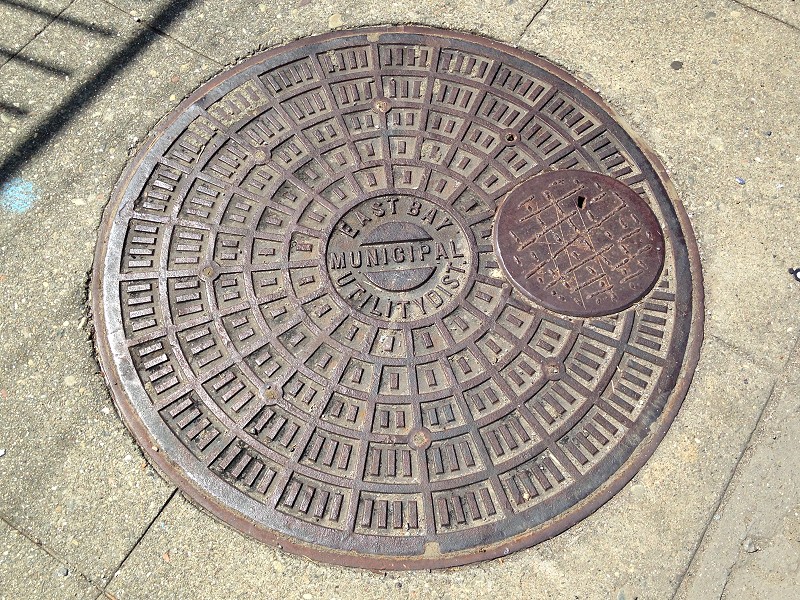
This large and elaborate East Bay MUD access cover, on San Leandro Avenue in deep East Oakland, displays a lovely radial design. It also includes good examples of some typical features of access covers.

At the top and bottom edges, at 12 and 6 o’clock, are lifting notches, where a worker attaches the hooks to raise the lid safely. Halfway out from the center is a ring of aeration holes, arranged on the major compass points. They happen to be filled with dirt, except for the one marking Northeast. Their function is to equalize the pressure between the hole and the atmosphere, guarding against the effects of unusual events, like a tornado in the air or a sudden flood or explosion down below, that might push the lid out of its rim.

The smaller lid on the right side has its own lifting hole. Presumably it allows access so someone can monitor conditions in the shaft without going through the chore of pulling off the large lid. Because a smooth finish could present a slipping hazard, the secondary lid was textured by a welder. Perhaps there’s an arcane pattern in it representing a message, but it’s more likely to be a random set of metal bits, a scribble arranged by eye and intuition.

The A.C.F.C. & W.C.D.

28 April 2017

The owner of this access cover has a name that rolls off the tongue: the Alameda County Flood Control & Water Conservation District. They’re the people who manage much of the East Bay’s runoff. One of our streams is buried here, along San Leandro Avenue — probably Stonehurst Creek, the little branch of San Leandro Creek that runs along the railroad tracks by 105th Avenue.

L. D. Frazee Heating

21 April 2017

Leonard D. Frazee was born in Illinois in 1870. The 1920 census listed his family at 699 36th Street, with his wife Ellen and three children who were born in Kentucky, Missouri and California respectively. The second child was Leonard Jr.

The Oakland business directories list Frazee between 1907 and 1928. At first he called himself a steamfitter, first in Emeryville and, as of 1910, at an address that became 3230 Courtland Street. From the 1914 to 1928 directories he was listed as a heating contractor at 699 36th Street, where he raised his family.

In 1919 he was granted half of a patent for an innovative damper design.

Frazee died in 1930. I’m not sure if he is related to the owners of the Frazee Paints business, but probably not.

Oakland sawblade

14 April 2017

659 15th Street is the nondescript butt-end of the building whose main space, facing Martin Luther King Jr. Way, houses the East Bay Fencers Gym.

The web offers me almost no information on what’s here. That’s OK. I think I know something about the person. The evidence in the concrete suggests a small-time artisan or artist, someone skilled and obsessive enough to create these objects, proud enough to mark the place, yet self-effacing too.

As a fruit is to the tree that bears it, so are artists to the community that nourishes them. As a fellow Oaklander, I accept and return the salute with this post.

Sidewalk maker: T. J. Garvey

7 April 2017

Thomas Joseph Garvey was born in Fresno in 1898; his father John J. Garvey was a Kansan of Irish descent and his mother Elizabeth was a Northern Irish native. By 1910 his family was living in Oakland, and he grew up at various addresses along Adeline Street. His 1918 draft registration form described him as a tall man of medium build, with blue eyes and brown hair.

He followed his father briefly into shipfitting, but in 1927 he was in business as a concrete contractor, living with his wife Fern (born in 1900) at 716 8th Street. As of 1930 the couple had moved up to 5686 Ocean View Drive, and from 1937 on they lived at 4520 Harbord Drive.

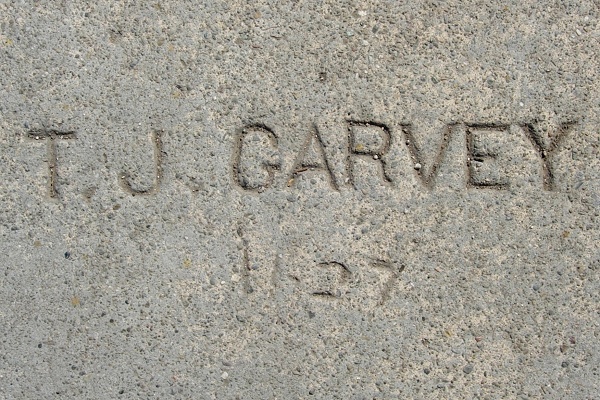
T. J. Garvey’s marks fall rather neatly into three periods. This was his first stamp.

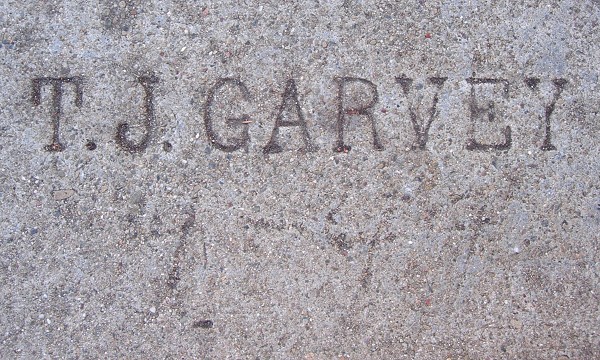
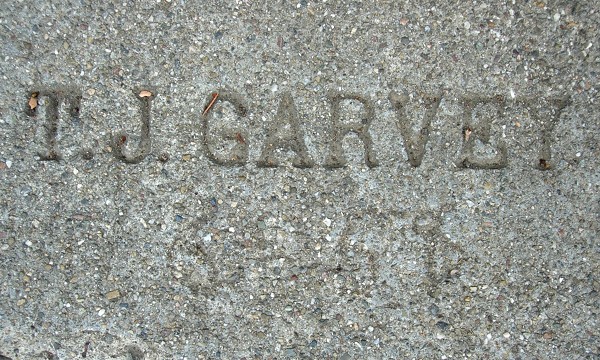
By the early 1930s, his stamp had begun to degrade, and he was touching it up by hand.

Most of his marks from then through the war years were partly or fully hand-drawn. Then in 1947 he got a new stamp that used a serifed font, like Courier.

He used this one consistently through the 1950s. The latest mark I have is this one from 1958, on Tunnel Road.

Garvey died in 1960, and his wife lived on in the Harbord Drive home at least through the 1960s. She died in 1987, and both are buried in Holy Sepulcher Cemetery in Hayward.

Marks from T. J. Garvey’s 32-year career are scattered widely throughout Oakland, though only a small fraction of them bear dates. You can at least assign them a decade just by looking at them. I’m only missing examples from 1929, 1932, 1942, 1943, 1945 and 1957. Perhaps they survive in neighboring cities.

San Francisco Gas & Electric Company

31 March 2017

If I recall correctly, this access lid is on Jefferson or Martin Luther King down around 10th Street. It belonged to the San Francisco Gas & Electric Company, which was in existence from 1896 to 1906. SFG&E merged with the California Gas and Electric Corporation to form Pacific Gas & Electric, still in business today as PG&E.

The company opened a gas manufacturing plant in Oakland in 1905, down where Howard Terminal is today.

The six cleverly placed lifting holes are a nice touch.