Sidewalk maker: Ed Doty

14 July 2017

Edwin “Ed” Doty was a major maker of Oakland and East Bay sidewalks, doing business with his son Abraham “Abe” for many years as Ed Doty & Son.

Doty was born in Canada in 1862 and became a naturalized U.S. citizen, but he gave conflicting information about his parents and the year he immigrated. Frank Merritt’s 1928 History of Alameda County has a long, colorful biography of him (helpfully quoted in this comment by “stacinator”), recounting his years ranching in the Yellowstone country, managing ironworkers in Hawaii, an idle year in Guam, drilling wells at Point Richmond and finally joining the Cement Workers Union in San Francisco, where he was suffering with a freshly broken arm and fractured skull at the time the earthquake struck.

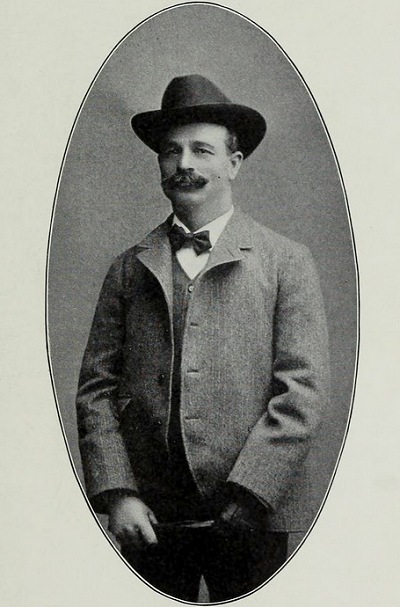
He married Lizzie Watlington in 1906 and they had one child, Abraham (1908-2003). Ed died in 1931. The biography in Merritt’s history includes this photo of Ed in his prime.
The 1909 directory lists him at 1687 26th Avenue. In 1919 he built a new home at 2487 26th Avenue and moved there. It’s a nice place; I’ll show it to you farther down.

A glass paperweight made by Ed Doty & Son, recently listed on eBay, contains the text “Trademark of Concrete Since 1907” and the address 3481 26th Avenue.

I’ve found “Ed Doty” sidewalk stamps in Oakland dating from 1923 to 1945, in a variety of configurations. The original imprint looked like this:

From 1928 to 1931 the Doty stamp looked like this, with larger letters:
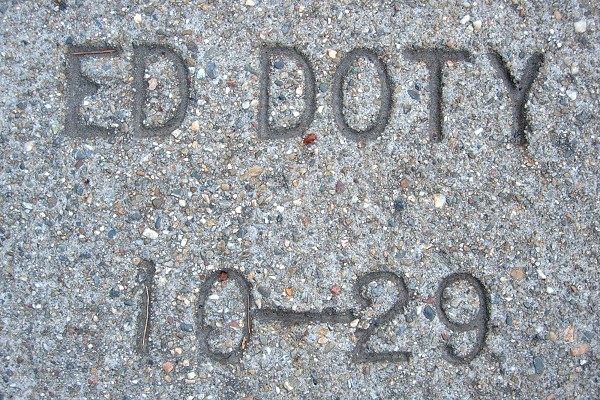
Or this, with a dot in the date instead of a dash.
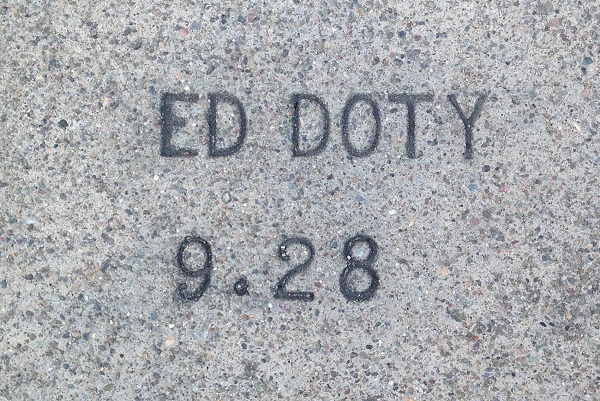
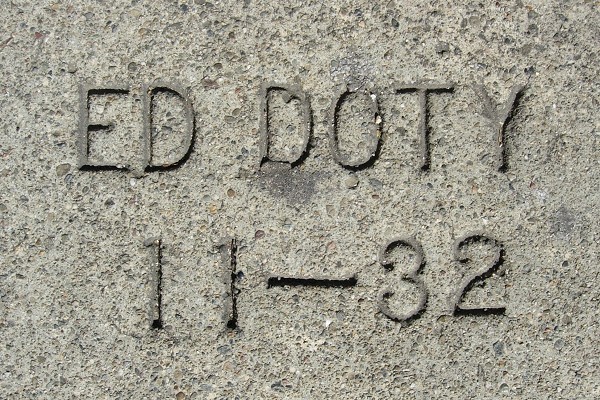
Starting in 1932, they looked like this, distinguishable by the shape of the “E” and the “O”. I have examples all the way up to 1944.
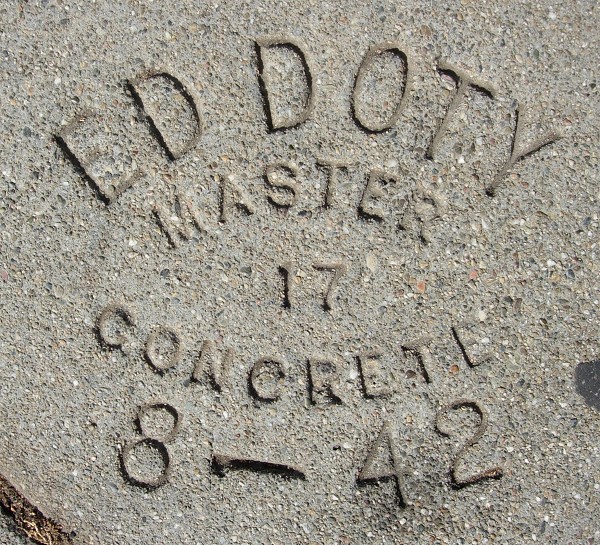
At some time before June 1937 the firm switched to a new design that incorporated the “concrete master” number. It used number 16 from then until March 1938:

Starting in April 1938 it used number 17. I speculate that Abe Doty had to replace his master finisher for some reason and needed a new number.
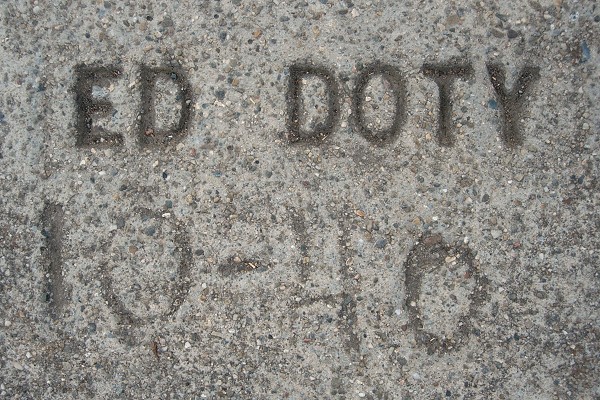
All along, the firm also kept using the original stamp, but with hand-drawn dates:
Here’s the Doty house. Of course, Doty laid most of the concrete on the block, replacing work by the earlier generation like Stevenson.
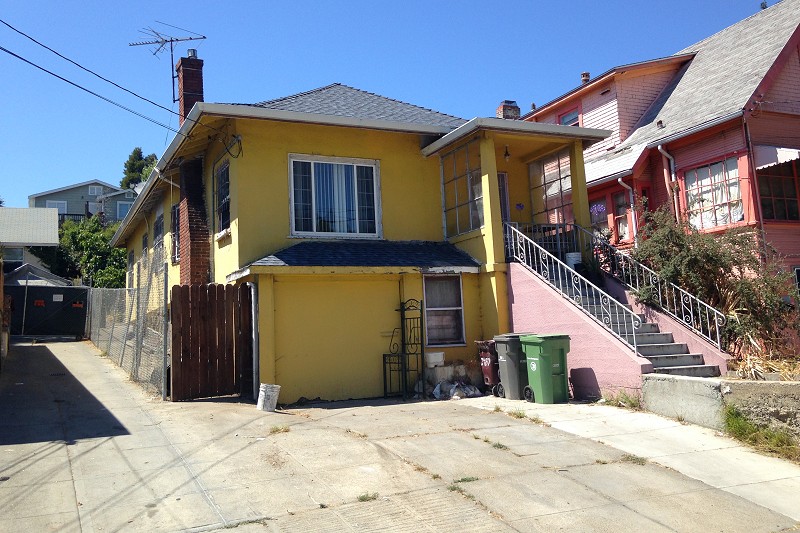
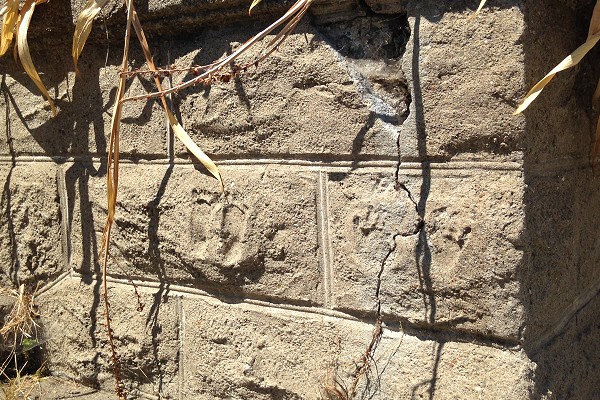
The driveway is gorgeous, as concrete driveways go. There’s a little panel on the corner bearing a small child’s hand and foot prints. And here, in the entryway, are some more. These could not have been Abraham’s; perhaps there were grandchildren handy.
In writing this post, I realize that there are details about the stamps that I need to clarify, so look for updates in the comments every now and then.
C. G. Janson

7 July 2017

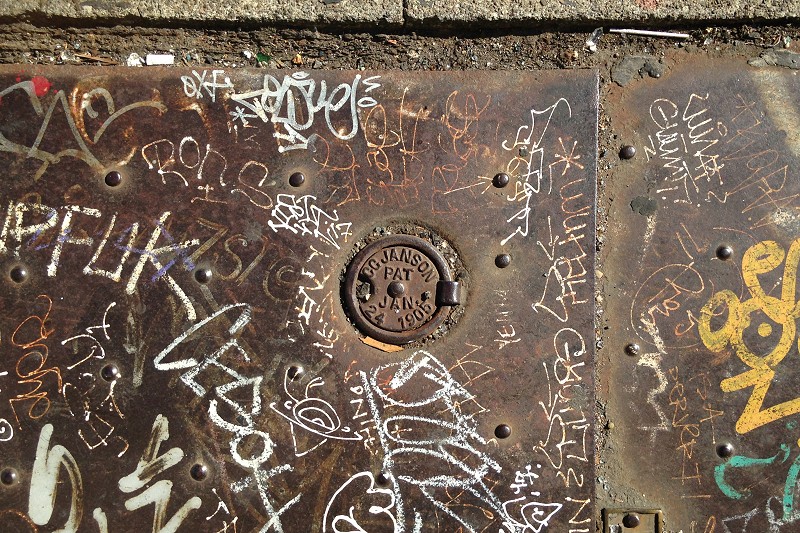
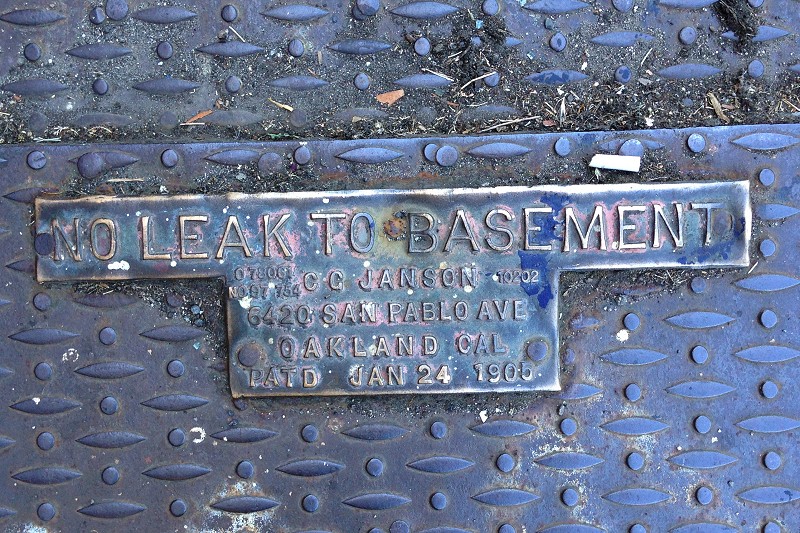
You’ve seen the sidewalk elevators in old Oakland sidewalks, with their ancient battered steel doors. Most of them came from San Francisco companies, but Carl G. Janson manufactured them in Oakland, at 6420 San Pablo Avenue.

I haven’t done a big search for Janson’s biography, but he was granted several patents, one for a sidewalk-elevator door frame in 1912 and another for a bunk in 1921. The 1905 patent referred to on this door doesn’t turn up.

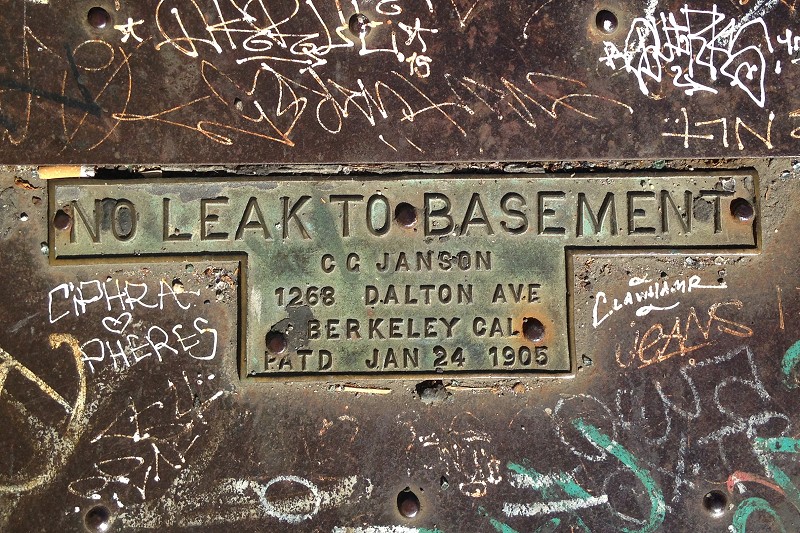
This Janson door on 13th Street indicates that his firm was in Berkeley for a time.

And maybe it was because I’d just left the Oakland Museum after seeing the Roy De Forest show, but the door struck me as unexpectedly attractive.

Sidewalk maker: Joe B. Silva

30 June 2017

Joe B. Silva was born in the Azores and later became part of the East Bay’s thriving Portuguese community. I know little of his life because my sources are limited and because “Joe Silva” is an extremely common name. I just know he was born in 1876 and died in 1962. His first wife, Mary Rose, bore seven children and died in 1938. She was to be buried in St. Mary’s, but FindaGrave has no record of her or Joe. His second wife was named Gertrude. Both were Portuguese.

The Portuguese have a long and complex history in America, as summarized in a timeline from the Library of Congress. The same is true for California. There were divisions between the continental and Azorean/Madeiran Portuguese, who came here at different times for different reasons. The Oakland Tribune named Silva as the Grand President of the “Protective Association Union Madeiran Society” (Associação Protectora União Madeirense do Estado da Califórnia, or União Madeirense for short), which was founded in 1913 in West Oakland. A continental Portuguese society was founded here four years later.

Silva was first listed in the Oakland business directory as a cement worker in 1922, living at 3408 E. 18th Street. However, his first sidewalk stamp looked like this:

I’ve seen only three of these in Oakland, one of which is dated 1922. Why did such a proud and prominent Azorean use an Anglicized name? There were Portuguese concrete contractors before this, like the Azorean Construction Company (1909), Francisco Comachao (1912) and M. Gonçalves (1914), but most Portuguese names did not emerge on our sidewalks until the mid-1920s and later. Be that as it may, Silva soon came out with a new stamp using his real name. The earliest of these I’ve found is from June 1924, and the latest is 1937.

Oakland directories from 1923 to 1940 listed Silva at 2209 E. 15th Street.

He may also have collaborated with Albert Moniz, who hand-drew several different “Moniz-Silva” marks without dates, but I think that was more likely the much younger A. J. Silva.

EBMUD Special District No. 1

23 June 2017

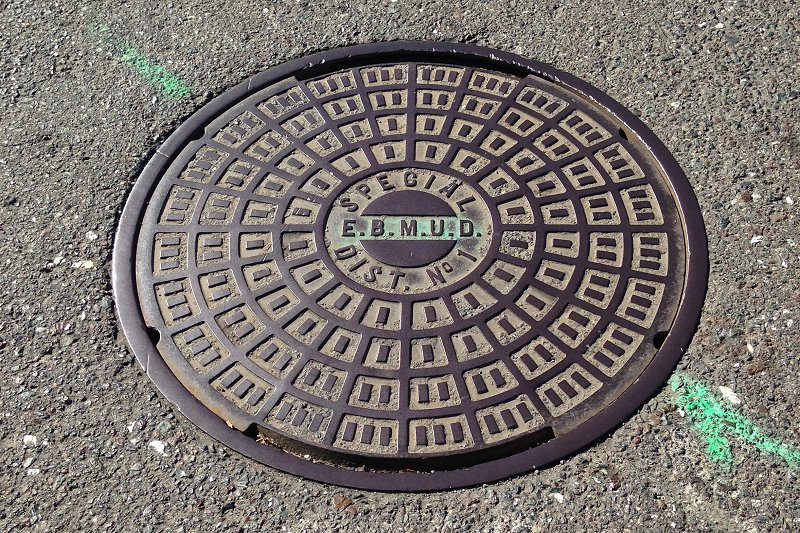
These handsome access covers are few and far between. They’re part of East Bay Mud’s sewage service.

Special District No. 1 was established in 1944 by elections in six East Bay cities and started operating in 1951. It serves a smaller area inside the region where EBMUD provides water service, as shown on this map from the utility’s site.

Wastewater from nine East Bay cities flows from city sewers to the District’s interceptors — large pipes that carry the water to the treatment plant near the Bay Bridge. From there the treated water goes into the Bay.

1939 – WPA (Dimond Canyon)

16 June 2017

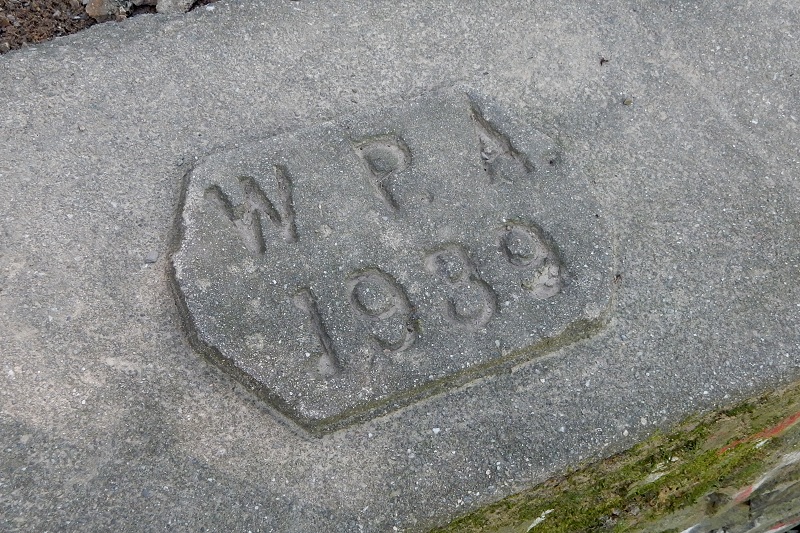
The Works Progress Administration employed hundreds of thousands of people during the Great Depression. A lot of those works involved concrete, and many well-made sidewalks and gutters around Oakland bear the “WPA” stamp from 1939, 1940 and 1941.

In Dimond Canyon, WPA projects were funded to remove landslides, build fire trails and run a sewer line down the bed of Sausal Creek. Finally, the WPA paid crews to put in a bunch of concrete channels and culverts for flood and erosion control. That was in 1939.

A lot of that work has been undermined by erosion. Eventually the stream will have its way again, unless the authorities find a need there and fill it again.

Sidewalk maker: P. M. Henning

9 June 2017

Paul Max Henning was born in 1886 in Giebichenstein, Germany. He served in the German navy for three years and then emigrated to America.

As of 1917, he was a PG&E employee living in Sacramento, where he requested an exemption from the draft, claiming a wife and father as dependents. His registration card recorded him as a man of medium height and build with light-blue eyes and light-brown hair. He also described himself as a German citizen.

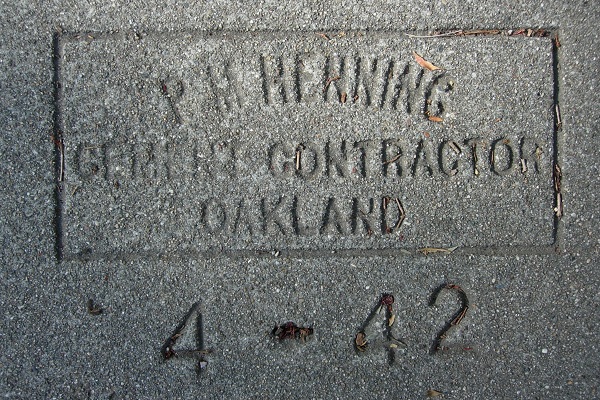
By 1921 he was living in Oakland, working as a clerk. The 1924 directory was the first to list him as a cement contractor, living at 726 15th Street. The next year he was at 5228 Lawton Avenue. The oldest mark of his I’ve found is from 1927. He ran ads in the Oakland Tribune in the late 1920s that would point readers to the address of a recent job, so you could go look at it or talk to the proud new homeowner. His mark was always sturdy.

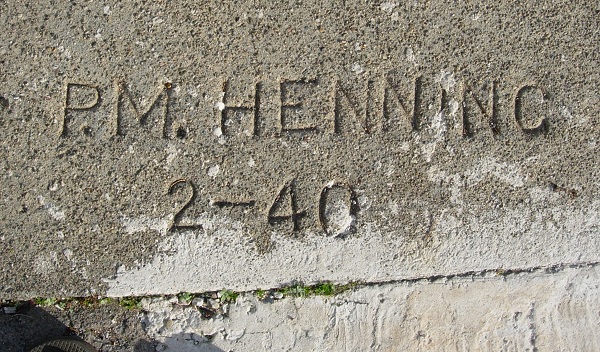
His mark never changed, with one exception — this single example from 1940.

In 1942 he gave the draft board an address at 333 Park View Terrace.

The latest date of his I have found is 1949.

Henning died in 1975, and his remains are encrypted in Mountain View Cemetery.

Union concrete masters IV

2 June 2017

Since posting my last set of OPCFIA union bugs from Local 594, I’ve found a few more.

I’ve profiled Nat Lena.

This one, you’ll know by the horseshoe and date, is from Ensor H. Buel. I’ll put together his story soon. But this shows what happens to so many marks as the years pass. When the parking-meter post at upper left was installed the workers smeared mortar on Buel’s mark, then more damage occurred when it was cut down, and sawcuts on the right were the latest insult.

After years of observing our sidewalk stamps, I notice when they disappear. Some are wiped out entirely as a whole lot is resurfaced, and others die gradually by a thousand cuts.