Piedmont pavement fancywork

18 August 2017

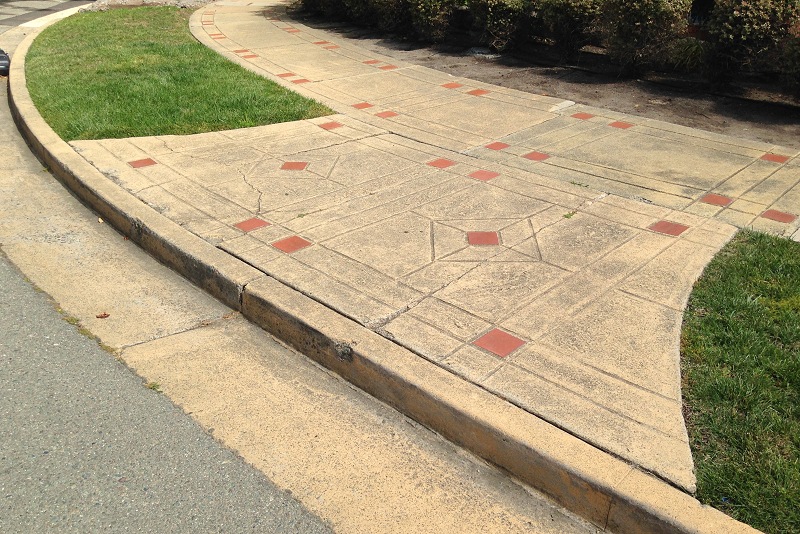
On Cambrian Avenue, in eastern Piedmont, are some striking examples of the concrete worker’s artisanship. This whole end of town is paved with the same pattern of grooves and plaques, apparently emplaced by the J. H. Fitzmaurice company. Where Cambrian and Sandringham Road meet is this elaborate custom corner.

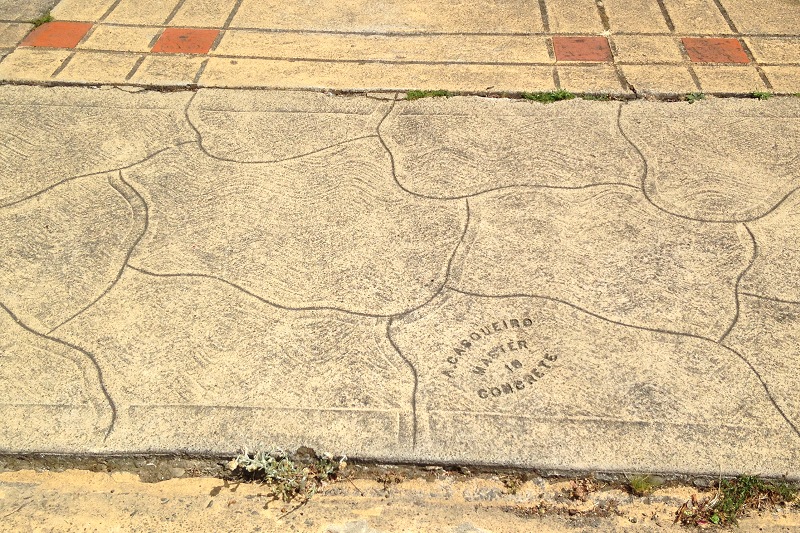
And nearby is a fine example of freeform finish work by August Casqueiro, marked with his “concrete master” stamp.

In all my years of documenting the maker’s marks, I neglected this aspect of sidewalk making. Time to collect a gallery, and maybe learn the names of these features.

Workers made the golden sidewalks, curbs and gutters by laying down a layer of colored slip on top of standard concrete, and then doing the fancy scoring and tiling. Red sidewalks are made the same way. The town of Piedmont diligently bevels off the sidewalks wherever the concrete becomes a tripping hazard, and that exposes the inside details.

Sidewalk maker: The Ransome Company

11 August 2017

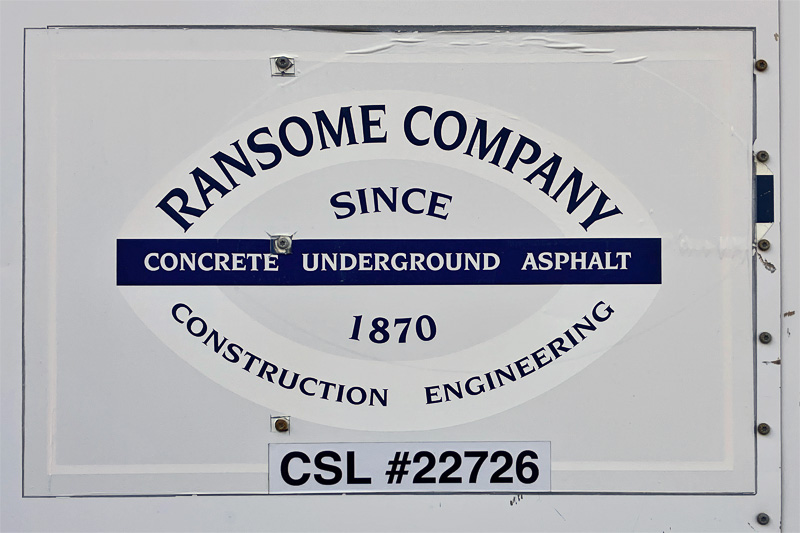
The Ransome Company traces its lineage back to 1870 and is still in the original business.
It was founded by Ernest L. Ransome (1844-1917), famous in engineering circles. His firm built the first reinforced concrete buildings in North America, including an Alameda refinery for “Borax” Smith’s company. The 1880 census listed him, his wife and their six children living at 1031 7th Avenue in East Oakland. He gave his occupation, there and in the 1880 business directory, as “artificial stone manufacturer.” The business was in San Francisco as of 1884, and the 1892 directory calls it Ransome & Cushing. At the time the family lived at 1505 10th Avenue with their six children.

Ransome’s firm is credited with constructing the Western Pacific train station on 3rd Street, Oakland’s first historical landmark.

His son Bernard Ransome (1873-1946) entered the business in 1898, starting in the East Oakland Contracting and Paving Company. He lived at 713 15th Street at the time. The rest of the family had moved to Brooklyn two years earlier.

There is a bit of confusion (in my mind anyway) about the Ransome company’s identity. Ransome Concrete Construction Company first appears in 1900 in the Oakland directory, at 1016 Broadway, with Bernard as its vice president and manager. A Hutchinson-Ransome Company also existed in 1902 and 1903, presumably a joint venture ensuing upon Bernard’s marriage in 1901 to Martha Hutchinson of the Hutchinson construction dynasty. (The couple lived at 426 Orange, in Adams Point, and later moved to 190 Grand Avenue. Bernard is buried in the Hutchinson family plot at Mountain View Cemetery.) By 1904 Ransome had left the Hutchinson Company, and that year ads for Ransome Construction Company appeared in the Oakland Tribune, listing Bernard Ransome as president and Hugh Crummey as secretary.

That year it was awarded a $300,000 contract to construct 12 miles of Foothill Boulevard below High Street, “the scenic boulevard between Oakland and Haywards.” The San Francisco Call reported, “The drive follows the contour of the hills at an elevation of about 200 feet, and gives a splendid view of the country.” This opened up a huge tract of land to developers. The firm also “bitumenized” San Pablo Avenue south of Emeryville starting in 1905. It also built the Ocean Shore rail line from Santa Cruz to San Francisco, through Devil’s Slide.

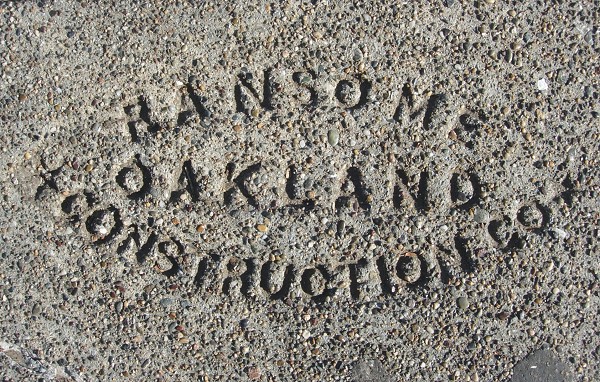
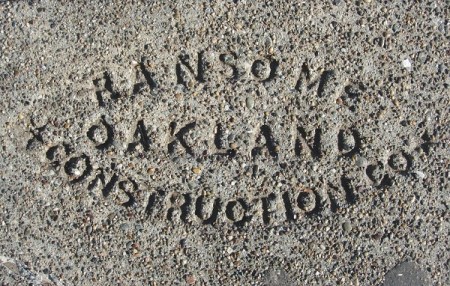
This sidewalk stamp, at 215 Ridgeway Avenue, may date from that time. The arched lettering and the presence of stars are typical of pre-1910 marks.
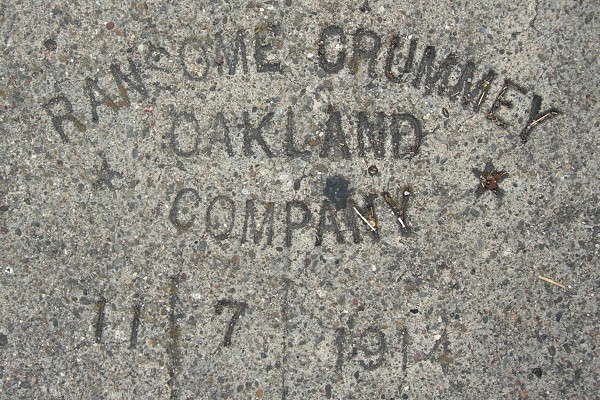
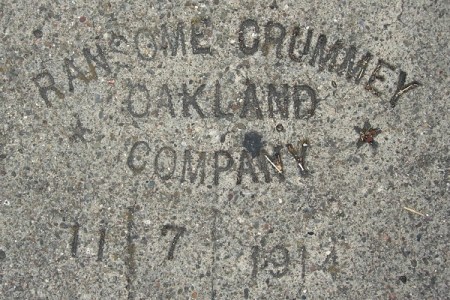
At the same time, the Ransome Concrete Company was listed in the 1907 San Francisco directory with Bernard Ransome and Hugh Crummey among its principals, specializing in “reinforced concrete building construction.” As of 1908 Ransome and Crummey had left and were listed just below the Concrete company as the Ransome-Crummey Construction Company. A famous court case later in that decade went against the company, the ruling hinging on the company’s suspension after it failed to pay taxes. I have found its sidewalk stamps dated 1914 and 1915.
At this time, the firm’s main yard was at 28th and Poplar in West Oakland. It gave Broadway its first asphalt paving. It operated rock quarries at Point San Pedro (for the rail line), Leona Heights (now the site of Merritt College), and Exchequer in the Sierra Nevada foothills (now under Lake McClure).

E. L. Ransome served as chairman of a new Ransome company in New York in 1916, but he died the next year. Ransome-Crummey disappeared from the directory as of 1921, around the time the notorious Ransome-Crummey case ended with its last appeal, although Bernard was still listed as a contractor.

Ransome teamed up with a Mr. Randle as the Ransome-Randle Company and were winning city contracts for street improvements in 1919 and 1920. At least one stamp from this company remains in Berkeley.

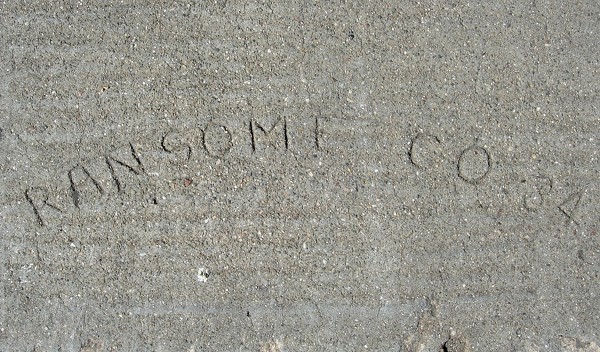
The Ransome Company appears to have been reincorporated in 1927 in Santa Cruz County, still under Bernard Ransome and Hugh Crummey. Bernard had left Oakland for Berkeley by that time. This odd mark is the only record I have from that time.
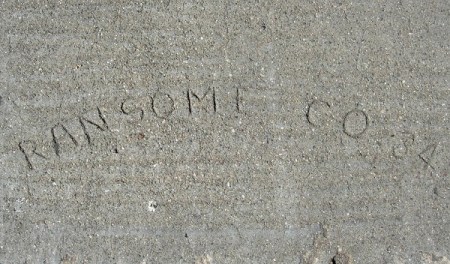
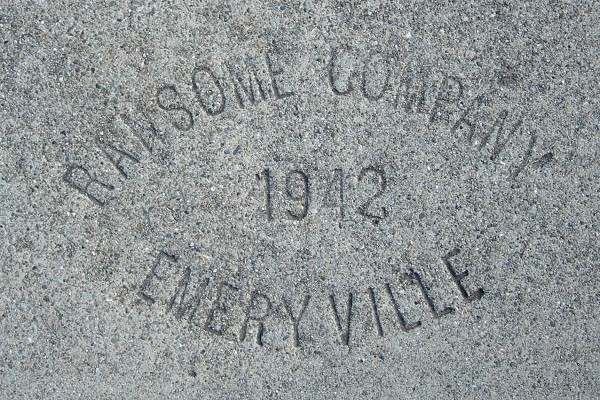
From 1934 through 1969 (the latest directory I have access to), the Ransome Company was in Emeryville at 4030 Hollis Street, and Bernard’s son Tallent was vice president under his father, who was president until he died at age 72. I have examples of this mark ranging from 1939 to 1991.
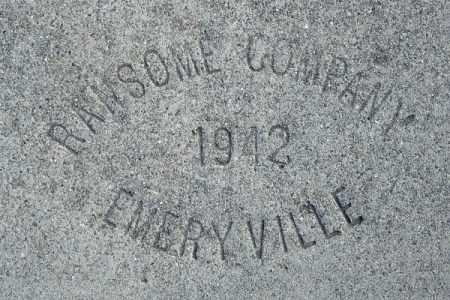
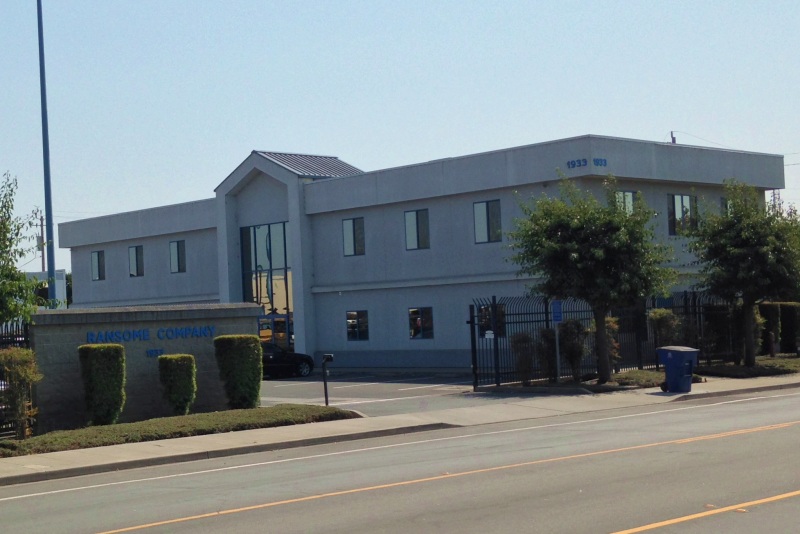
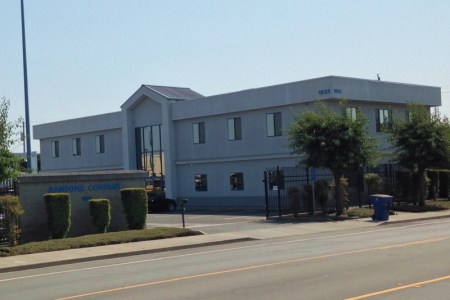
Today the firm is in San Leandro, at 1933 Williams Street, but is no longer led by a Ransome. Here is its headquarters . . .
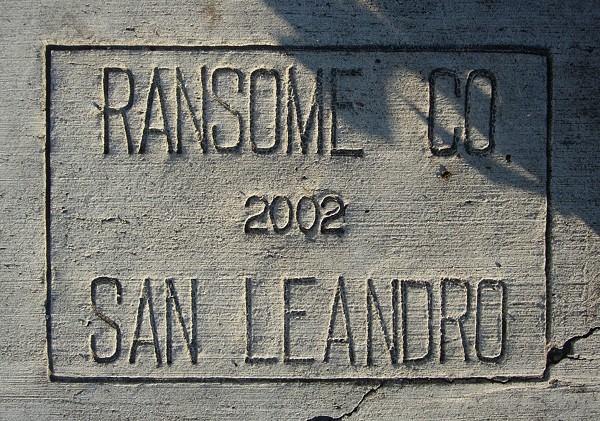
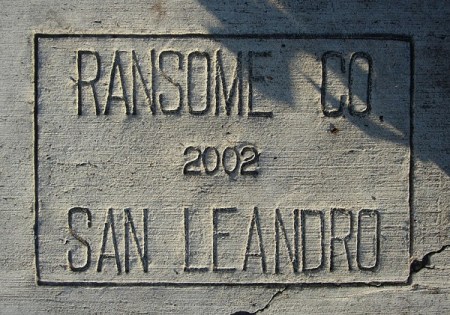
. . . and a recent sidewalk stamp . . .
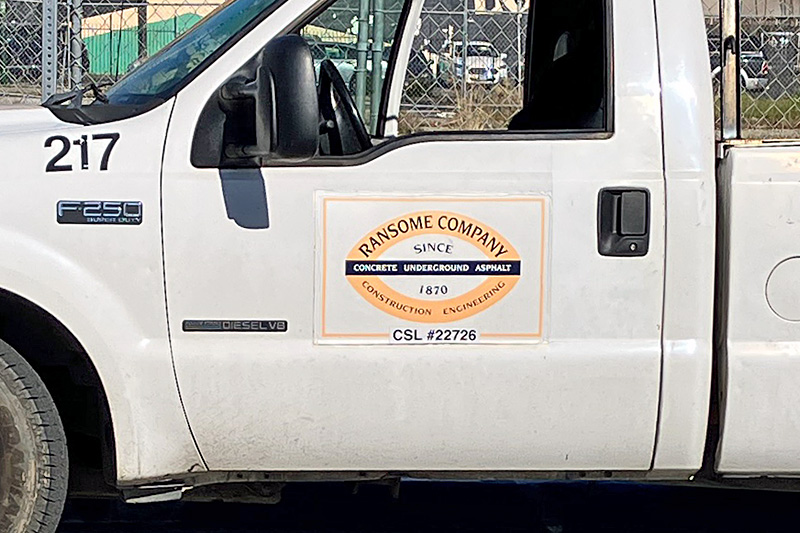
. . . and one of today’s trucks.
United Iron Works

4 August 2017

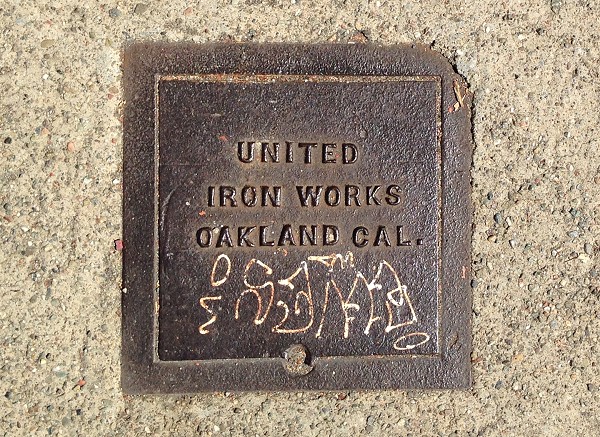
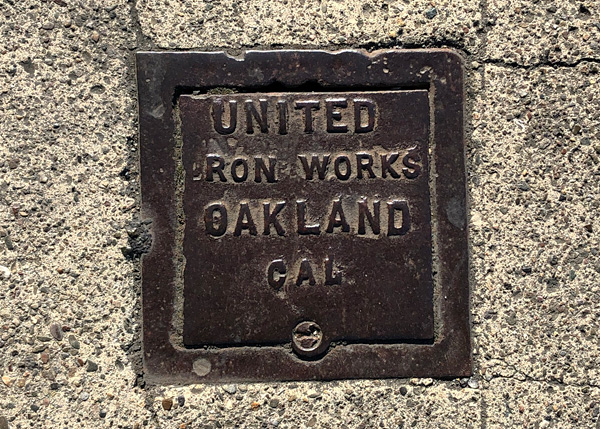
United Iron Works manufactured all sorts of metal things, but I had no idea until I spotted this on a sidewalk a few weeks ago.

And another one I found later.

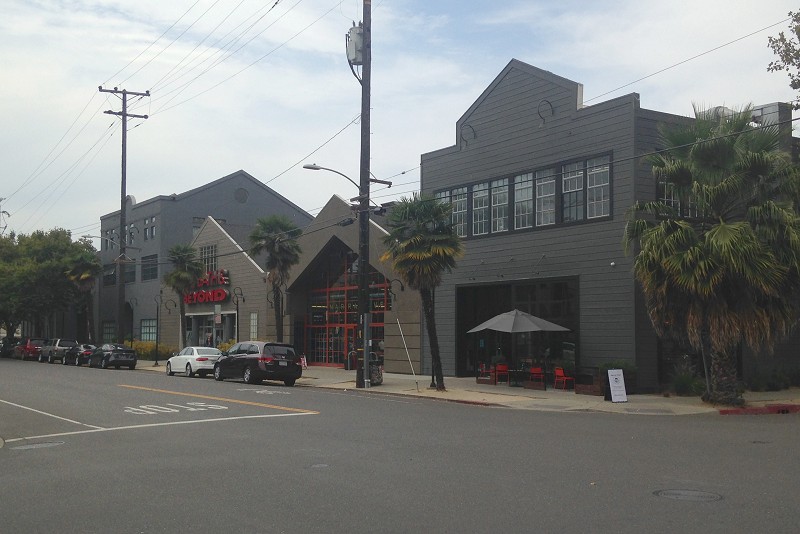
United Iron Works had that name from 1904 until 1955 and operated out of a complex of buildings, built starting in the 1880s, on both sides of 2nd Street between Clay and Jefferson Streets. Today a Cost Plus market sits where the foundry used to be, and a Bed Bath & Beyond store occupies one of the surviving buildings. The whole complex is a registered historic landmark.

The company was founded as Oakland Iron Works in 1871, according to the landmark application, and was reorganized as United Iron Works in 1904. The renovated complex is called Oakland Ironworks today.

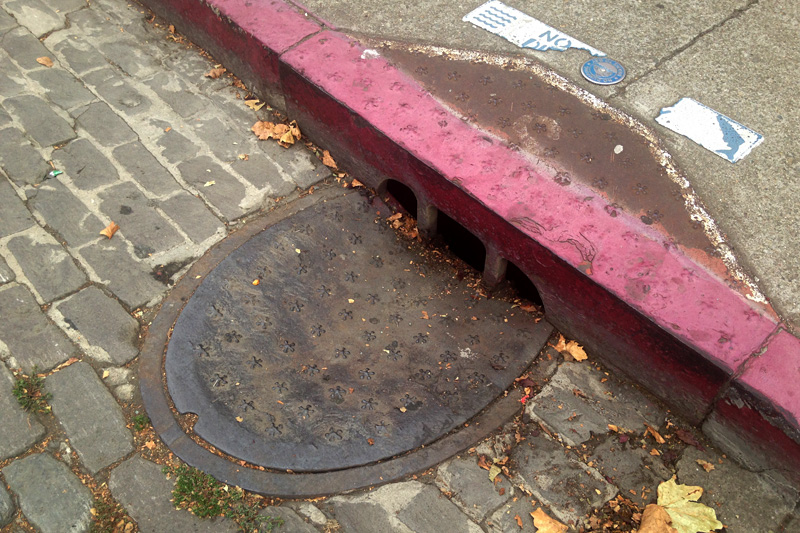
I have a suspicion that the firm made this interesting street drain just across Clay.

I’ve been here a hundred times and never noticed it until just now.

Sidewalk makers: Andersen & Montgomery

28 July 2017

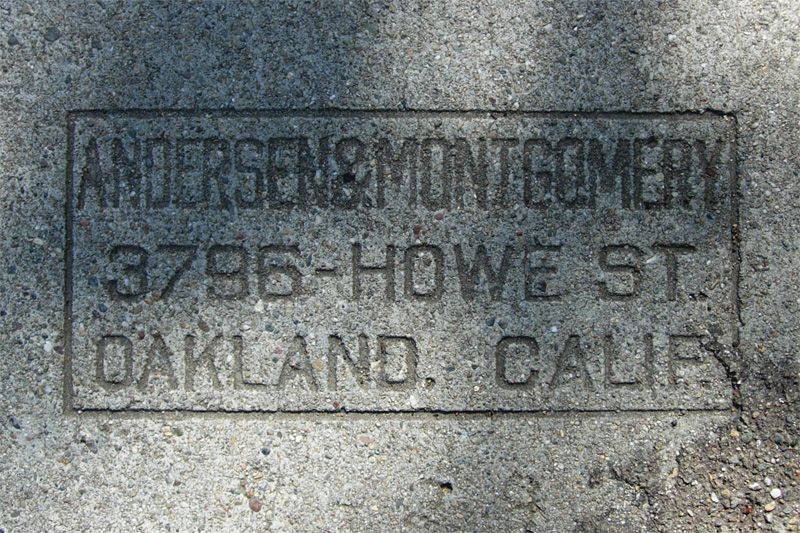
The Andersen & Montgomery partnership did a small number of surviving sidewalks in the Piedmont Avenue neighborhood and in Piedmont.

I’ve found two other marks dated 1929, but usually there are no dates.

The address on the stamp, 3796 Howe Street, was wiped out by the construction of the MacArthur-Broadway shopping center and then by the new Kaiser hospital building. John Andersen lived there with his wife Hulda (Lobel), according to the 1930 directory and the census. He was born in Denmark in 1859 and immigrated to the U.S. in 1883. Hulda was German, born in 1864, and immigrated in 1888. So they were pretty old by this time. She died in 1954, but I don’t know about him.

John Andersen was surely the “J. Andersen,” of 3774 Howe Street, responsible for this mark:

These date from 1912 to 1928 and are found mainly in North Oakland.

Robert B. Montgomery was a much younger man, born in Colorado in 1904 or 1905. He married the former Alice Sueell in 1929 and raised a family at 2626 Ivy Drive, where her folks lived. He dealt with bungalows, mainly. He is also responsible for this 1931 stamp on E. 24th Street.

It’s the only dated example I’ve found. Montgomery got in the paper in 1951 when he bought the Olympic Hotel building, at 2nd Avenue and E. 12th Street, and moved it across the street.

Standout Streets: Elston Avenue

21 July 2017

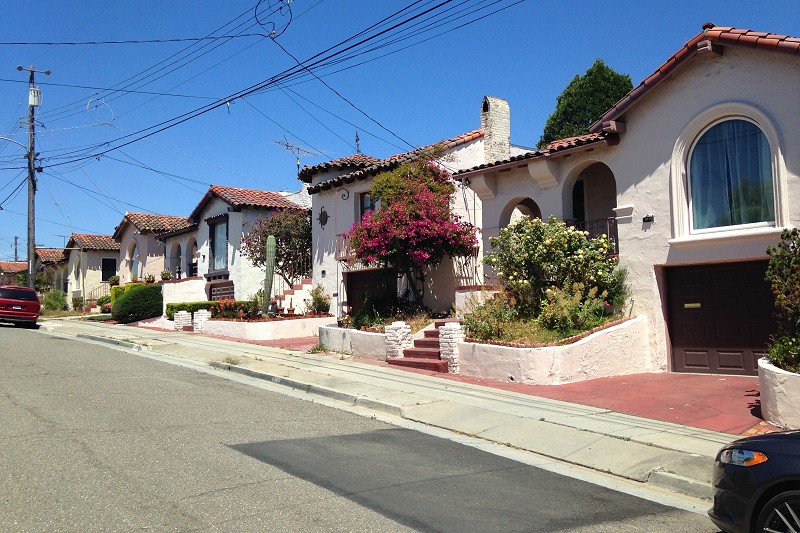
The 3700 block of Elston Avenue that’s just behind the Altenheim is an exquisite set of homes, each custom-built in the mid-1930s in the same Spanish Revival style and with a streetscape to match.

First the houses.

The first time I came upon this street, an old-timer came out and regaled me with the story of the developer who assembled this set of houses, building them one or two at a time. Like Henry Ford’s Model T, you could have whatever you wanted as long as it was beige stucco with a red tile roof. I wish I could recall the developer’s name, but perhaps one of you can identify him in a comment.

Elston Place is in the middle of the block, offering views downtown.

The street corner here has one of the details that adds to the block’s charm, a dated Fitzmaurice mark from 1933 when the base sidewalk was laid down.

Here’s another view farther up the block that includes the driveways.

Look close (all these images are clickable, as usual) and you’ll see a familiar triangle there.

Yes, good old Frank Salamid did every driveway on this block. Thus every artisan who made this block added to the rare degree of unity and consistency that makes well-preserved Elston one of my very favorite Oakland streets.

Sidewalk maker: Ed Doty

14 July 2017

Edwin “Ed” Doty was a major maker of Oakland and East Bay sidewalks, doing business with his son Abraham “Abe” for many years as Ed Doty & Son.

Doty was born in Canada in 1862 and became a naturalized U.S. citizen, but he gave conflicting information about his parents and the year he immigrated. Frank Merritt’s 1928 History of Alameda County has a long, colorful biography of him (helpfully quoted in this comment by “stacinator”), recounting his years ranching in the Yellowstone country, managing ironworkers in Hawaii, an idle year in Guam, drilling wells at Point Richmond and finally joining the Cement Workers Union in San Francisco, where he was suffering with a freshly broken arm and fractured skull at the time the earthquake struck.

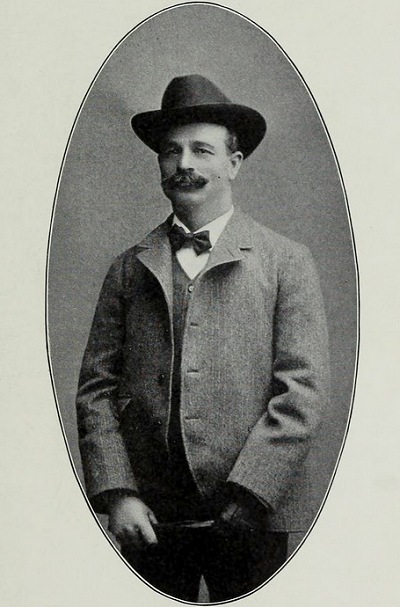
He married Lizzie Watlington in 1906 and they had one child, Abraham (1908-2003). Ed died in 1931. The biography in Merritt’s history includes this photo of Ed in his prime.

The 1909 directory lists him at 1687 26th Avenue. In 1919 he built a new home at 2487 26th Avenue and moved there. It’s a nice place; I’ll show it to you farther down.

A glass paperweight made by Ed Doty & Son, recently listed on eBay, contains the text “Trademark of Concrete Since 1907” and the address 3481 26th Avenue.

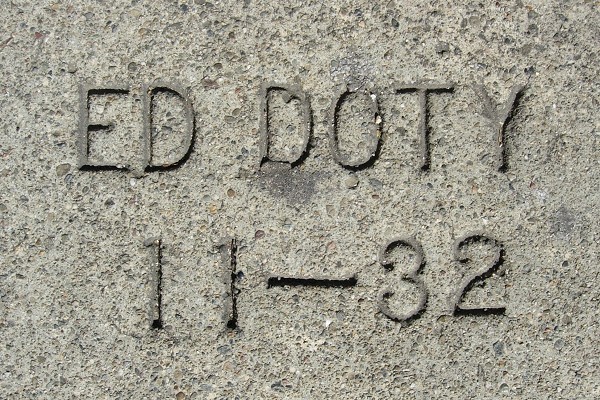
I’ve found “Ed Doty” sidewalk stamps in Oakland dating from 1923 to 1945, in a variety of configurations. The original imprint looked like this:

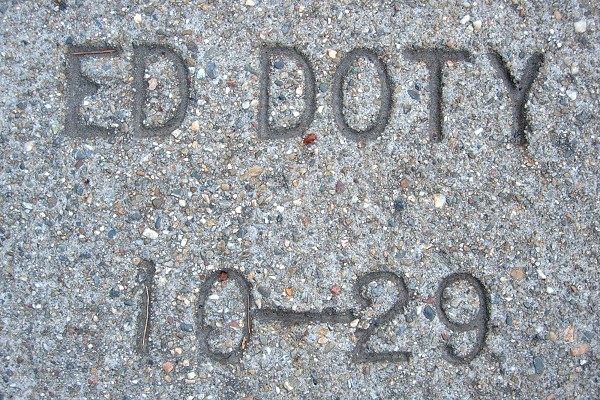
From 1928 to 1931 the Doty stamp looked like this, with larger letters:

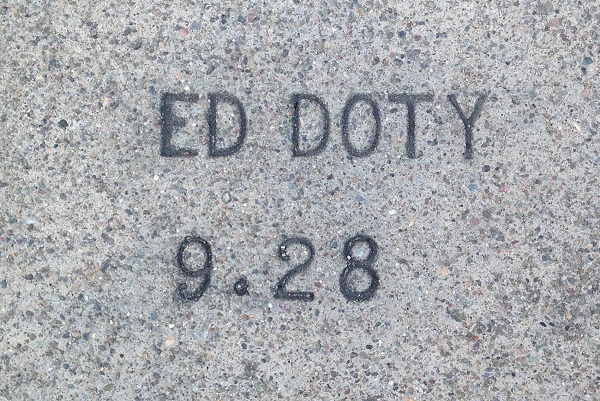
Or this, with a dot in the date instead of a dash.

Starting in 1932, they looked like this, distinguishable by the shape of the “E” and the “O”. I have examples all the way up to 1944.

At some time before June 1937 the firm switched to a new design that incorporated the “concrete master” number. It used number 16 from then until March 1938:

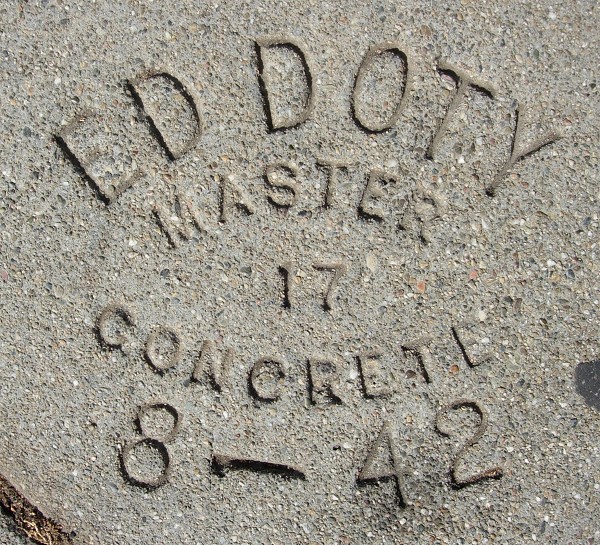
Starting in April 1938 it used number 17. I speculate that Abe Doty had to replace his master finisher for some reason and needed a new number.

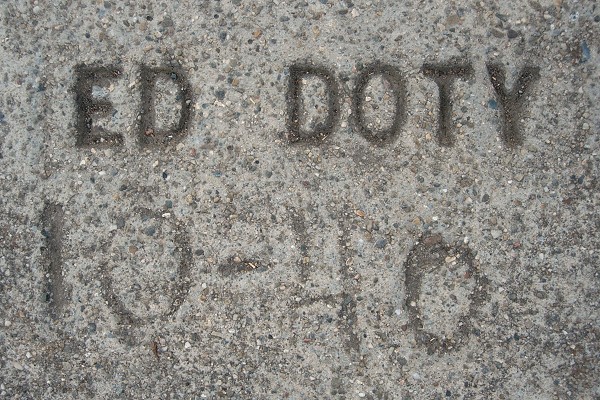
All along, the firm also kept using the original stamp, but with hand-drawn dates:

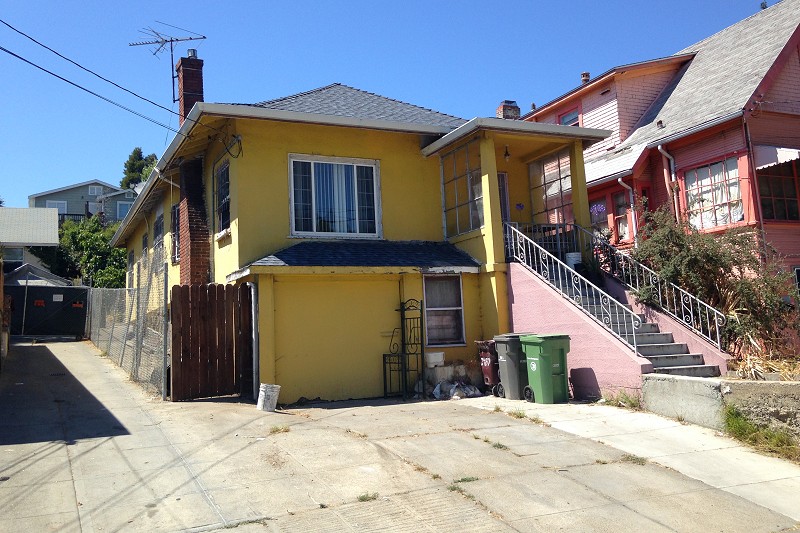
Here’s the Doty house. Of course, Doty laid most of the concrete on the block, replacing work by the earlier generation like Stevenson.

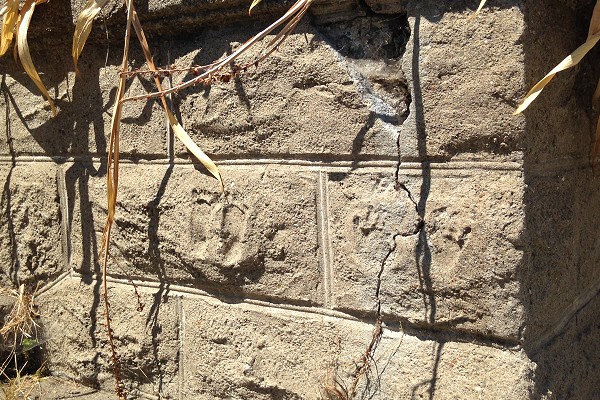
The driveway is gorgeous, as concrete driveways go. There’s a little panel on the corner bearing a small child’s hand and foot prints. And here, in the entryway, are some more. These could not have been Abraham’s; perhaps there were grandchildren handy.

In writing this post, I realize that there are details about the stamps that I need to clarify, so look for updates in the comments every now and then.

C. G. Janson

7 July 2017

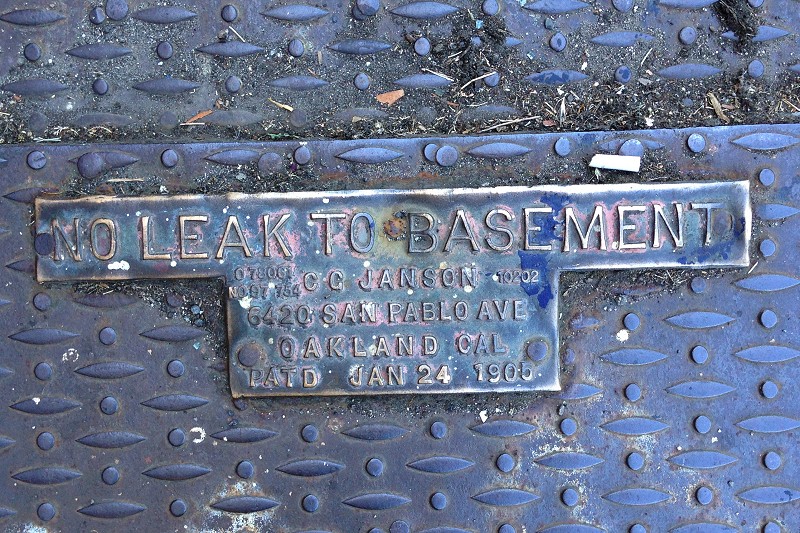
You’ve seen the sidewalk elevators in old Oakland sidewalks, with their ancient battered steel doors. Most of them came from San Francisco companies, but Carl G. Janson manufactured them in Oakland, at 6420 San Pablo Avenue.

I haven’t done a big search for Janson’s biography, but he was granted several patents, one for a sidewalk-elevator door frame in 1912 and another for a bunk in 1921. The 1905 patent referred to on this door doesn’t turn up.

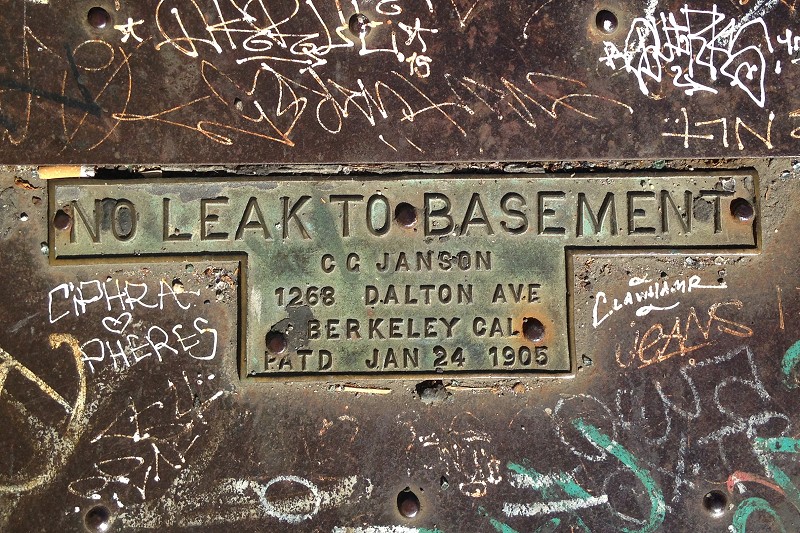
This Janson door on 13th Street indicates that his firm was in Berkeley for a time.

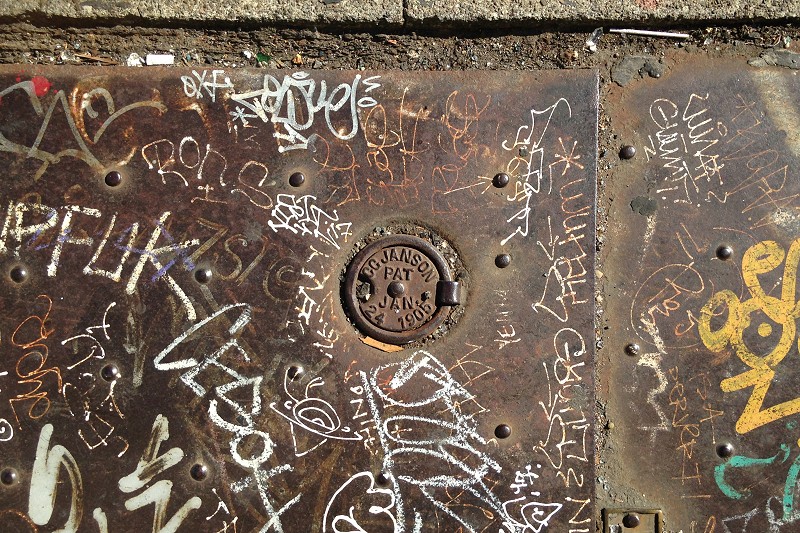
And maybe it was because I’d just left the Oakland Museum after seeing the Roy De Forest show, but the door struck me as unexpectedly attractive.