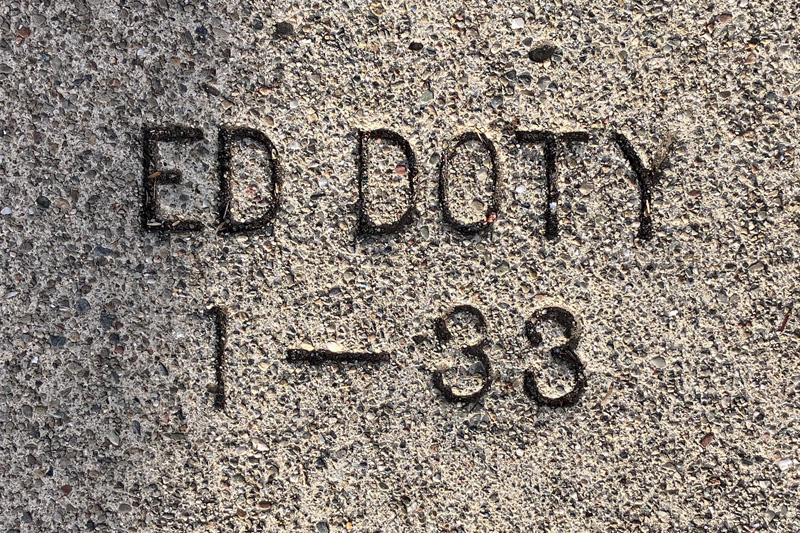
2412 26th Avenue
I posted a 1933 Doty mark before, but this is a much better, standard version of his stamp.
2412 26th Avenue
I posted a 1933 Doty mark before, but this is a much better, standard version of his stamp.

Livio Giovanni Scaramelli (1902–1969) was born in Lucca and emigrated from Italy at age five to Alameda with his mother Maria, joining his father Pietro who had emigrated five years before. He went by Lee John Scaramelli off and on during his life. He married Alma Ballwanz at age 22, at which time he worked as a welder. His father died in 1915 and in 1923 his mother married tile worker Antonio “Anthony” Falcier (1870–1949), another Italian immigrant, who trained Livio in his business, and in 1924 he appeared in the directory as a tilesetter. By 1926 he’d changed his listing to cement contractor and started to advertise in the papers. He moved a few times in Alameda, but from 1934 to 1949 he was at 815 Santa Clara Avenue before relocating to Walnut Creek. He advertised his services (for patios and floors) as late as 1957. He died in Carson City, Nevada.
In 1938 a newspaper puff piece said about him, “‘Lasting Satisfaction’ is his motto, and the only order he gives the five men working for him is: ‘The best is none too good.’ . . . [He] has the gold of kindness in his nature . . . is never a backslider in boosting the home town and would find friends even on Robinson Crusoe’s island.”
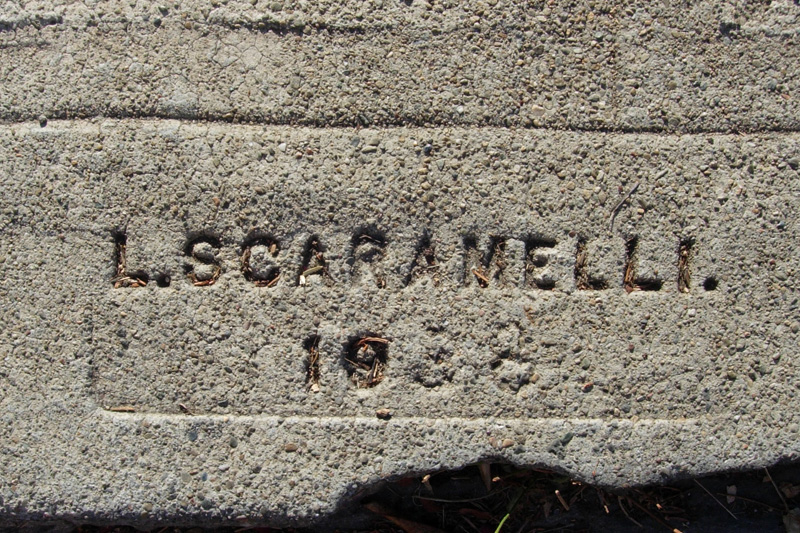
L. Scaramelli sidewalk stamps have dates from 1927 to 1954. In the 1940s he drew his dates by hand in a sure, elegant script.
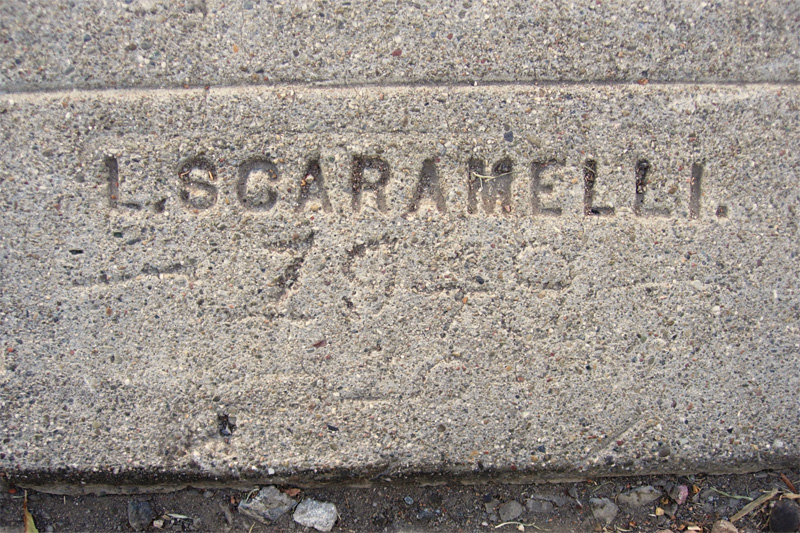
They all have a period—“Scaramelli.”—at the end.
From Frank C. Merritt’s History of Alameda County (1928):
“Cement has taken its rightful place high in the list of the leading building materials and is now practically indispensable in the construction of modern business blocks and residences. One of the leading cement contracting firms in the East Bay district is that of Riechel & Bredhoff. The senior member, Olaf Riechel [1877-1946], was born in Chicago, Illinois, February 21, 1878 [sic], and received his early education in the schools of that city. When twelve years of age he accompanied his parents on their removal to Alameda, California, and in the public schools of this city completed his studies. When seventeen years of age he went to work for Powell Brothers, with whom he learned the trade of cement working. He was promoted to the position of foreman and eventually became superintendent of construction, having in charge the erection of the Orpheum Theater building and other, important business structures, as well as large apartment houses and fine residences. He remained with that firm for twenty years and in 1918, formed a partnership with H[arold]. G[eorge]. Bredhoff, under the firm name of Riechel & Bredhoff, and engaged in the cement contracting business. They are doing a large business in their line, particularly as subcontractors, besides which they have laid many miles of cement walks and curbs in the East Bay cities. They did the cement work on the Heald Business College building, the Lynn building and the Barber block, as well as apartment houses and homes, and also erected the cement walls around the Pacific Gas and Electric plant on Thirty-first street, Oakland. They have likewise been very successful in building and selling homes.
“H. G. Bredhoff [1888-1975] was born in San Francisco, California, on the 8th of March, 1888, and received his educational training in the public schools of Alameda and Oakland. On leaving school he learned the trade of cement worker and was employed on the construction of the old Realty Syndicate building in Oakland. He was with Powell Brothers for sixteen years, leaving the employ of that firm to enter into business with Mr. Riechel. He is a member of the Fraternal Order of Eagles.”
Riechel was the son of German and Danish immigrants, and Bredhoff had German grandparents.
The firm operated out of 2509 Clement Avenue, Alameda.
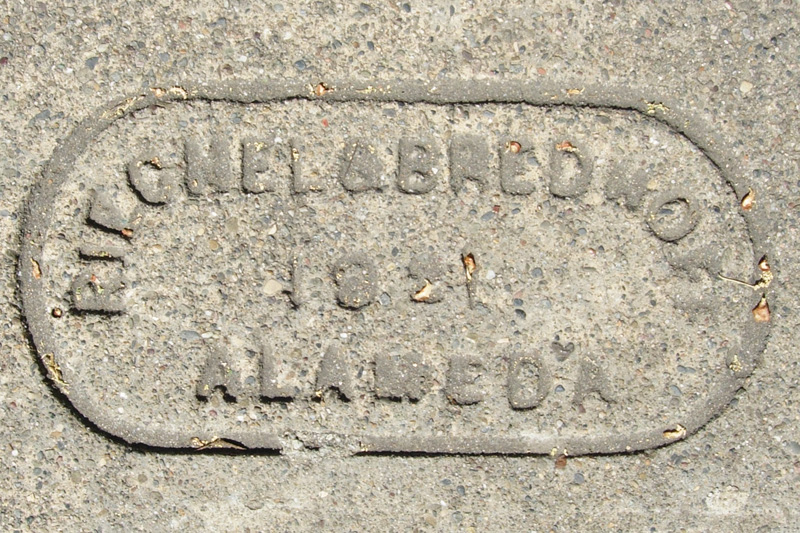
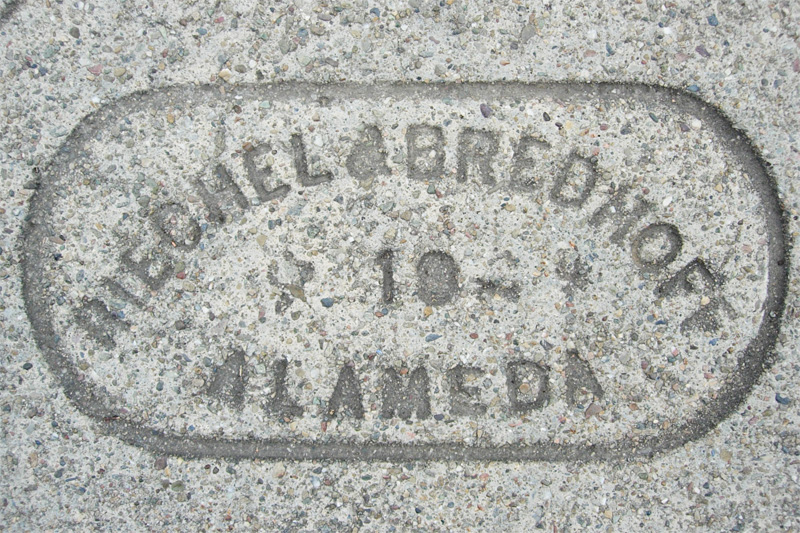
Riechel & Bredhoff stamps appear on Oakland sidewalks with dates from 1921 to 1951. They have two forms that I call the high and low arch. The low arch is much less common, but both stamps have comparable age ranges. I didn’t differentiate them at first, so there’s still more research to do.
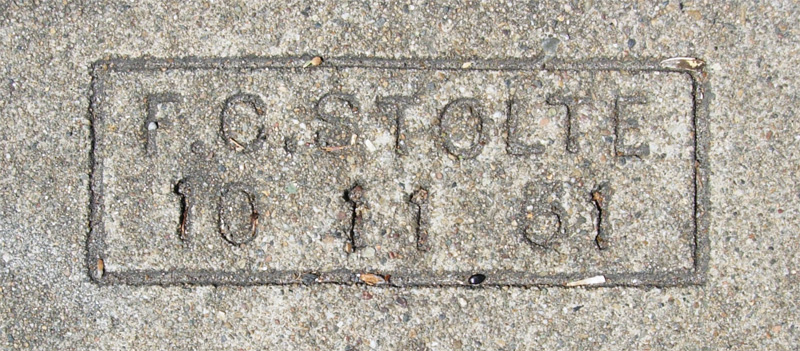
Ferdinand Charles Stolte (1889-1983), the son of German immigrants, was raised in Oakland and became a successful builder of high-end homes, apartments and commercial buildings in the area. He’s interred in the Mountain View Cemetery mausoleum with his wife, the former Elizabeth Moran of Crow’s Landing, and their son F. Charles Jr.
Merritt’s 1928 history of Alameda County reported, “He is painstaking in the fulfillment of his contracts, employs none but expert workmen and the work done by him has been uniformly satisfactory to those who have employed him.”
I have recorded a few dated Stolte marks ranging from 1931 to 1951.
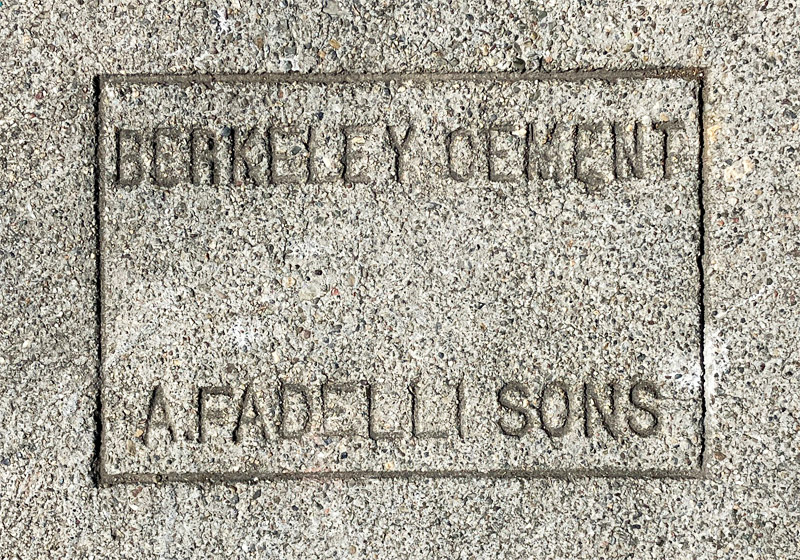
Berkeley Cement originated in 1947 according to its website; however, I have documented three examples of a Berkeley Cement stamp from 1946 with a horseshoe design. At first it was a partnership between Alfred Marian Fadelli (1911-1985) and Frank Massaro, of Triberti & Massaro fame, that was dissolved in 1958.
Alfred’s sons, the late Andrew A. Fadelli and Ronald Fadelli, joined the firm soon after. Why “A. Fadelli Sons” is on their stamp is unclear; the name was never used formally that I can tell, and Alfred was alive and listed with the sons in the 1967 directory. Perhaps the sons specialized in sidewalks in their early years.
The firm, still owned and run by the Fadelli family, offers a wide range of construction services with union labor.
Most examples of the A. Fadelli Sons stamp are undated. I have found only a few dated 1962, and all examples appear to be around that age.
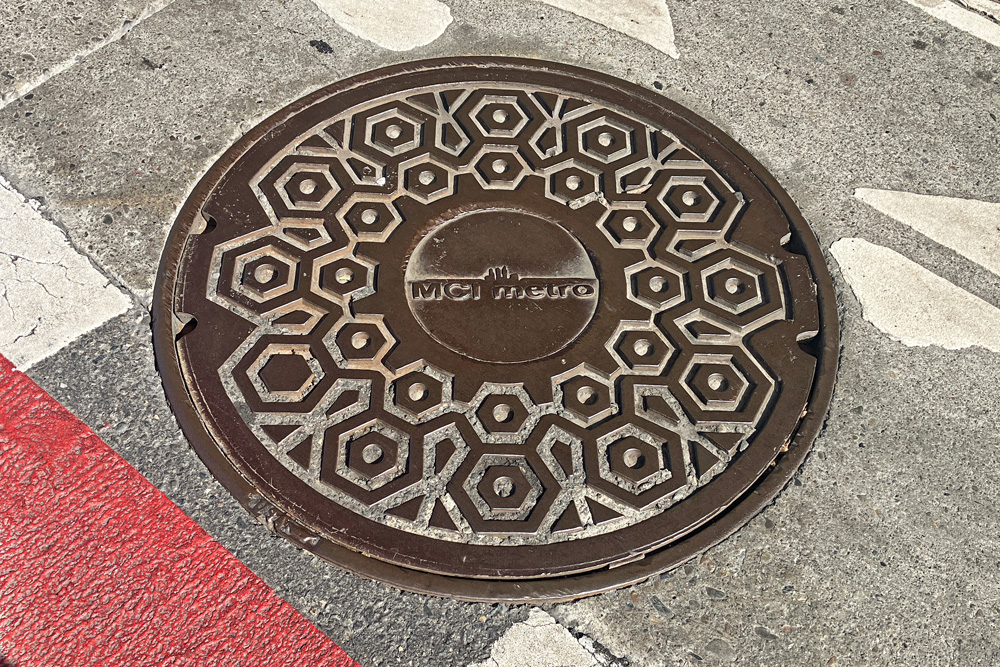
20th Street near Broadway
MCImetro is a division of Verizon that handles backbone fiber traffic. It was formerly MCI Access Transmission Services before being acquired in 2006, so that’s the nearest thing to a date. The lid shares the same rugged hexagon design used by AT&T, Bell System and Western Union.

Grass Valley is a small tourist-and-commuter town in the Sierra foothills with a long history of gold mining. There are more sidewalk stamps to be found here; these are just the two I noticed while strolling on Main Street.
 Oakland Underfoot