Archive for the ‘ Profiles’ Category

Sidewalk makers: The Ferreros

25 August 2017

Fred Peter (Federigo Pietro) Ferrero was born in 1883 in Castellamonte, Torino province, Italy, emigrated in 1899, and launched a pottery business in 1920. Around 1927 he changed the firm to Fred Ferrero & Son, with his eldest son Romeo Achilles Ferrero (1908-1998). The other son Aldo Joseph (1912-1987) joined the firm, making it Fred Ferrero & Sons, in 1932. Fred died in 1944. In 1928 the History of Alameda County said about him, “He is a man of excellent personal qualities, straightforward in all his relations, and cordial and friendly in manner, and throughout Alameda County he is held in high regard.”

The company’s address was 1715 Webster Street, Alameda, starting in the early 1920s. Noted work by Ferrero includes the concrete and plaster for the Latham Square Building (1926) and the “art stone and staff ornaments” for the Grant Miller chapel on Telegraph Avenue (1931).

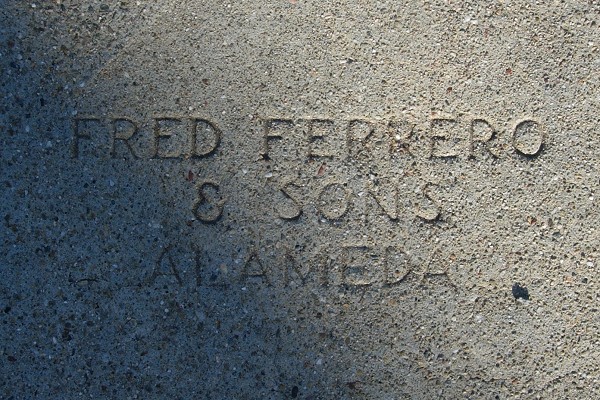
There are only two Fred Ferrero marks on Oakland sidewalks, neither of them dated. This one is on Longfellow Avenue.

Fred and Lucia (1888-1975) as well as Romeo and Jennie (1909-1978) are buried in San Pablo.

Aldo is the A. J. Ferrero of Alameda whose marks appear on Oakland sidewalks from 1952 to 1981. They are elegant and lightly pressed, so that they show up best when the sun is low.

In the mid-1960s, the firm also used this lozenge-shaped mark. It’s identical to the mark used in Alameda for work produced by the City of Alameda, so perhaps they had a contract with the city at that time.

Aldo and Jan (1913-1991) are also buried in San Pablo.

There is also a G. Ferrero, who left a single surviving mark in Oakland from 1927, but he is not mentioned in connection with Fred’s family.

Sidewalk maker: The Ransome Company

11 August 2017

The Ransome Company traces its lineage back to 1870 and is still in the original business.
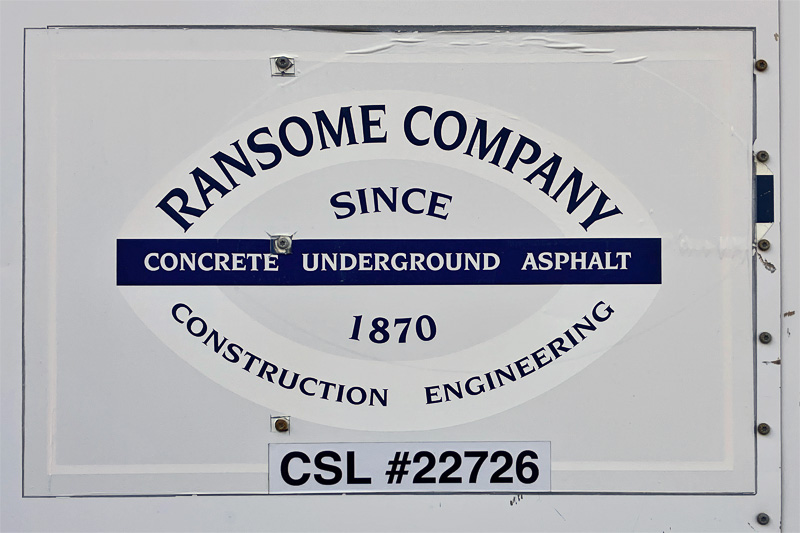
It was founded by Ernest L. Ransome (1844-1917), famous in engineering circles. His firm built the first reinforced concrete buildings in North America, including an Alameda refinery for “Borax” Smith’s company. The 1880 census listed him, his wife and their six children living at 1031 7th Avenue in East Oakland. He gave his occupation, there and in the 1880 business directory, as “artificial stone manufacturer.” The business was in San Francisco as of 1884, and the 1892 directory calls it Ransome & Cushing. At the time the family lived at 1505 10th Avenue with their six children.

Ransome’s firm is credited with constructing the Western Pacific train station on 3rd Street, Oakland’s first historical landmark.

His son Bernard Ransome (1873-1946) entered the business in 1898, starting in the East Oakland Contracting and Paving Company. He lived at 713 15th Street at the time. The rest of the family had moved to Brooklyn two years earlier.

There is a bit of confusion (in my mind anyway) about the Ransome company’s identity. Ransome Concrete Construction Company first appears in 1900 in the Oakland directory, at 1016 Broadway, with Bernard as its vice president and manager. A Hutchinson-Ransome Company also existed in 1902 and 1903, presumably a joint venture ensuing upon Bernard’s marriage in 1901 to Martha Hutchinson of the Hutchinson construction dynasty. (The couple lived at 426 Orange, in Adams Point, and later moved to 190 Grand Avenue. Bernard is buried in the Hutchinson family plot at Mountain View Cemetery.) By 1904 Ransome had left the Hutchinson Company, and that year ads for Ransome Construction Company appeared in the Oakland Tribune, listing Bernard Ransome as president and Hugh Crummey as secretary.

That year it was awarded a $300,000 contract to construct 12 miles of Foothill Boulevard below High Street, “the scenic boulevard between Oakland and Haywards.” The San Francisco Call reported, “The drive follows the contour of the hills at an elevation of about 200 feet, and gives a splendid view of the country.” This opened up a huge tract of land to developers. The firm also “bitumenized” San Pablo Avenue south of Emeryville starting in 1905. It also built the Ocean Shore rail line from Santa Cruz to San Francisco, through Devil’s Slide.

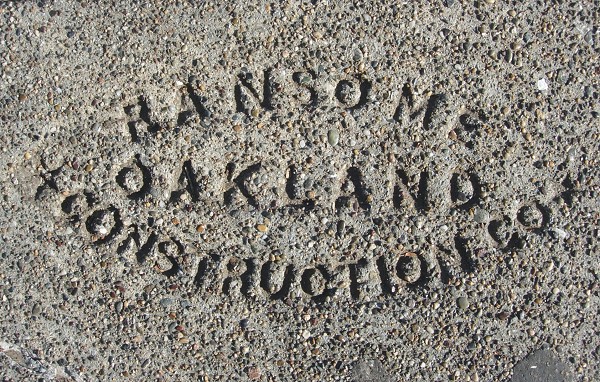
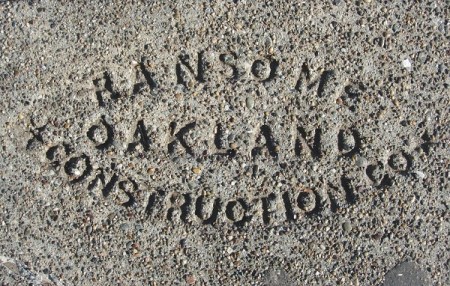
This sidewalk stamp, at 215 Ridgeway Avenue, may date from that time. The arched lettering and the presence of stars are typical of pre-1910 marks.
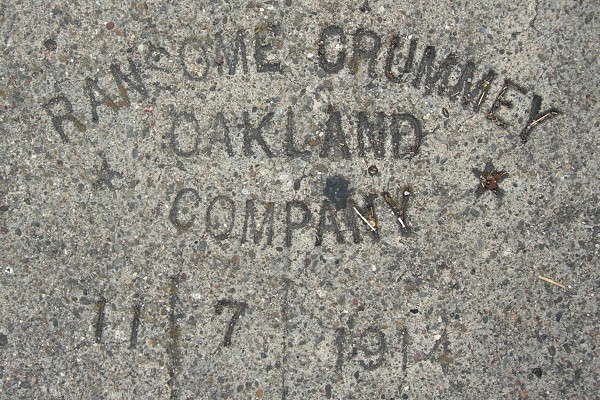
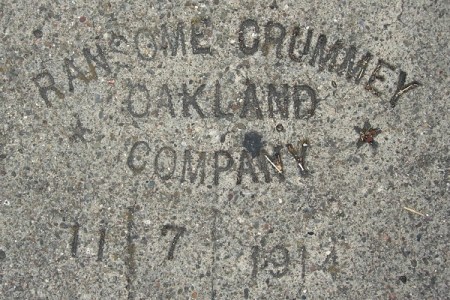
At the same time, the Ransome Concrete Company was listed in the 1907 San Francisco directory with Bernard Ransome and Hugh Crummey among its principals, specializing in “reinforced concrete building construction.” As of 1908 Ransome and Crummey had left and were listed just below the Concrete company as the Ransome-Crummey Construction Company. A famous court case later in that decade went against the company, the ruling hinging on the company’s suspension after it failed to pay taxes. I have found its sidewalk stamps dated 1914 and 1915.
At this time, the firm’s main yard was at 28th and Poplar in West Oakland. It gave Broadway its first asphalt paving. It operated rock quarries at Point San Pedro (for the rail line), Leona Heights (now the site of Merritt College), and Exchequer in the Sierra Nevada foothills (now under Lake McClure).

E. L. Ransome served as chairman of a new Ransome company in New York in 1916, but he died the next year. Ransome-Crummey disappeared from the directory as of 1921, around the time the notorious Ransome-Crummey case ended with its last appeal, although Bernard was still listed as a contractor.

Ransome teamed up with a Mr. Randle as the Ransome-Randle Company and were winning city contracts for street improvements in 1919 and 1920. At least one stamp from this company remains in Berkeley.

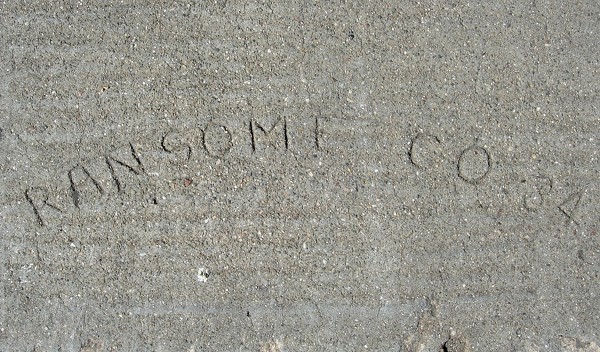
The Ransome Company appears to have been reincorporated in 1927 in Santa Cruz County, still under Bernard Ransome and Hugh Crummey. Bernard had left Oakland for Berkeley by that time. This odd mark is the only record I have from that time.
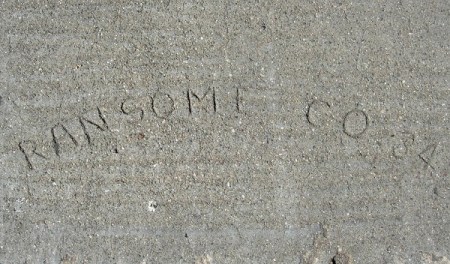
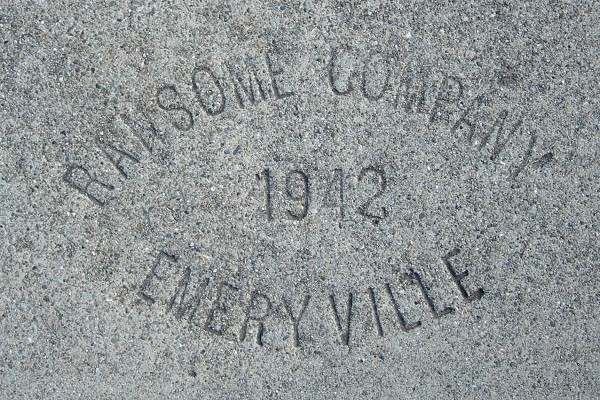
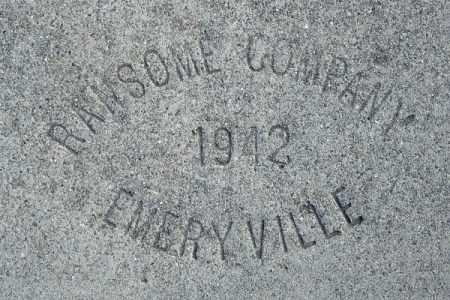
From 1934 through 1969 (the latest directory I have access to), the Ransome Company was in Emeryville at 4030 Hollis Street, and Bernard’s son Tallent was vice president under his father, who was president until he died at age 72. I have examples of this mark ranging from 1939 to 1991.
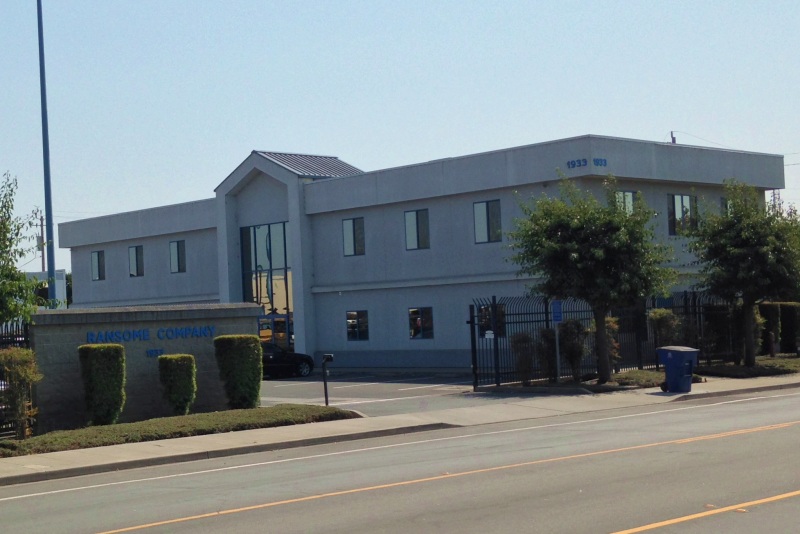
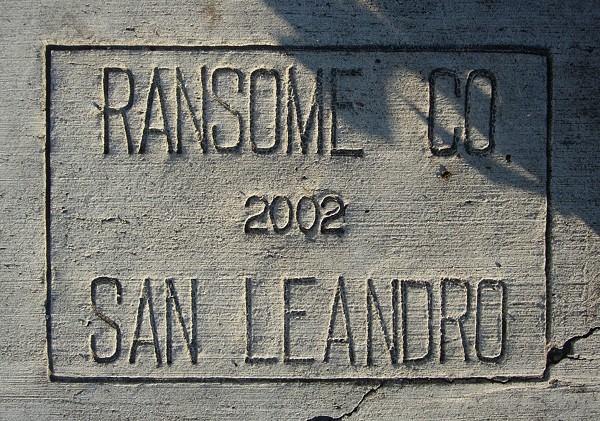
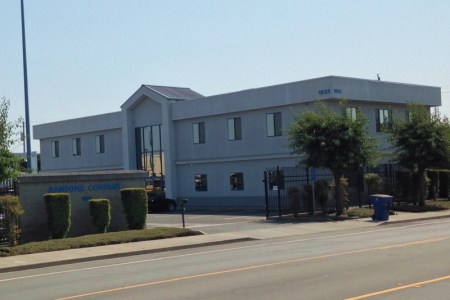
Today the firm is in San Leandro, at 1933 Williams Street, but is no longer led by a Ransome. Here is its headquarters . . .
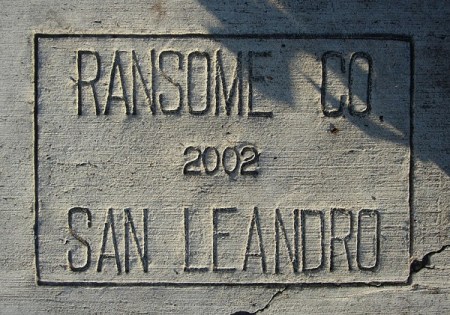
. . . and a recent sidewalk stamp . . .
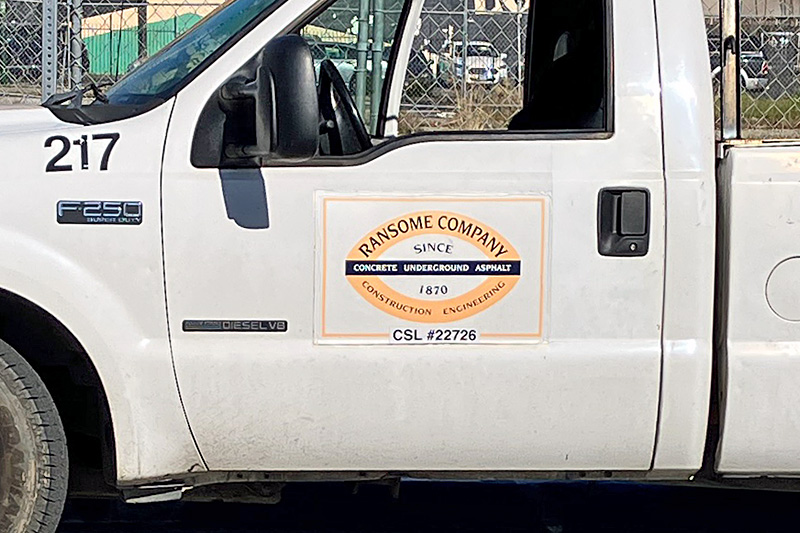
. . . and one of today’s trucks.
Sidewalk makers: Andersen & Montgomery

28 July 2017

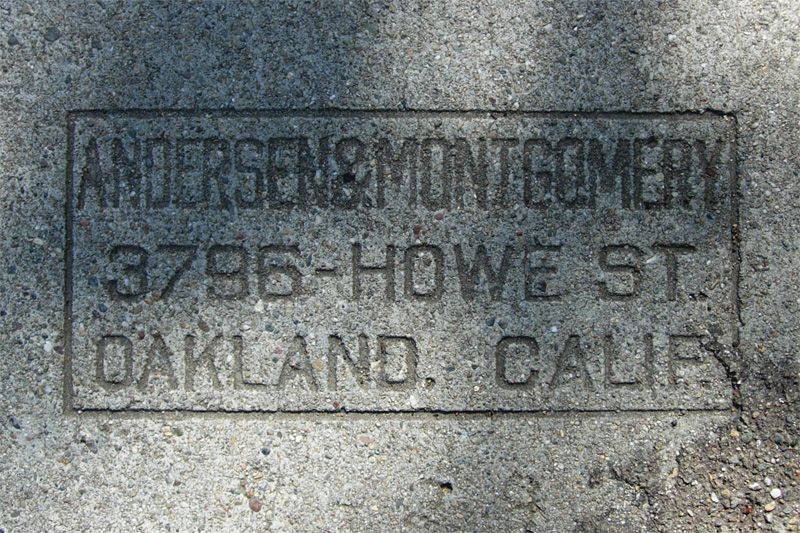
The Andersen & Montgomery partnership did a small number of surviving sidewalks in the Piedmont Avenue neighborhood and in Piedmont.

I’ve found two other marks dated 1929, but usually there are no dates.

The address on the stamp, 3796 Howe Street, was wiped out by the construction of the MacArthur-Broadway shopping center and then by the new Kaiser hospital building. John Andersen lived there with his wife Hulda (Lobel), according to the 1930 directory and the census. He was born in Denmark in 1859 and immigrated to the U.S. in 1883. Hulda was German, born in 1864, and immigrated in 1888. So they were pretty old by this time. She died in 1954, but I don’t know about him.

John Andersen was surely the “J. Andersen,” of 3774 Howe Street, responsible for this mark:

These date from 1912 to 1928 and are found mainly in North Oakland.

Robert B. Montgomery was a much younger man, born in Colorado in 1904 or 1905. He married the former Alice Sueell in 1929 and raised a family at 2626 Ivy Drive, where her folks lived. He dealt with bungalows, mainly. He is also responsible for this 1931 stamp on E. 24th Street.

It’s the only dated example I’ve found. Montgomery got in the paper in 1951 when he bought the Olympic Hotel building, at 2nd Avenue and E. 12th Street, and moved it across the street.

Sidewalk maker: Ed Doty

14 July 2017

Edwin “Ed” Doty was a major maker of Oakland and East Bay sidewalks, doing business with his son Abraham “Abe” for many years as Ed Doty & Son.

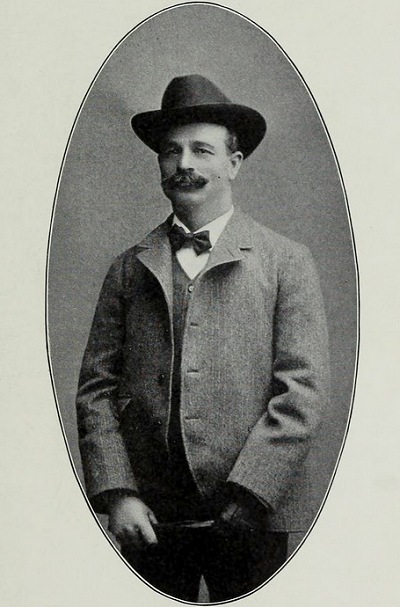
Doty was born in Canada in 1862 and became a naturalized U.S. citizen, but he gave conflicting information about his parents and the year he immigrated. Frank Merritt’s 1928 History of Alameda County has a long, colorful biography of him (helpfully quoted in this comment by “stacinator”), recounting his years ranching in the Yellowstone country, managing ironworkers in Hawaii, an idle year in Guam, drilling wells at Point Richmond and finally joining the Cement Workers Union in San Francisco, where he was suffering with a freshly broken arm and fractured skull at the time the earthquake struck.

He married Lizzie Watlington in 1906 and they had one child, Abraham (1908-2003). Ed died in 1931. The biography in Merritt’s history includes this photo of Ed in his prime.

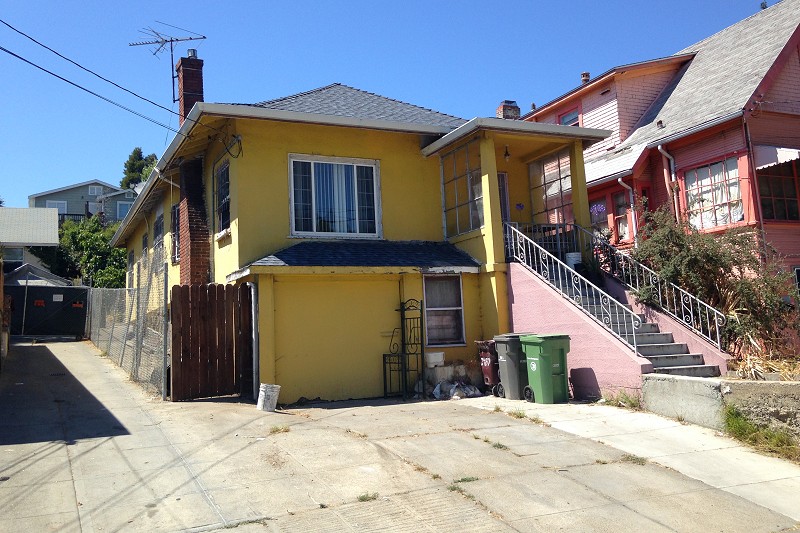
The 1909 directory lists him at 1687 26th Avenue. In 1919 he built a new home at 2487 26th Avenue and moved there. It’s a nice place; I’ll show it to you farther down.

A glass paperweight made by Ed Doty & Son, recently listed on eBay, contains the text “Trademark of Concrete Since 1907” and the address 3481 26th Avenue.

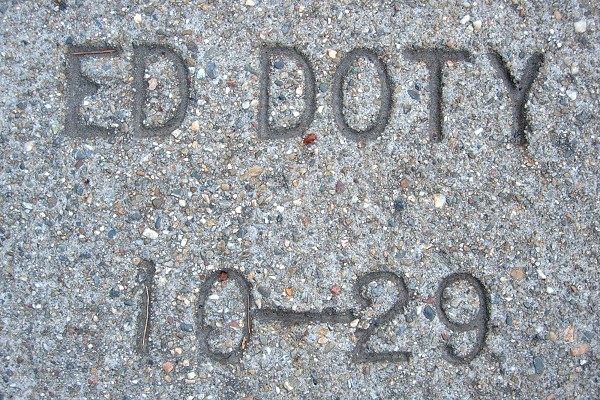
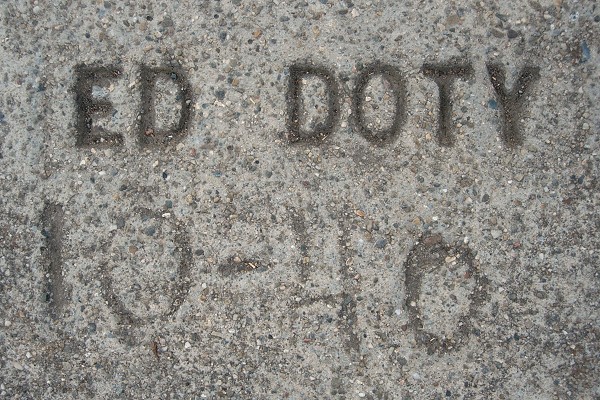
I’ve found “Ed Doty” sidewalk stamps in Oakland dating from 1923 to 1945, in a variety of configurations. The original imprint looked like this:

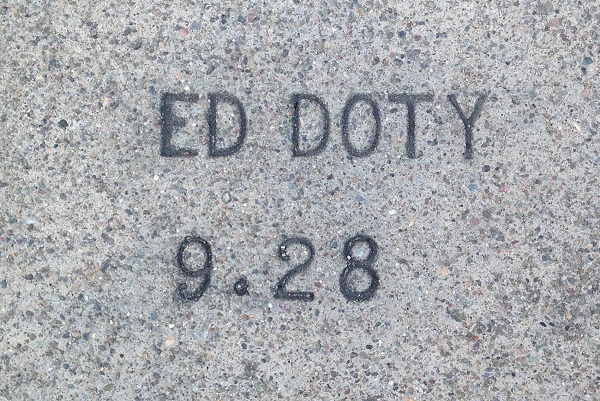
From 1928 to 1931 the Doty stamp looked like this, with larger letters:

Or this, with a dot in the date instead of a dash.

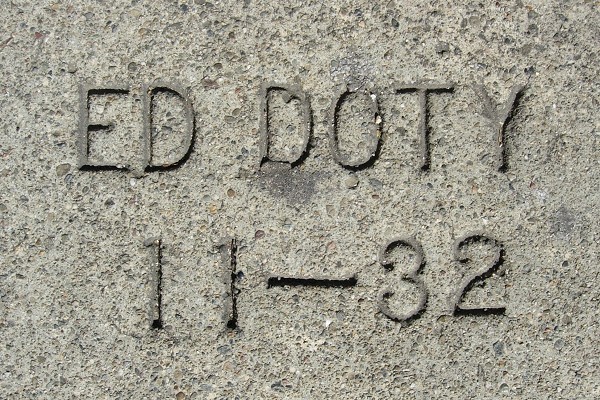
Starting in 1932, they looked like this, distinguishable by the shape of the “E” and the “O”. I have examples all the way up to 1944.

At some time before June 1937 the firm switched to a new design that incorporated the “concrete master” number. It used number 16 from then until March 1938:

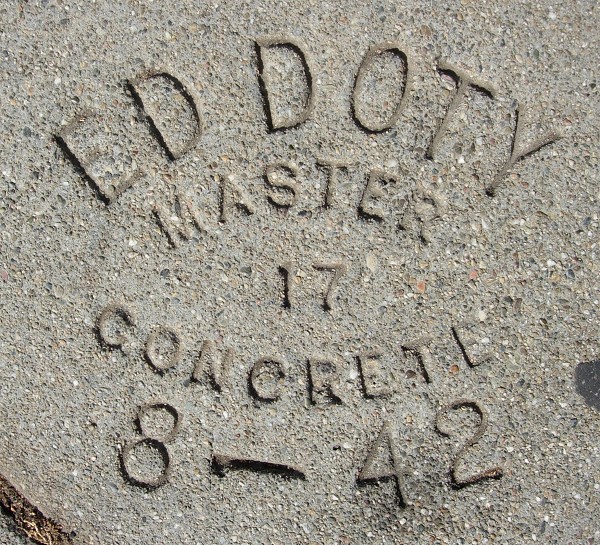
Starting in April 1938 it used number 17. I speculate that Abe Doty had to replace his master finisher for some reason and needed a new number.

All along, the firm also kept using the original stamp, but with hand-drawn dates:

Here’s the Doty house. Of course, Doty laid most of the concrete on the block, replacing work by the earlier generation like Stevenson.

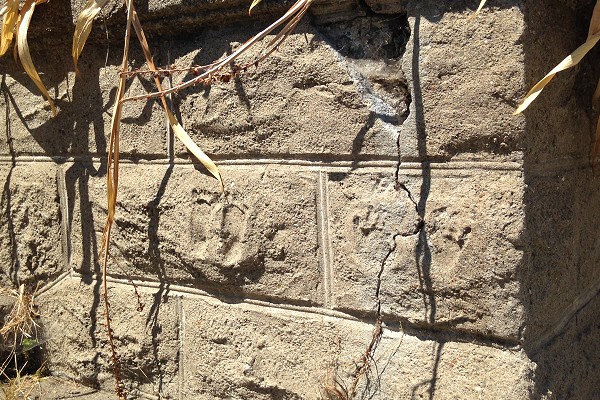
The driveway is gorgeous, as concrete driveways go. There’s a little panel on the corner bearing a small child’s hand and foot prints. And here, in the entryway, are some more. These could not have been Abraham’s; perhaps there were grandchildren handy.

In writing this post, I realize that there are details about the stamps that I need to clarify, so look for updates in the comments every now and then.

Sidewalk maker: Joe B. Silva

30 June 2017

Joe B. Silva was born in the Azores and later became part of the East Bay’s thriving Portuguese community. I know little of his life because my sources are limited and because “Joe Silva” is an extremely common name. I just know he was born in 1876 and died in 1962. His first wife, Mary Rose, bore seven children and died in 1938. She was to be buried in St. Mary’s, but FindaGrave has no record of her or Joe. His second wife was named Gertrude. Both were Portuguese.

The Portuguese have a long and complex history in America, as summarized in a timeline from the Library of Congress. The same is true for California. There were divisions between the continental and Azorean/Madeiran Portuguese, who came here at different times for different reasons. The Oakland Tribune named Silva as the Grand President of the “Protective Association Union Madeiran Society” (Associação Protectora União Madeirense do Estado da Califórnia, or União Madeirense for short), which was founded in 1913 in West Oakland. A continental Portuguese society was founded here four years later.

Silva was first listed in the Oakland business directory as a cement worker in 1922, living at 3408 E. 18th Street. However, his first sidewalk stamp looked like this:

I’ve seen only three of these in Oakland, one of which is dated 1922. Why did such a proud and prominent Azorean use an Anglicized name? There were Portuguese concrete contractors before this, like the Azorean Construction Company (1909), Francisco Comachao (1912) and M. Gonçalves (1914), but most Portuguese names did not emerge on our sidewalks until the mid-1920s and later. Be that as it may, Silva soon came out with a new stamp using his real name. The earliest of these I’ve found is from June 1924, and the latest is 1937.

Oakland directories from 1923 to 1940 listed Silva at 2209 E. 15th Street.

He may also have collaborated with Albert Moniz, who hand-drew several different “Moniz-Silva” marks without dates, but I think that was more likely the much younger A. J. Silva.

Sidewalk maker: P. M. Henning

9 June 2017

Paul Max Henning was born in 1886 in Giebichenstein, Germany. He served in the German navy for three years and then emigrated to America.

As of 1917, he was a PG&E employee living in Sacramento, where he requested an exemption from the draft, claiming a wife and father as dependents. His registration card recorded him as a man of medium height and build with light-blue eyes and light-brown hair. He also described himself as a German citizen.

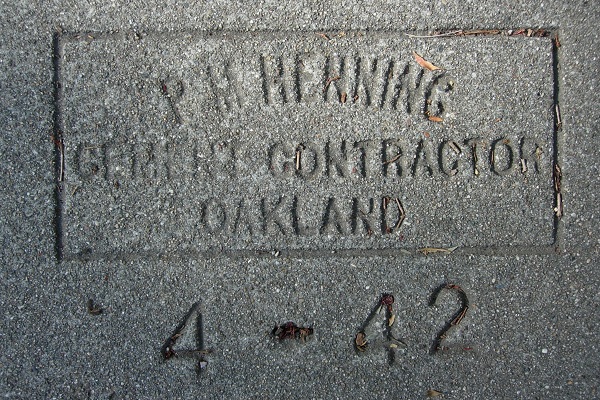
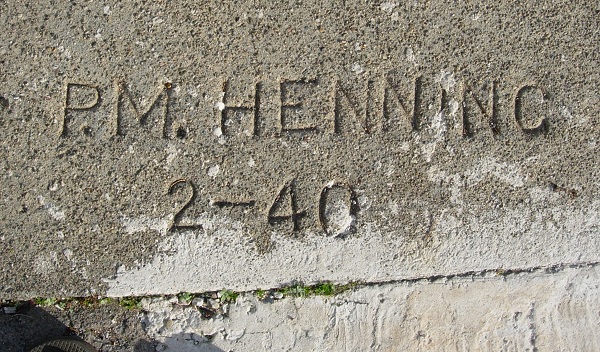
By 1921 he was living in Oakland, working as a clerk. The 1924 directory was the first to list him as a cement contractor, living at 726 15th Street. The next year he was at 5228 Lawton Avenue. The oldest mark of his I’ve found is from 1927. He ran ads in the Oakland Tribune in the late 1920s that would point readers to the address of a recent job, so you could go look at it or talk to the proud new homeowner. His mark was always sturdy.

His mark never changed, with one exception — this single example from 1940.

In 1942 he gave the draft board an address at 333 Park View Terrace.

The latest date of his I have found is 1949.

Henning died in 1975, and his remains are encrypted in Mountain View Cemetery.

Sidewalk maker: J. C. Estey

19 May 2017

The worn, unobtrusive stamp of J. C. Estey can be seen wherever the pavement is oldest. But this man left a rich record.

John Crowell Estey was born in 1842 in Londonderry, New Hampshire. Some sources spelled the family name “Esty.” He served in the Union Army during the Civil War. A letter he wrote to his parents in 1865 is extant, in which he told them of the death of his brother Charles in a Confederate prison. He added, “It won’t do for me to live single much longer. In 1868 if I live and nothing happens before, then I think I will take a wife.”

The 1870 census listed him as a farmer, married to the former Harriet “Hattie” Evans and father of two-year-old Minnie, living in Manhattan Township, Kansas.

By 1876 he was registered to vote in San Francisco. In 1878 he was awarded a patent on a scheme to extract power from inside a water line.

As of 1879 Estey had moved to Oakland. The 1880 census listed him as a coal dealer with three children, including a son Charles. In 1882 the Daily Alta California reported that he had been elected Assistant Superintendent of the Central Mission Sunday School in Oakland. That same year the Oakland Tribune reported that he was moving his coal yard to 16th and San Pablo. In 1886 he was listed as a farmer in the rolls of the State Anti-Riparian Irrigation Organization of California, living at 535 17th Street, where the Oakland Ice Center is today. He was listed as an officer in the Civil War veterans association that same year.

Voter records show that between 1892 and 1896 he relocated to 458 E. 17th Street in East Oakland. In 1896 he was active in the People’s Party.

The 1900 census listed him as a cement contractor, and so did the 1901 Directory of American Cement Industries. He advertised in the Tribune in 1901 as “Contractor for all kinds of Cement Work, Concrete and Stone Walls.” This is significant because it pins him down as one of Oakland’s earliest sidewalk makers. It is conceivable that some of the pavement bearing his mark dates from before 1900. However, I have found only a few dated examples, all from 1912. Baker Street, in the Golden Gate neighborhood, has a bunch of them.

Estey died in 1919. I have no information on his gravesite, but he qualified for a Civil War veteran’s grave.